
lester_smothent's Reviews
7 reviews Back to lester_smothent's Equipboard

172
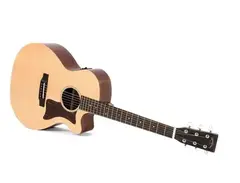
There's something to be said about this guitar.
When moving up from a beginner's level of instruments, the question of choosing a guitar with a solid top arose. This guitar was chosen. And at the time, it was an excellent choice.
The sound of the guitar, compared to cheaper instruments without a solid top, is something almost everyone who moves up to the next level will notice.
I give this instrument credit; the motivation and desire to improve my guitar playing was evident from the first day I bought it.
The comfort of the Grand Auditorium body with a cutaway for the high positions is undeniable. It's perfect for learning and honing your skills.
I spent quite a bit of time with this guitar. And perhaps without it, I would never have felt the desire to move on.
Yes, the instrument is extremely simple in appearance. Everything is classic, no binding. However, none of that was required. The key was high-quality build quality and acceptable sound. There was nothing to complain about on these points.
Now, with a full-bodied instrument, the difference in sound is noticeable. But not dramatic.
The guitar has a drawback: it's been through various revisions at different points in time. I don't know how significant this is, but on my particular guitar, and based on reviews of other guitars of the same model, the truss rod nut is extremely tight.
Tightening it myself was unpleasant, difficult, and even scary. So, I had it adjusted by a luthier. But after that, the instrument doesn't require any neck adjustments at all.
I'll note that for an acoustic guitar, the tuning above the 12th fret was very low. At the same time, NOT A SINGLE extraneous tone, clang, or buzz came out of the instrument. It's a joy for fingerstyle playing.
There's not much to say about the pickup. I tried playing the setup, but it left me with no impressions. The guitar is still used exclusively in acoustic mode, without any connection. Although the built-in tuner is a nice bonus.
If I were asked whether I would recommend this instrument to someone moving up from beginner, my answer would be 100% yes.
172
There are some nuances
This guitar is quite complex.
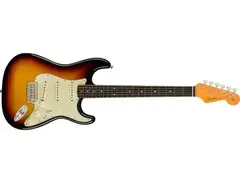
When I first picked it up and unpacked it, the first thing I noticed was that it's a rather beautiful Stratocaster. I bought it based on reviews, commercials, and pictures, and many things weren't immediately obvious.
The color isn't your typical sunburst. It has its own distinct yellow tint. Perhaps this is a signature feature of the American Vintage guitar series. Perhaps the nitro lacquer imparts its own tint, but it looks quite interesting and stands out from other sunburst guitars I've owned in the past.
The pickguard has a greenish tint. If you've never seen anything like it before, it's almost impossible to tell from pictures this mint green effect. And the first problem with it was obvious—it cracked in three places, near the screw holes. This is not uncommon on vintage guitars, but to see it cracked straight out of the box on a brand new one raises questions.
There are no complaints whatsoever regarding the appearance of the neck and fretboard; they look solid and respectable. Lacquered necks are generally a matter for amateurs—I am one, so I was pleased. However, playability and tuning are the second major drawback of this guitar. To access the truss rod, the neck has to be unscrewed from the body. While this would be fine if you had to do it a couple of times, the neck's extreme sensitivity to humidity forces you to do it frequently. And the most counterintuitive thing is that this neck only returns to its final shape after tightening the truss rod nut about five days later!
Then there's the fretboard radius itself. This makes the instrument more difficult to play. The radius is something to consider. You can certainly get used to it, but this topic is specifically intended for those who understand what a 7.25 radius is (I had no idea at first, as all my guitars had a relatively flat radius).
Now, regarding string height and the most annoying thing – fret buzz: Perhaps the seasonal humidity played a role, but the frets have popped out at both sides of the neck. The varnish they were coated with couldn't withstand the protruding pressure in some places and cracked slightly. But that's not the most annoying thing. It's that with a fret height of 1.8 mm at the 12th fret of the 6th string, there's a buzz and clank in various places on the neck from the 1st to the 20th fret, all the strings, which carries into the amp and headphones. Attempts to adjust the neck arch to increase the fret reach don't produce a significant effect. Since the ringing will still be picked up by the amp, setting the height to 2-2.25 mm above the 12th fret makes no sense, as it will compromise playability.
You'll definitely need to take the instrument to a luthier, and it'll likely be there for a long time, as the neck arch changes and takes a long time to stabilize.
The guitar comes with a case. And yes, there's something to be said about that, too. It's nice, but the mechanisms leave a lot to be desired. One of the latches has been sticking constantly since day one, and I had to get used to the correct release mechanism to open the case lid.
And yet, despite all the aforementioned shortcomings, this Strat has one undeniable advantage: the classic Fender Stratocaster sound. I can play these single-coil pickups without much noise coming into the amp, and I didn't use any shielding. But then again, classic vintage Strat single-coil pickups aren't universally suitable for specific applications. In my usage scenario, the tasks are fully covered.
In summary, I can say that this guitar is not for beginners at all. It's not even for amateurs. This instrument is specifically for those who understand what they're getting and are willing to correct any flaws that undoubtedly exist, right out of the box. But with a competent guitar repairman, this Strat can be turned into a gem, and the instrument definitely deserves it.
This review will be updated after a follow-up visit to the repairman and the remaining issues are resolved.

172
Favorite pick
The pick has been in use for so long that the wear on its tip should, in theory, be a sign it's time to throw it away. The fact that the tip is worn down gives me a special feeling when strumming, perhaps it's just habit. Although this doesn't happen with other picks. That's probably why finding a pick that feels close to this one is simply impossible for me to use as my primary pick for rythmic and heavy strumming. The logos had worn off long ago; it was only at a certain angle that I could tell it was a Daddario. I tried other picks of similar thickness, but for some reason they didn't work. Unlike this one, I either didn't like the material or the way other picks felt in my hand.
172
My full-fledged entry into the guitar world
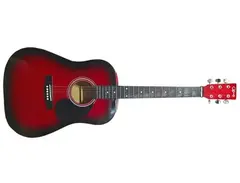
A representative of the extremely little-known Guitarland guitar brand (the brand sounds rather funny to me). For its time (about 20 years ago), the guitar wasn't that expensive. It was actually a gift, so it's hard to even guess the exact price because there's little to compare it to, and there are practically no old price tags left for guitars from this brand. Being the first decent guitar on which I could easily practice songs without having to strain my fingers to press the strings, it proved to be quite sufficient for entering the vast world of guitar playing. Most likely, if I hadn't gotten my hands on this instrument, practicing and playing the guitar would never have become my hobby. So, I'm certainly grateful for it.
But if you look at the sound itself in more detail, it doesn't really stand out with any special characteristics. It just sounds good. The notes play their positions. The sustain isn't disappointing. However, overall, there's no real depth to the sound. The 4-5-6 strings definitely lack expression. This realization came to me at the time when I compared it to another guitar in a similar price range, if not cheaper, which this instrument was inferior to in terms of sound quality. However, the instrument's strong point is the body finish. Over 20 years, the guitar hasn't lost any of its color (which, in my opinion, looks quite nice) or the varnish. Nothing has peeled, faded, chipped, or worn away. The same can't be said for the neck, however. Initially, I didn't even realize the black fretboard was actually painted, but over time, in areas where I played most frequently, the paint has peeled off the neck (like the varnish peels off the maple necks of some Fender guitars). It certainly has its vintage charm, and I can't really blame the instrument for that. Overall, the neck has remained quite playable and pleasant all this time. I love it as my first proper guitar. I still have fond memories of that. But when you start to improve your performance, it's always worth moving on to more advanced instruments.
172
A good starting option.
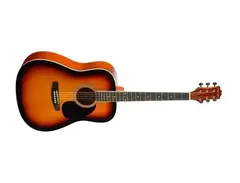
I've owned this guitar for quite a while. I've learned quite a few riffs, guitar parts, and fingerstyle covers on it. And until you realize the difference between it and truly expensive, solid-bodied brand-name instruments, there's really nothing to complain about. For the price it was purchased for, it performed (and still does, though not in my hands) quite well. Surprisingly, the sound is quite pleasant, with a definite warmth and volume. This is true even compared to instruments with solid tops. The guitar's finish is quite good. Over the years, neither the varnish nor the color have changed. Among the real flaws, there was an odd stain under the varnish, but I never even had to think about it. Plus, the tuners are quite average, which isn't surprising for a guitar in this price range. For a beginner, it's an excellent choice. But in today's world, competition in this instrument niche is fierce, and there are clearly more attractive options. And finding similar guitars isn't easy. A good starter option.
172
Exceeded expectations
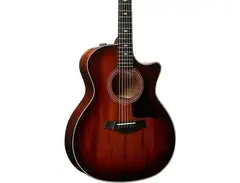
When I first took the guitar out of the case from the box, I was already quite impressed with the quality of the included case, but the biggest surprise awaited inside. The guitar exceeded all expectations. The finish is excellent, all joints are precise, there are no defects in the paint, and the frets don’t catch the hand while playing. The guitar’s appearance is stunning. Photos on the internet don’t fully convey (as expected) its truly elegant and neat look. The feel of the top is also very pleasant. I have matte guitars, but here the satin finish has its own unique feel. Even the smell of the guitar is quite nice, although I don’t know how long it will last.
As for the sound of the instrument itself, I generally expected an unusual tone from the guitar’s solid mahogany body and was pleased with what I got. The sound is distinctive, with that warmth everyone talks about when describing this wood — it’s definitely there. It may seem slightly quieter to some compared to, for example, spruce guitars, but for me, it’s just right. From the factory, the action up to the 6th string at the 12th fret was 2.25 mm, which is quite good and a commonly seen value. The stock strings also turned out to be surprisingly pleasant, bright, and comfortable to play.
P.S. The guitar is a 2024 model.
172
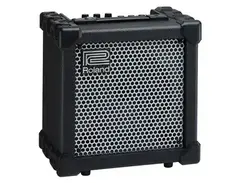
A good combo for beginners
As for a transistor combo, the clean sound turned out to be quite good. 4 overdrive modes from crunch to lead metal are quite capable of satisfying the needs of beginner players at the early stages. There is an aux, but the sound will still not be as pleasant as through digital combo amps, it is still a transistor. The signal from it to headphones is also not the most chic, but you can practice. For 10+ years, no problems have surfaced, nothing has fallen off, nothing has broken.