marlie6211's Reviews
3 reviews Back to marlie6211's Equipboard
138
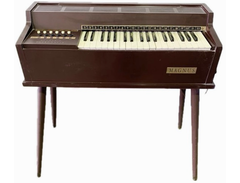
An accordion on a tabletop and tons of nostalgia
I was given one of these as a Kindergartner about 150 years ago and played (ironically) the song "Long, Long Ago", which I learned by ear, for my class. (Not an incredibly impressive feat for most, but maybe not bad for a 6 year old 😉). This is the instrument that instilled a lifelong love of making music for me. Sadly, mine broke after 3-4 years...I cried for days. There's not a lot of videos of them or pages with info about them, but I have many vivid memories of it, so here is what I remember....
This style of Magnus organ changed very little from the 1960s to the early 80s, which is when I got mine. It basically is like an electric accordion that sits on a table. Rather than an accordion's manual air bellows, when the Magnus is switched on, a rather noisy fan powers up, and the organ must "warm up" before it is playable. (About 10-15 seconds if I remember correctly.)
My version, at least, was actually sold at a toy store. I can't say for sure but I am nearly positive there are no ports of any kind for recording or amplifying. Not that it needed much amplifying... at full volume it could nearly wake the dead! 😄 There must not have even been a headphone jack, otherwise my mother would have certainly made me use it to preserve her sanity...it was not a subtle instrument at all.
It had it's own unintentional (and kinda funny) manner of "percussion", because the keys were so stiff you could hear a click each time you pressed one of the piano keys. I assume it changed the airflow direction when a key was pressed, and that the air pressure release was why the keys clicked. The volume was controlled with a slide on the front of the organ on the lower left, it slid forward into the organ and backward away from it to control the volume.
Definitely geared toward beginners, Magnus organs have a label above each of the keys. But they are not even music notes, they are numbers. To this day, when I hear the song "Long, Long Ago," I sing along in my head...."1, 1 2 3, 3 4 5.... 6 5 3" 🤣
I played that organ for hundreds of hours. It finally perished when one day instead of "warming up" after the fan was switched on, it just made a continuous loud noise not unlike a whoopee cushion. 😂 I suppose whatever held the air inside ruptured. Because my mom had one as a child in the 60's, and hers broke in the exact same manner mine did, it makes me wonder if they were prone to that problem with extended use. I wish I had been able to disect mine to see for sure what made this thing tick and what was broken, but I was too young.
I collect vintage keyboards, still have the Yamaha I got in about 1986 to replace the broken Magnus. But I haven't gotten another Magnus organ yet. It's a novelty, but it doesn't have a lot of practical uses (for my music, anyway). Recording with a mic would certainly be possible, but it would also pick up the loud clicks of the keys and probably the fan as well. However, I am sure there are many people more clever than I who could find a use for it. I may get another someday simply for the nostalgia. It gets 5 stars from me even with its considerable limitations simply because it is so very unique. This was the instrument that taught me to love creating music, so it will always have a special place in my heart.
138
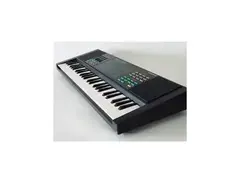
A fun, very unique little vintage synth
This was my very first synth (if you can really call it that, it's more of a synth mixed with a toy keyboard). I learned the demo song by ear one measure at a time (Billy Joel's "Just the Way You Are"), and played it in my 3rd grade school talent show...that's when I was officially hooked on keyboards. My Yamaha PSS-270 is still going strong, and I still enjoy playing it.
Being from about 1986 or 87, it is obviously quite limited compared to what's out there today. But it does have a few things that, in my experience, were completely unique to keyboards of that era. For one thing, while it was at a toy keyboard price point, it has a synthesizer chip that was actually used on far more professional and expensive Yamahas. It is incredibly durable...the keys have much more weight and realistic feel than others at that level. It has gone with me as I've moved many times over the years, while I've had other keyboards chip, crack, or break entirely during these moves, this one doesn't even have a scratch on it. (I lost the original AC adaptor somewhere along the way, but it was quite easy to find a replacement.) I have much more expensive synths that don't feel nearly as sturdily made. I'd say it is almost indestructible, but I won't test that theory.😉
It also has an RCA connection, which for a $40 keyboard at that time is almost unheard of. I couldn't have cared less as a kid in the 80s, but it is a cool feature now.
As for playing quality of the instrument itself, obviously this is now only an accessory keyboard to be used for special effects, or just a very portable and durable keyboard to play around with for fun. It has a sound bank that is very extensive for a keyboard that age (100 sounds) ...and many of the sounds don't need a lot of distortion or other effects added, they come out of the keyboard that way. 😉 "Dog Pianist" and the 3 "human voice" settings are favorites of mine...one of them sounds exactly like the teacher from the Charlie Brown cartoons. "Ocean", "Crystal" and "Baby Doll' are among the other sounds I have used in my recordings.
It is utterly horrible at imitating any of the instruments listed in the sound bank. But some of the other sounds are so bizarre and unique, it makes it impossible not to love this thing. A portamento button adds to the fun. There is a sustain button but the sustain function is quite weak. There is also a vibrato button. It is not true stereo, but like several Yamahas of that era, had a button called "Stereo Symphonic" that tried to make it sound as if it was stereo. It is somewhat effective on other models I have, but it fails on this model.
No drum keys or pads, only 10 pre-programmed rhythms that, frankly, were not even contemporary at the time it was made.
So in summary, a fun little keyboard that is quite unique for its time and its original selling price. It's quite limited and not much of a "serious" instrument. But it's a little piece of synth history...so if you love vintage keyboards as much as I do, it is a wonderful find. At the risk of sounding like a weirdo...each one of my keyboards has it's own "personality" to me. While most of my synths sound much better and can do more than this one can, I just love the personality of this little keyboard.

138
Still my favorite
This is still my primary synth..have never found one I enjoy using as much as this one. I am laughing reading the comments that call it "very old", since I bought mine brand new. (Yes, it was the 90's, and I'll accept "old" but not "VERY old", lol).
For the time and the price point it was at, this thing was absolutely astounding when I bought it. I paid about $300-$400 for it if I remember correctly. It would not be live performance quality, but for the music I create, I like it precisely because it sounds a bit vintage. Once you are familiar with it, the functions are quite easy to use, and the 2 6-track internal memory function is great for starting a new song in its early stages without firing up the whole studio setup. I almost always start my song ideas with this keyboard. (Keep good batteries in it though, otherwise if it loses ac power you'll lose your content).
I have the 3 pin midi ports connected to an external mixer and then into the computer. The quality when using the DAW with this setup suffers just a tiny bit, but I haven't pinpointed whether it is the computer, keyboard, mixer or cables (I am far from a great studio engineer 😄). It doesn't cause a big problem for me, though.
I strongly dislike only one thing about this keyboard...the touch response. It is pretty much a choice between a whisper or "hitting the keys with a hammer" levels. It is very easy to have one note come clanging out horribly because the key was struck SLIGHTLY too hard. We're talking levels that overmodulate the sound and ruin an entire section, just from a very slight difference in pressure. You don't hear it until playback though, and that makes it even more infuriating. In fact, I keep touch response turned off because it is so unpredictable. Granted, touch response was newer and not found on many keyboards at that price point back then. But for practical purposes, they really could have just omitted it altogether on this one.
Also, if travelled with, you'll need a very sturdy case. This keyboard has absurdly thin plastic casing compared to its weight (which is rather heavy for its size). A couple of places on the side have chipped off over the years just from picking up or moving mine. (I have other 90s Casios with the same issue, my Yamahas seem much sturdier)
But even with those issues, I love it. I have a closet full of old keyboards/synths, and this is the only one that always stays out and has its own permanent channel on the mixer. Even my newer, more expensive ones don't have some of the functions that the CTK-611 has. Could just be sentimental reasons, but it is still my all time favorite.

