
nycsynth's Reviews
11 reviews Back to nycsynth's Equipboard

186
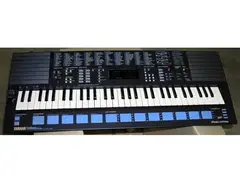
FM Pro-sumer Sleeper
The Yamaha PSS-680 resided in the fuzzy area between a consumer grade (entry level) toy and a truly professional synthesizer. But don't be fooled by the PSS branding: the PSS-680 (and the similar PSS-780) offer quite a bit of performance and a remarkably good MIDI implementation. Features include:
- Programmable 2-operator FM synthesizer
- Multitimbral operation
- Drum pads (and voices)
The PSS-680 has an EXTENSIVE MIDI implementation that is better than many pro keyboards of the day. It sends and receives parts on fixed MIDI channels, but is capable of multitimbral operation. It has some very interesting built-in patterns that can be used in conjunction with the auto accompaniment features to generate ideas.
The drum sounds are PCM-based and very retro and it would probably be best to sample them, but they are interesting nonetheless and useful in synthwave tracks.
Programming the FM synth is very easy, and there are also some nice sounding presets.
All in all, despite the fact that this has mini keys and was not aimed at the pro market, it is very conceivable that Yamaha could have upscaled the keys and added more preset memories and had an FM winner on their hands with this synth. Given that they are generally available cheaply, provide good retro sounds, and have a downright solid MIDI implementation, I'm definitely rating this a 5 for value and fun factor alone.
186
Excellent feature set and probably as future-proof as you can get!
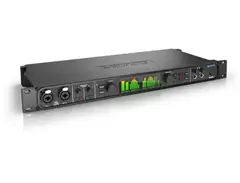
After years of struggling with various audio interfaces, I've finally found one that I am extremely happy with! The 828es, which I purchased when I outgrew my MOTU Ultralight Mk4, offers plenty of high-quality I/O and enough interface options to ensure a long life in my home studio. I think that few, if any vendors can match MOTU when it comes to being future-proof. This unit has no fewer than three computer interfacing options including USB, Thunderbolt, and AVB. While the best latency figures probably come from Thunderbolt (which is the mode in which I use it) the USB drivers from MOTU are the best I've ever used, and shattered my expectations. It's class-compliant USB interface ensures it will be functional for years to come.
The 828es has a great amount of I/O and is well-though-out; it includes two front-panel mic inputs, monitor outputs on XLRs in the back, and plenty of balanced analog TRS. It supports word clock sync, includes TWO ADAT I/O for a total of 16 inputs and 16 outputs when running at 44.1khz or 48khz, includes SPDIF, and can support higher sample rates as well.
The MOTU 828es has excellent quality converters (ESS Sabre32, same as found in some Apogee devices that cost $$$$$) and it exposes an onboard mixer and router that can be configured from a web browser (another future-proof feature.) The routing matrix is relatively straightforward to use and enables the user to configure the device in the best way to integrate with your DAW.
I see no drawbacks at all with this device, and it forms the cornerstone of my studio. Along with two MOTU 2408 mk3 units used as standalone analog-to-digital converters, I am thrilled to have 24 line inputs on tap at 48khz for my large number of synths. Before considering the hype of more expensive units with similar features, check the specs and the reputation. MOTU has been around since the start, their drivers are solid, and their designs withstand the test of time.
186
Unusually powerful and flexible source of drum and percussion sounds
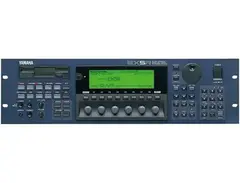
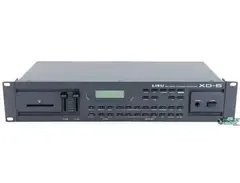
The Kawai XD-5 is a digital rackmount synthesizer that is optimized for drums and percussion.
Nearly identical in architecture to the Kawai K4/K4r synthesizer, the unit provides 256 ROM-based samples with a mix of attack sounds and waveform cycles, up to 4 of which can be combined in a patch. Modulation can be achieved via routing velocity, after touch, and an LFO to various parameters. The XD-5 also includes a resonant low pass filter.
The XD-5 does not include dedicated trigger inputs for drum pads like many of its contemporary counterparts. However, as a true synthesizer rather than simply a ROM playback unit, it is far more flexible when it comes to sound design. Additionally, in addition to its dedicated stereo mix output, the XD-5 provides 6 additional outputs for routing sounds to dedicated mixer channels.
If you're looking for a very unique source of drums and percussion sounds, are a sound designer, and don't mind some menu diving (although the interface is rather intuitive, and there are editors available) then the XD-5 is a sleeper. People are starting to catch on to this and prices seem on the rise. Get yours before prices go to the stratopshere!

27225
I'm a fan of the Kawai K series, but this wasn't on my radar at all. Great write-up!
186
Nice to have around
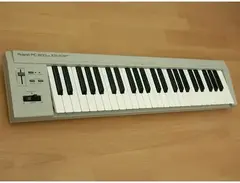
The Roland PC-200 MK II is a no-frills 49-key MIDI controller that can operate from a 9V battery or an optional power adapter. It provides velocity sensitivity, an old-style Roland bender that has pitch bend but an "on/off" style modulation control. It also provides transpose buttons and a slider that can be assigned to various MIDI messages. Aftertouch is not provided, although the slider can be assigned to channel aftertouch, which is...a nice touch!
For its day, the PC-200 MK II was a nice companion to Roland's synth modules; the first time the author saw one personally, it was being sold in a package with a Roland SC-55 Sound Canvas.
In the present year, there are better, USB-capable (and powered) alternatives. However, this unit is very inexpensive and can be handy if you're throwing a module in your duffel back for a weekend trip. The author uses this as a test device when working on DIY synth designs to avoid damaging potentially far more costly equipment when experimenting with electronics.
That said, the PC-200 MK II might be interesting for those on a tight budget looking for MIDI controller. They are often available for practically nothing in local listings (Craigslist, etc.) and eBay. Even then, however, potential purchasers should consider something else first: there are a panoply of budget controller options available today that are superior to the PC-200 MK II.
186
Fun, low-fidelity sampling drum machine
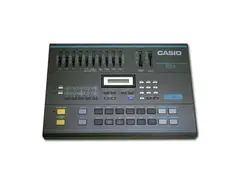
The Casio RZ-1 is a low-fidelity sampling drum machine that came onto the scene in 1986. Its 12 PCM samples are more or less typical for the day, and it also offered the ability to sample up to four (very) short sounds. Boasting a number of level controls and individual outputs (not one for every sound, but close) the RZ-1 offers some flexibility, although there are only 12 sounds, and there are no other ways to modify them other than two tone controls that apply to the sample outputs.
Reportedly, the RZ-1 was used by early rap producers on a budget, including RZA from the Wu-tang clan. However, the RZ-1 is probably too limited for modern hip-hop production due to the extremely short duration of the samples. Even the producers of that era ditched cheap stuff as soon as they could in favor of SP-1200's.
As much as the author loves nostalgia, this item gets two stars. The sounds aren't great, and the samples are easily located for those interested. (In fact, the author has plans to create a sample bank for the MPC. Leave a note if interested!) Additionally, the build quality on Casio gear is pretty terrible, and this means that the RZ-1 won't hold up to much abuse.
The author recommends a more modern machine or a software sampler like those included in most DAWs these days. The reality is that DAW-based samples are easy to use, far more flexible in terms of tweaking, and any decent DAW includes a bit-crushing plug-in if you crave that lo-fi sound. A hardware alternative not far off the price range of a good RZ-1 would be a used Akai MPC-500, which lacks individual outputs but could be configured with RZ-1 samples (or anything else) and has far more sample memory.
References: https://equipboard.com/pros/rza/casio-rz1 https://www.akaipro.com/mpc500
186
One of the few synths in the world with poly aftertouch
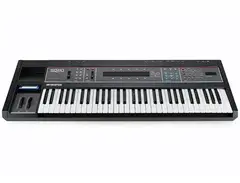
The Ensoniq SQ-80 is a hybrid digital/analog synth that utilizes wavetable oscillators and analog filters using CEM chips. It earns a five star review from me because of its unusual feature set. Its three-oscillator-per-voice architecture is unusual for the era, and while lacking "knobs", it has arguably one of the best button-based interfaces for a synth of the era. Additionally, it provides analog-synth style features like ring modulation and oscillator sync, which are rare on digital synth of the era.
Like its predecessor, the ESQ-1, it is a stereo synth that allows voices to be panned in the stereo field. It is almost identical in function to the ESQ-1, and indeed can load ESQ-1 patches, but adds additional waveforms as well as aftertouch.
And let's talk about aftertouch! The SQ-80 is one of the only synths of the era (along with some other Ensoniq synths) to provide polyphonic aftertouch, as opposed to channel aftertouch. Many modern synths such as the Novation Peak, Summit, and soft synths like Arturia's clone of the Yamaha CS-80, can be configured to respond to poly aftertouch.
Other than that, the keybed is not spectacular, in my opinion. It has a very light touch, and some complain that it is "clacky", an issue that can only be resolved through a hard-to-find bushing replacement kit. (Check Syntaur for these.) On the plus side, the design of the keybed was state-of-the-art for its day, and due to the way it works, does not really have parts that can wear easily. Along those lines, it should last a lifetime.
Those looking for the SQ-80 sound on a budget (without poly-aftertouch) should check out its cheaper, more popular cousin, the ESQ-1.
186
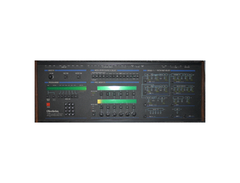
Without doubt, one of the best synthesizers ever made.
The Oberheim Xpander is legendary for being one of the greatest analog synths of the 80's era. It represents the pinnacle of achievement in the era in terms of programmability. It is essentially a modular synth that is configured through a sophisticated modulation matrix. it can be used in poly mode, but each of its six voices are also independently configurable. Combined with its individual outputs, the Xpander is sort of like having 6 computer controlled modulars in one box.
No mention of the Xpander would be complete with a discussion of its filter; a multimode filter that provides no fewer than 15 (!) configurations, including low pass, band pass, high pass, and various combinations. There are few, if any analog synths other than the Xpander and its keyboard cousin, the Matrix 12, that have a filter this flexible. (Notable exception: the Mutable Instruments 4-Pole Mission filter offers a similar design.)
All of this comes at a cost: the Xpander is not cheap. At the time of this writing, they are generally around $4000. Additionally, the Xpander's use of rare filter chips and VFD displays makes it a risk in some ways: parts are difficult, if not impossible to find. Those interested in achieving something close to its sound without making such a serious investment might check out a Mutable Instruments Ambika with the 4-Pole Mission filter boards.
Lastly, those dying to own an Xpander should be on the lookout for the American-made version. Perhaps paradoxically, the Japanese-made units were not as well made, and the modern VFD display replacement that is made for the Xpander will NOT work with Japanese models. for this reason, Japanese Xpanders should be avoided as they will be harder to future-proof. Japanese Xpanders can be identified by looking at the back panel. On Japanese models, the legends describing the purpose of the various jacks are below the jacks, as opposed to the U.S. made versions, where the lettering appears above the jacks.
186
One of Kawai's underrated gems
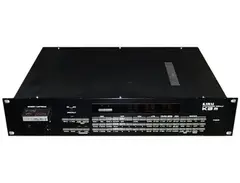
The Kawai K3 (and K3m) is a hybrid digital / analog synth that uses wavetable oscillators and an analog filter section using the legendary SSM2044 filter chips, which some say are the best sounding filter chip made.
Despite not having knobs, the front panel contains dedicated buttons for parameters and is fairly easy to edit. There are also software (and hardware) editors available for this synth.
In addition to standard waveforms, the K3 has several interesting waveforms oriented towards bells and traditional instruments. There is also a programmable additive waveform that is constructed using partials, a hint to their later forays into additive synthesis with the Kawai K5 and Kawai K5000.
This synth lacks some features like PWM, but it has a great bottom end and is a favorite of mine for pads and bass sounds. Overall, I think this is an underrated piece of gear; those who own it would rarely consider parting with it. The rack module is, in my opinion, the preferred (but more rare) synth, because the keyboard only has one wheel (as opposed to the pitch bend AND modulation.)
-s.webp?v=1783809055)