
patrick_richardson's Reviews
11 reviews Back to patrick_richardson's Equipboard
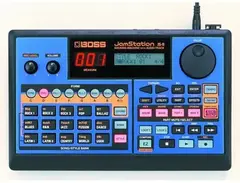

Interesting-if-limited tool for ideas and sound-design
I bought this unit looking for another "drum machine" or "groovebox" to play more realistic/acoustic sounds (sine the MIDI sound-engine has standard Roland fare). The unit proved to be very different than expected to some mixed disappointment and delight.
Structurally: it's like that software "Band in a Box", became a real hardware box. Each "Song" Project sequences 4 MIDI Tracks...
Drums
Bass
Inst1
Inst2
... to be steered along a common timeline (only by Bar #) according to 2 meta-data layers:
Form, these are largely preset patters, containing assorted Form parts ("Intro"/"Verse1"/"Verse2"/"Break"s/"Outro") in specific wonderfully specific/dated) rhythms and motifs for the 4 MIDI "parts" (Drums/Bass/Inst1/Inst2)
Chord Progression: spell out a sequences chord Root (C...B) and type (Major, Minor, 7th, etc), and the Bass/Inst1/Inst2 parts (normally programmed in C major) will play the given Form of the chosen Style to follow them.
In addition to all this MIDI, the Timeline also drives;
Audio: the unit can record 1 track of mid-fidelity linear audio along w/ the arrangement, for vocals/whatever you want to add. Audio will be (crudely) time-stretched/compressed if you change the MIDI sequence tempo to run slower/faster than when the audio was originally recorded.
So, the unit is NOT a conventional "beat box" (and should not be approached/used as such), for several reasons:
First : it's organized differently; while a traditional drum machine records "Patterns" of step/MIDI data, and build up inductively making "patterns-of-patterns" in some "song mode" toward a particular-sounding composite result...the JS-5 works deductively. It effectively STARTS in song-mode. 1) First pick a "Style", (preset or original), 2) then sequence the "Form" variations (intro/verses/breaks/outro) and "Chord" progression desired. 3) add Audio track for additional texture/whatever.
This makes it easier to get going quickly and to change/extend arrangement, but...
can't add new variations beyond the Forms of the chosen
cannot change time-signature between part
If you want it just repeat a specific pattern of a preset or original Form (like just "Verse1") you have to edit the Form sequencer, and/or set the Loop to repeat that part indefinitely.
Second: Since the instrumentation is MIDI, you can freely change the instrumentation of Drum, Bass, Inst1, and/or Inst 2 to ANY inter la sounds, or have the JamStation drive external MIDI gear. Internal MIDI sounds are impressive, but no are editing presets. JS-5's MIDI sound are a (subset of ) preset from Rolands JV or XV, mixing realistic/acoustic sounds (pianos, guitars, horns, etc), with a dozen "synth" sounds. However, you cannot edit the sounds beyond
using mixer to send a Track to internal Chorus and/or Reverb
assigning ONE (MIDI) track to the ONE Insert FX-processor (of standard Roland fare, allowing chorus/phaser/pitch/auto-wah/etc).
Unforutnately, the Audio track cannot use cannot use ANY Send or Insert effects (not input nor otuput)
Third : It CANNOT program original patterns onboard, you need an external MIDI controller to enter notes for original motifs (which must be in C major, if you wish to transpose using the Chord sequencer) . Recording is Real-Time only, w/ no visual editing.
So in practice: using to to "build" sounds/motifs/patterns up from scratch" is not at all its workflow, and not really the point. Instead, if you "play by it's rules", you can get stylish (if cheezy/dated/etc) results going quickly (In fact it has an "EZ" mode where you need only specify the Style and chord-progression type, and it spits out a song archetype, laying each Form part once, automatically). After some initial frustration with this using it as an canvas to build upon, I embraced its "canned" nature and started treating the JamStation more as a source to cut from...
sending MIDI from JS-5's various Styles to automatically program MIDI on newer, more-open sequencer.
treating the EZ-bake-d Songs as licence-free material for sampling and remix, with Track-muting for easy "stem-separation"
exploit the Audio track's crude time-stretching, either for grainy sound-design ambient textures, or by using the precision of the MIDI sequencer to beat-match some source, sample it as audio, and push back out to other devices.
Technical Specs:
MIDI is 32 Voice polyphony.
Tempo runs 20 ~ 260 BPM, at 96 PPQ.
Styles: 200 internal, 20 User... each continaing 8 Form-parts.
The unit has limited internal memory MIDI, meta-data (100 songs) and Audio recording (< 2 minutes). Expanding this requires discontinued/now-expensive 5v Flash cards, allowing another 100 song-files, and (the maximum-accepted 64 MB card) expanding Audio recording to over 50 minutes of linear recording.
Historically, this unit combines the peak of "portable hardware recording to flash-media", and "MIDI black-box hardware arranging",...and has been replaced by computers that can out-do it on all fronts; from recording time and fidelity, to editing, to MIDI sound generation. However, in the modern era of people eschewing the all-powerful computer for "DAW-less jamming", the JamStations unique workflow, quirks, limits, and workflow may prove an oblique, inspiring tool.
Preferred Settings + Usage:
Great palate of drums. Plentiful and varied BASS presets. Love the (few) cheezy orchestral sounds. The mid-grade audio is fun, especially for hardware time-stretching of LONG samples
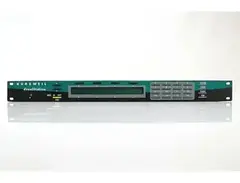
Incredible proof-of-concept MIDI hardware
A collaboration between Kurtzweil instruments Harry Starr (of Starr Labs) Katt electronics (of DrumKat ) Dan Dauz (of Dauz drum trigger pads)
Only a few thousand seem to be made, this Rack unit converts all manner of sensor/switch/MIDI inputs into desired MIDI messages (notes/ControllerChanges/ProgramChanges/Sequences, etc). Features 16 TRS (2-zone) inputs, and multiple MIDI ins/outs, and very intuitive menu navigation on it's big Starr screen. 16x2-zone sensors means you each "Kit" gets 32 Triggers, each could send any Midi Message (notes, CCs, etc) in various ways (single, sequenced, chokes, one-shot, loops)
Concept was WAY ahead of it's time, way before DAWs became center of music production/performance... and yet it supports features/workflow that are still hard to fine (or even remake) on modern computer music systems.
While it seems born to be a "trigger to midi converter" it can do SO much more, based on how you connect to it, program it, and drive it. You could also: - Plug in 16 foot-switches and send any combination of midi data for a bespoke foot-controller. - Sent it single midi messages to trigger lists of pre-programmed macros of messages (chords of notes, dumps, etc - use notes or sensors to trigger through (drumKat style) Sequences / Arpeggios.... may even be able to record/play these on the fly.
Preferred Settings + Usage:
I'm using it among my e-drums and sound modules to trigger chords, arpeggios, and control data THROUGH my drumming. I'm still learning it, and I'm still impressed by how flexible and powerful it is. Programming the Trigger Inputs has been a bit challenging, as I'm used to Roland/Alesis style parameters for calibration.
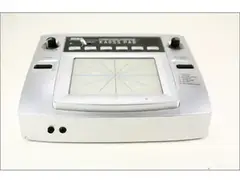
The touchpad that started the revolution
...technically, this was NOT the first instance we could see of an XY touch-pad to control effects programs... not even by Korg. Korg had two synths with multi-dimensional controllers for FX/etc... The Korg Prophecy 1995 had a ribbon strip mounted on a rocker-log version of a pitch-bender, allowing for some primitive XY control with a single finger. The Korg Z1 [1997] polyphonic/multi-timbral synth had a proper XY field above classic Mod and Pitch wheels.
So the KP1 [1999] is just a bigger touch pad fill of presets (no programming), mounted with DJ-style RCA jacks. ...and the one-finger musical gestures were born.
I still own at least one KP1. At a certain point I definitely had two. The filters, reverb and delay have a definite lower-fidelity smoothness to them, and the device overloads less harshly than some other FX boxes I have. Plus, the pitch-shifting programs and time-stretching sample-players sound SO primitive they are FANTASTIC for sound-design.
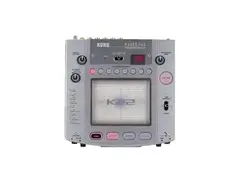
Best balance of hands-on-"chaos" and MIDI-smart FX
The KP1 was a great proof of concept, but it could not be sync'ed or remote-controlled by MIDI, as it only had a MIDI Out. The KP3 had tons of features, almost too many that it required sub-menus, operations that took several steps of button pressing, and a text display... all of which tended to slow down the "chaos".
Having owned ALL the Kaoss pads, the KP2 is my favorite, since 1) all the interfacing is direct, no submenus or SHIFT button shortcuts. 2) sampling is quick and dirty 3) several FX sync to clock on the MIDI Input 4) the FX programs tend to feel more "general purpose," and not specifically made for electronic dance music/dubstep/etc... 5) the "BPM Looper" program (#60) is so cool they re-created it for the KP3 "plus model"
At one point, I owned three, and I still own two...
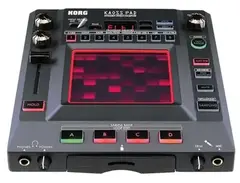
powerful tool, but a bit to structured for true "chaos"
Other's have spoken fairly of the power of this unit's FX, sampling, and looping. However, the KP3 feels just a bit clunky in that it has a shift key, and can switch context. The KP1 and KP2 did not.... with the exception of downtime-modes like setting up MIDI channels, the previous KPs were touch-and-go... and the operations of sampling, saving presets, etc NEVER disrupted the flow of playing in a "hands on" way (even without looking).
The buttons/lights/screen on the KP3 switch between at least modes: - main mode, where touch-pad controls FX and buttons ABCD start/stop/mute the Sample/Loop tracks, and keys 1-8 select Programs - Track Edit mode, where the ABCD keys select a track, the keys 1-8 will (dis)engage slices of the loop, and the touch-pad adjusts (relative) level of that Track.
Couple this with the fact that that the Shift key can dive into various menus, and Saving presets is a two-button, two-step, "confirm?" process... I feel like I spend more time looking at this thing, and less time "hands on/eyes off" FEEL-ing it out. Starts to feel too structured and organize to be "fun Chaos".
This is why I own two KP3s, but still kept my two KP2s, and one KP1.
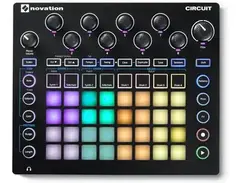
cheesy presets, not easy to program, but rewarding to personalize
Novations "Circuit" groove-box is a puzzling piece. Internal Virtual-analog style synth, based on the (Super/Ultra/Mini)Nova wavetable synth system. Very expressive system with EGs and LFOs for oscillators/filters/distortion. Presets in "packs" feels cheesy and designed to show off superficial range. No screen and blank knobs, where most presets map multiple parameters non-systematically to "macro" knobs make this a "tweak and see what happens affair. Requires a (very well done) software editor to personalize... which i've been working to do. The modes/menus become very intuitive for context switching of the 8x4 grid of pads, allowing yout play parts, mix and match patterns, and control effects, but you have to push buttons to jump around alot. This is made less-clunky by momentary context-switching, but it still feels like it requires two hands to drive. I really like how the pads can be set to a specific key and scale, and send out MIDI control. It allows me to explore notes/chords/etc on external synths without using a conventional piano layout. Many of the Circuits very inspired design ideas were used on later Novation gear, such as their MK3 controllers and X-series LaunchPads.
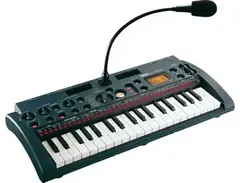
lightweight TONs of fun.
The various sampling modes make it a breeze to capture what you want. The onboard sequencer can help not just sketching out patterns, but also automate the keys (to trigger sampling when armed). Each part leads to each other part, making for very fluid fun. The recessed buttons and putting all menu-diving and control/data knobs extreme right are a pain, but the software editor is slick and hepful. If they made a V2 "MACROsampler," I'd buy it !
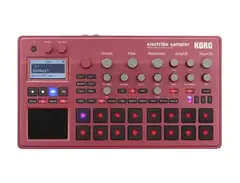
verstatile and exprssive enough to REALLY need a software editor
I have the black E2s, sampler model. Korg was brilliant to leave some basic Virtual Analog synthesis resources in the sampler model. You can reesample internal sounds or external feeds. Samples and patterns have lots of features, so editing samples, kits and sequences s a pain on the small screen. Korg REALLY should have taken the time for a realtime software editor/librarian, like SoundDiver (10 years ago) or OverBridge (a few years after this). If I travel with a piece of gear, this is it. It does a little bit of everything, with enough creative horsepower to keep surprising myself.
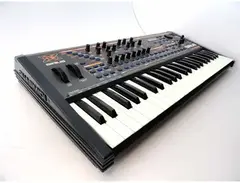
amazingly flexible quick-and-dirty sound design tool outpaces it's dated heritage
This device was made as a "band in a box" for techno music, a product of the late 1990's "groove synth" craze. All the presets are hilariously dated, but the ROM waveset and simple subtractive synthesis architecture is flexible enough to remain mid-fi fun for keys, drums, vocoding, and more WELL beyond it's rave-y roots.
For more information on tech and features, read my WikiPedia article HERE: https://en.wikipedia.org/wiki/Quasimidi_Sirius
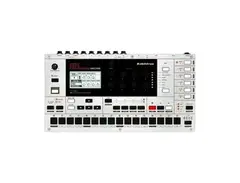
powerful and flexible sound desing, yet obtuse and mysterious.
This synth is refreshingly contrary to most synth design. While most sound modules try to maximize polyphony and preset variety from a single synthesis method (subtractive, FM, etc), this unit... - has only 6 tracks, each capable of only a single monophonic voice. - has 5 different synthesis methods, some with sub-algorithms - doe not emphasize grab-and-go presets, but is built around diving around menus and sculpting sound in the moment. You can not save syntheses patches at the track-level, only Kits/combinations at the program level. The sequencer is both a source and a destination for control. Control this via MultiTrig mode, and you have incredibly fat stacks, splits, or patters you can transpose in real time. Everything is build to around everything else. There is no center.
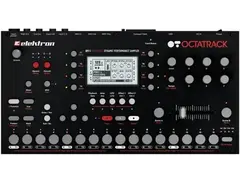
a modular swiss-army knife of classic and modern sampling
see my "1 year after purchasing" review here:
https://thepatrickrichardson.blog/2016/06/01/my-octatrack-at-year-1/