
adrian86's Reviews
4 reviews Back to adrian86's Equipboard

95
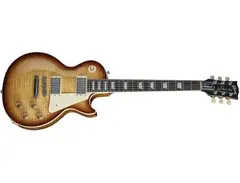
The traditional Les Paul with a nice late 80s/early 90s vibe.
The Gibson Les Paul Traditional is just a simple classic Les Paul that reminiscent of the Les Paul Standards since the late 1980s. Mine is from 2011 and features two Gibson 57 Classic humbuckers, traditional weight relief, a Nashville bridge and Tonepros vintage tuners. There are no coil taps, boosts, Min-E Tune or any super modern features on this guitar. It has a two piece mahogany body and a one piece mahogany neck. The one I have was laqcuered in Light Burst which looks like a faded Heritage Cherry finish. Being a nitro finish it started to age a bit on its own, but I really like that. It came with a black Gibson snakeskin case with white furry lining which has a nice vanilla kind of smell and is still going strong after a constant use.
The Gibson 57 Classic pickups are really nice sounding pickups which have a moderate output which is slightly hotter than vintage PAFs and a real nice clarity to them. When I use them with my amps (Marshall JCM 900 MkIII, Marshall YJM 100, Fender ´57 Twin Amp RI) they clean up very well offer a lot of different sounds when you use the volume and tone controls. The neck pickup can be a bit boomy but when the pickup height is set up correctly it works very well for those classic Les Paul neck pickup tones. Due to its clarity the bridge pickup can be a little bit ice picky sometimes but most of the time I set the tone control to 7, which smooths out the tone just enough and leaves a bit of treble reserves for later.
I tried other pickups in this guitar, namely the Dimarzio 36th Anniversaries, the Seymour Duncan Slash pickups and the Seymour Duncan Joe Bonamassa pickups and finally went back to the 57 Classics. This does not mean the other pickups sounded bad but that the 57 Classics are a very good choice for these guitars, if you like their vintage character.
Over the years I also replaced the chromed zinc taipliece with a light aluminium one in nickel, added a ABR-1 conversion bridge, changed the pickup covers to nickle and replaced pots and caps with CTS TVT 500ko pots and Russian PiO caps. These mods mainly added a bit more clarity and changed the appearance slightly. I would have no problem to recommend this guitar in its stock form.
95
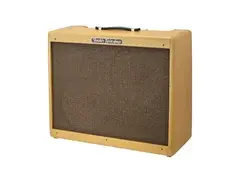
Classic amp with a pure tone
This Twin Amp has according to Fender 40 watts, it features one normal and one bright input each with a high and low input. It has 2 5U4 rectifier tubes, 4 12ax7 preamp tubes and 2 6L6 power tubes. Each channel has a volume control and share treble, bass and presence controls. There are two Alnico speakers installed.
Due to the 2 rectifiers it sounds really twangy and sparkly at lower to medium volumes. But as soon as you put the amp up to 4-6 (depending on your guitar) you are getting a fantastic sounding overdrive, after about 4-6 it only adds distortion but it is more than loud enough for everything at that point. You cannot bridge the channels with a patch cable like on a ´59 Bassman or Marshall 4-holers, if you want to mix the channels you have to use an ABY-box. As the name suggests the Bright channel is really bright, but apart from the bright cap it is identical to the normal channel. Personally I prefer the Normal channel in all situations, although I really liked the Bright channel when I could turn it up to 9, but by then I knew I could never to that at a rehearsal or even a normal gig. The two controls (bass and treble) do really change the sound, but one has to keep in mind that true to the tweed tradition they are also adding gain to the signal. The effect of the presence control is subtle but still useful.
The speakers in this amp are Eminence AlNiCo speakers designed by Weber and are really glorious sounding once they are broken in. For fun I tried other speakers like the Eminence Cannabis Rex, Jensen C12N, Celestion G12M Greenbacks and Celestion Vintage 30a. Each speaker slightly shifted the tone of the amp into a slightly different direction, so there is a nice option for further tweaking the sound if one ever grows tired of this amp.
This amp works well with pedals and a nice reverb unit adds a beautiful dimension to the sound, but I feel that you would not miss the reverb with this amp if you are not a giant reverb fanatic. Like with most tube amps you have to turn it up a bit to hear its full potential, that way the amp itself and pedals really come alive as soon as the amp is on 3, which is already loud house or low to medium rehearsal volume.
I use it with Stratocasters (normal ones and a Clapton), Telecasters and Les Pauls. Most of the time I also use several pedals and never had a problem with the sound.
There a several ways to further tweak the amp´s sound and response besides speakers. First you could change the V1-3 12ax7 preamp tubes to 12ay7 tubes, this would give you an impression how the amp was originally designed to sound like. This also removes a lot of the available treble and makes the bright channel much more appealing at non cranked volumes. You could also remove one of the two rectifiers, this further softens the sound and gives you a little bit earlier overdrive and more compression. I tried all that and right now I´m back to the stock configuration, but I was happy with each way. Please keep in mind that it is useful to re-bias the amp when you change the type of the preamp tubes or remove a rectifier tubes as the readings of the power tubes will change.
I never regretted buying this amp, if it was still available I would gladly recommend it to everybody who like higher powered tweed tones.
95
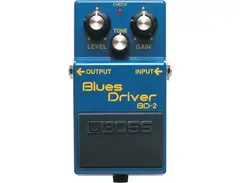
The most neutral overdrive I have hear yet.
For me this Overdrive pedal has become one of the classic pedals that everyone knows and I think everybody knows at least one person who has one of these in their posession.
At first I was not really happy with it, I felt it was very bright and brittle but I liked the fact that it is a really dynamic pedal. After a while of playing around with it I turned the tone knob completely down and suddenly it sounded 90% like my amp (Fender ´57 Twin Amp RI) but with a nice rounded dynamic overdrive on top of it. Since then this pedal is probably my favorite Overdrive, as it does not feel like a pedal or even an artificial drive on top of my amp´s original tone. It does seem to cover a lot more of frequencies than most other drives I know. There appears to be no bass cut, mid hump or treble boost with the tone control turned down. By now I only use the tone control to add treble if I am playing in a really dark sounding room.
The Blues Driver reacts very good to other pedals in front of it, often I use it together with an Ibanez TS9 to get a bit more gain. But this does not mean that the BD2 has not enough gain, in fact in can be quite fuzz-like when you crank the drive knob. There are also immense level reserves in case you want to use it as a clean boost.
So if you are looking for a pedal that has a really transparent drive then here it is!

41031
Thorough review of a readily available effect... you forgot to mention how cheap they are to boot.
95
@jimmarchi1 yeah, you´re right the BD2 is really cheap, especially compared to many more praised overdrive pedals
95
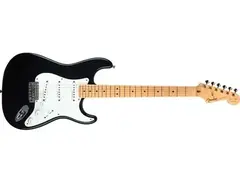
A really versatile Stratocaster with useful features
As a big Clapton fan this guitar was always high up on my list. I got my first one new in 2010 and a second one from 1989 a few years later and since then it is one of my favorite models in the Fender line.
The TBX-tone control and the 25db Midboost really give a lot of versatility and allow the player to change the tone from cutting and bright to smooth and warm. The neck shape is very comfortable, although the V is less pronounced than on older models. I compared it with my 1989 Clapton Stratocaster, but honestly, I cannot decide which neck shape I like more. Both, however, are similar.
The Vintage Noiseless pickups have a lot of clarity and are an integral part of the modern Clapton tone. The Gold Lace Sensors in comparison are a little bit smoother sounding while being not as crystal clear, but the TBX-control can take care of that. One has to keep in mind that the boost is always on, even when set to zero, that means that Clapton Strats always a have a higher output than most other strats, even if these are also equipped with the same pickups. This is also the reason why these guitars don´t really sound like vintage Strats, the tones definitely have a modern edge to them.
While playing these guitars I learned that you could use its features to get a smiliar tone to Eric Clapton but also to find new sonic possibilities. Speaking of Clapton-tone, most of the time I use this guitar with my Fender ´57 Twin Amp and that way it is really easy to find the tones heard on Clapton´s more recent live recordings. It also works really well with most Overdrive pedals, for example I really like it with a Boss Blues Driver BD2, the Hermida Zendrive or a Mad Professor Sweet Honey. While all this aims for a more traditional tone these Clapton Stratocasters also excel with modern amps.
I never unblocked the vintage tremolo, but I guess it would work the same as any other American Vintage tremolo.
Overall I can really recommend this guitar to every guitarist looking for a really versatile Stratocaster with little bit of Clapton-vibe.