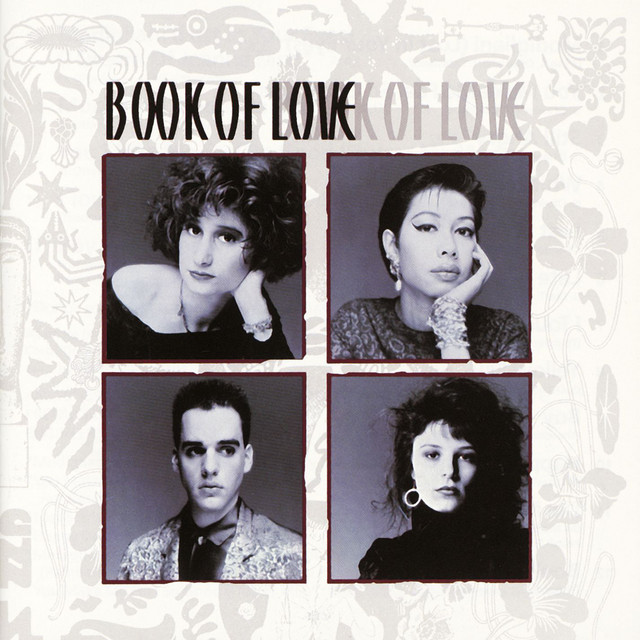
Book of Love – Book Of Love
The music gear and equipment used by the artists, producers, engineers, and more involved in the making of the 1986 album Book Of Love.
Music from Book Of Love
Artists on Book Of Love


Gear Used On Book Of Love
Explore the instruments, equipment, software, and production tools used in the making of Book of Love – Book Of Love (1986). Click more on each item to see exactly how it was used.
Keyboards and Synthesizers used by Ted Ottaviano on Book Of Love

Avg price: $1,216.96
In this July 9th, 2026 interview for Synth History, Ted Ottaviano recounts some of the synths that were key to his work with Book of Love:
Synth History: What were some of your early pieces of gear and how has it changed throughout the years?
Ted: My first synth was a used Roland Juno-6. It was on sale alongside the Roland Juno-60, which had MIDI capabilities, something I couldn’t imagine ever needing at the time–I was young and a bit naïve. The Juno had that unmistakable ’80s sound. For a while it felt like its moment had passed, but over time it’s really come back around and is now considered a classic. The Roland Juno-106, a more streamlined and affordable version, went on to become a staple for dance producers—and still is today. I actually still have mine.
Synth History: Your debut album came out at a time when analog synths were being phased out for digital synths. What was the rise of digital like?
Ted: Our first time in a pro studio was in late ’84 at Unique Recording. It was right on the cusp of the digital era, and they had a lot of new gear in-house. I brought my Juno and ended up using it for most of the parts until we discovered the Yamaha DX7. That was a game changer. It was a digital synth using FM synthesis, and it could create these really metallic, bell-like sounds that we just fell in love with. We went hard core. I bought a DX7 shortly after. I still have that one too.


Avg price: $209.50
In this July 9th, 2026 interview for Synth History, Ted Ottaviano recounts some of the synths that were key to his work with Book of Love:
Synth History: What were some of your early pieces of gear and how has it changed throughout the years?
Ted: My first synth was a used Roland Juno-6. It was on sale alongside the Roland Juno-60, which had MIDI capabilities, something I couldn’t imagine ever needing at the time–I was young and a bit naïve. The Juno had that unmistakable ’80s sound. For a while it felt like its moment had passed, but over time it’s really come back around and is now considered a classic. The Roland Juno-106, a more streamlined and affordable version, went on to become a staple for dance producers—and still is today. I actually still have mine.
Synth History: Your debut album came out at a time when analog synths were being phased out for digital synths. What was the rise of digital like?
Ted: Our first time in a pro studio was in late ’84 at Unique Recording. It was right on the cusp of the digital era, and they had a lot of new gear in-house. I brought my Juno and ended up using it for most of the parts until we discovered the Yamaha DX7. That was a game changer. It was a digital synth using FM synthesis, and it could create these really metallic, bell-like sounds that we just fell in love with. We went hard core. I bought a DX7 shortly after. I still have that one too.
Studio Equipment used by Ted Ottaviano on Book Of Love
-m.webp?v=1785077870)
Avg price: $3,999.00
In this Aug 14, 2015 feature for Red Bull Music Academy, Ted Ottaviano elaborates on the drum sounds for their lead single "Boy":
“Boy” was given a bigger, bolder sound at Unique, but it remained a fairly simple song. “It’s really Juno, a set of tubular bells, orchestral charms, and then 808 drum machine, which was basically triggered to play kick and snare samples,” says Ottaviano. “Those are pretty much digital drum samples [and] I’m not going to say where they’re from. They’re not the native 808 sounds. You couldn’t even get that sound of an 808.”
Note: the Engineers at PWL in the UK used a similar technique for their 80s productions, triggering sampled kicks and snares held in-memory in an AMS delay unit using the individual mono audio outs on their Linn 9000's as triggers. Producers did this because MIDI was still a new technology at the time -- and even studios with good MIDI sequencers on hand would find that that it had too much timing jitter/slop for triggering the most important percussive elements -- so using a sampler that could be triggered via audio (like an AMS DMX delay) ensured the most rock solid timing possible for kicks and snares.