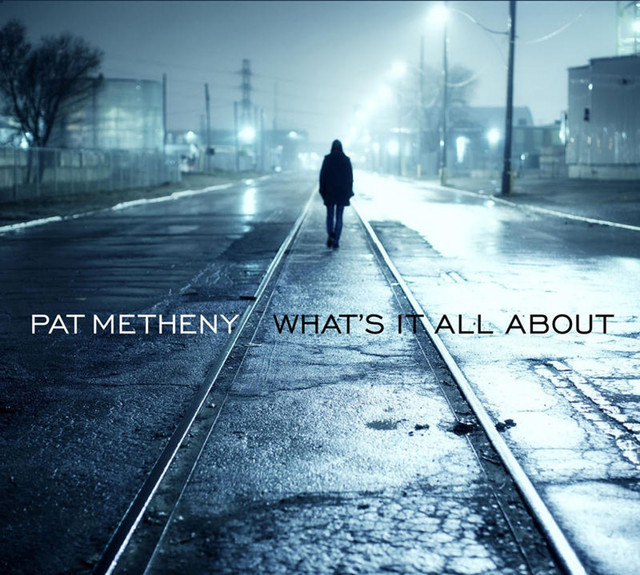
Pat Metheny – What's It All About
The music gear and equipment used by the artists, producers, engineers, and more involved in the making of the 2011 album What's It All About.
Music from What's It All About
Artists on What's It All About
-

Roles:
Groups:
Pat Metheny Group Joni Mitchell (band) Noa & Pat Metheny Antônio Carlos Jobim, Pat Metheny John Scofield & Pat Metheny Pat Metheny Trio Pat Metheny Unity Group Pat Metheny Unity Band Pat Metheny & Lyle Mays Charlie Haden & Pat Metheny Anna Maria Jopek & Friends with Pat Metheny Pat Metheny & Ornette Coleman Pat Metheny & Sonny Rollins Trio Pat Metheny & Brad Mehldau Jim Hall & Pat Metheny Derek Bailey, Pat Metheny, Gregg Bendian, & Paul WerticoProducer Recording Engineer -

-
-

Gear Used On What's It All About
Explore the instruments, equipment, software, and production tools used in the making of Pat Metheny – What's It All About (2011). Click more on each item to see exactly how it was used.
Guitars used by Pat Metheny on What's It All About
Semi-Hollowbody Electric Guitars

Avg price: $17,995.00
Pat describes acquiring this Gibson previously owned by Wes Montgomery and George Benson.
You got a guitar that was owned not only by Wes Montgomery, but also by George Benson? I’m really not that materially oriented, but I thought, “If I could ever get one of Wes’ guitars, that would be something I’d really love.” One thing led to the next, and we all knew that George Benson had one of Wes’ guitars, and somehow I wound up with that L-5 – from George.
It’s the 1961 Gibson L-5 CES that we all know from the cover of Movin’ Wes, and George used it on the first couple of CTI recordings he was on. He used it as a studio guitar. I think George could pick up a telephone pole with a cable on it and it would sound f***ing amazing. He seems kind of impervious to whatever. He’s an interesting case, that guy (laughs).


Manzer Fanned-Fret Baritone Acoustic
You also have a few Manzer baritone guitars. Craig Snyder asked her to make him a baritone guitar. And like many guitar players, I’ve picked up baritone guitars over the years and thought, “Wow, that’s cool. What would I ever use that for?” And if I try to play chords, it’s too muddy. So, baritone guitar was never something on my radar – I thought. I’ve known Craig from around town; he’s a studio guitarist and jingle writer, and he owns CR Guitars in Rhinebeck, New York. We happened to be working in the same studio and he brought in the baritone Linda made for him. I loved it right away and asked her to make me a copy of the one she’d made for Craig. I played the few things I thought would sound good on it, and I found myself very quickly putting it aside. Again, it was too muddy.
Then, one night in 2001, after I’d had it four or five years, I remembered that in my hometown of Lee’s Summit, there was a colorful character named Ray Harris. An amazing guitar player – kind of country, but he’d go play with the jazz guys, too. He had these guitars he’d invented, including this double-neck that was a 12-string on one side, and the bottom was this wacky tuning where he could play the bass and melody at the same time. And I realized it was a baritone guitar, because it went from A to A. But he did a Nashville tuning – meaning he would take the middle two strings, replace them with lighter-gauge strings, and tune them up an octave – but with a baritone guitar.
So I remembered that and did the Nashville tuning, like I’d done on “Phase Dance,” to Linda’s baritone. I’d just gotten a new mic and thought, “I’m going to record this,” and ended up recording for about four hours in that tuning, not really knowing what I was doing. I finally arrived at thinking of the bottom two strings as a cello, the middle two strings as a violin, and the top two strings as a viola. So you could play your normal kinds of things, and they would come out sort of sounding backward, with some hip bass notes.
After I listened to the stuff for about six months, it wound up being the record One Quiet Night.
After hundreds of hours of live performance under my belt, I really understood what was going on with voicings and possibilities, because I got into the habit of playing baritone guitar at the beginning of every concert. So I made What’s It All About – the only time I played other people’s music. They were songs I’ve always loved and would play around the house, so I thought it would be fun to make a record like that.