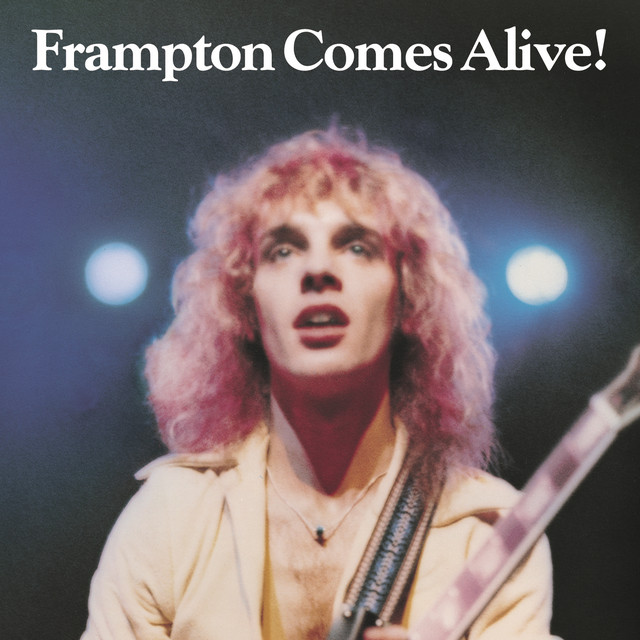
Peter Frampton – Frampton Comes Alive!
The music gear and equipment used by the artists, producers, engineers, and more involved in the making of the 1976 album Frampton Comes Alive!.
Music from Frampton Comes Alive!
Artists on Frampton Comes Alive!
Gear Used On Frampton Comes Alive!
Explore the instruments, equipment, software, and production tools used in the making of Peter Frampton – Frampton Comes Alive! (1976). Click more on each item to see exactly how it was used.

Guitars used by Peter Frampton on Frampton Comes Alive!

Gibson Les Paul Custom 1953-1957
Avg price: $46,466.34
Peter Frampton talks about his customized 1954 Gibson Les Paul, dubbed the "Phenix", in this video.


Peter Frampton "Phenix" 1954 Les Paul Custom
Avg price: $6,665.67
Peter Frampton's 1954 Les Paul Custom, recreated to match its current day condition, over thirty years after surviving a plane crash. The same guitar featured on Frampton's Double Live album and was returned to him in 2012. This limited edition of 35 guitars heavily aged by Tom Murphy, is created based on the very same Les Paul Custom that Peter now (again) tours and records with as his number one.

Effects Pedals used by Peter Frampton on Frampton Comes Alive!

Used live for "Do You Feel", in the studio for "Show Me The Way" and on Frampton Comes Alive!. The first is recalled by Frampton in this September 2013 Vintage Guitar article, the second is described by this Getty Images item, and the third was handwritten on the pedal by Frampton in 2003. The photo featured here was taken by Carl Lender and uploaded to Flickr on September 7, 2009. The unit also features as pedal 27 in Stompbox: 100 Pedals of the World's Greatest Guitarists, as can be seen in the quick browse video at 0:14. According to the Vintage Guitar article and this 2006 Musician's Friend interview with Bob Heil, Frampton's girlfriend Penny gave him the device as a Christmas present.
Frampton's writing
(This is the one on F.C.A.)
Peter Frampton '03
Vintage Guitar
When Peter Frampton began using the Heil Talk Box in 1974, he remembers it being viewed with skepticism as an “alien effect.” Similar contraptions had been around since 1939, but few people recognized them or their otherworldly capabilities. Frampton had yet to record with it, so when he used it onstage, it caused a furor.
“I was only using it on one number – ‘Do You Feel’ – and when the song goes very quiet into that jam at the end, I’d walk over to the center mic and start playing the Talk Box,” Frampton remembers. “No one had heard it before, so people snapped their heads around. It was a huge effect.”
(...) Peter Frampton first saw a talk box in action when Pete Drake came to Abbey Road Studios for George Harrison’s 1970 All Things Must Pass, on which a young, uncredited Frampton also played.
“Pete sets up opposite me, and in a slow moment in the studio, he gets out this little box and puts a pipe in his mouth, and all of the sudden the pedal steel sound is coming from his mouth!” Frampton remembers. “The pedal steel is playing the notes and he’s mouthing it and he sounds like he’s singing. That was the same sort of sound I’d heard [as the call signal] on Radio Luxembourg, except with a pedal steel it was very clean. It’s a sound that’s been very inspiring to me all of my life.”
Frampton later heard Walsh’s solo and Stevie Wonder’s use of Kustom Electronics’ 1969 The Bag talk box on his 1972 LP Music of My Mind. As Heil ran the sound system for Frampton’s previous band, Humble Pie, the two were pals.
“My girlfriend knew I was looking for a Talk Box,” Frampton says. “She called Bob up and said, ‘Do you have one I can buy?’ and he just gave her one to give me as a Christmas present. That was the one that was on Comes Alive.
“For a moment or two there, using it was pretty alien. Everybody was saying ‘What the hell is this?’ My management company let me use their rehearsal room in Manhattan, and I’d go in every day and practice with it. I started using it on ‘Do You Feel’ very early on, probably in ’74. The first time I ever used it on a record was back in England, where we were doing the Frampton record, and I used it on ’Show Me The Way’ – just tried it to see if it would work and I said, ‘Oh, well, I’ll keep it.’”
Frampton ran the Talk Box through a dedicated and modded ’70s Marshall amp. “I used to use [the amp] a lot cleaner, but found I could enunciate more when I had a bit of dirt on it,” he explains. “I use [the Talk Box] straight – no echo, no nothing. You make the wah-wah sound by manipulating your mouth. There’s not really any trick. My thing is that I close down the tube by putting pressure on it to help enunciate; I step on it like you would a garden hose.”
Getty Images
Part of the Bob Heil's collection for the Rock and Roll Hall of Fame include this serial #1 Heil Talk Box created by Heil for Joe Walsh and used on Joe Walsh's "Rocky Mountain Way." He also gave one to Peter Frampton to record "Show Me The Way." (Photo by Derik Holtmann/Belleville News-Democrat/Tribune News Service via Getty Images)
Musician's Friend, 2006
Joe Walsh had recorded "Rocky Mountain Way" using an 8" speaker and a funnel, a device used in Nashville by the steel guitar players. Well, it wasn't very loud so you couldn't use it live. So here we are, two ham radio operators on a Sunday afternoon out in my plant. We grabbed a 250-watt JBL, built a low-pass filter, got all the plumbing together, and voila—the Talk Box. That's how it started. After that tour, everybody's going nuts! "What's this thing he's got?" So I put together a commercial unit called the Heil Talk Box. Then Peter Frampton's girlfriend Penny called me wanting a Christmas present for Peter. So I sent a Talk Box. The rest of the story writes itself from there.
The first 50 were done in fiberglass, and Peter still carries his fiberglass one today. When you see him, somewhere in his gig box is that original Heil Talk Box. I have serial number 1 that will go in the Rock Hall with Peter and Joe's signatures.