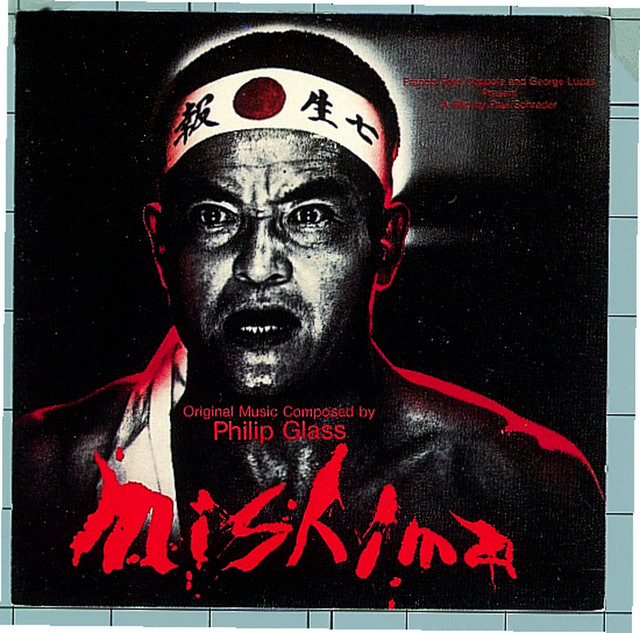
Philip Glass – Mishima
The music gear and equipment used by the artists, producers, engineers, and more involved in the making of the 1985 album Mishima.
Music from Mishima
Artists on Mishima

Gear Used On Mishima
Explore the instruments, equipment, software, and production tools used in the making of Philip Glass – Mishima (1985). Click more on each item to see exactly how it was used.

Philip Glass
Roles:
Keyboards and Synthesizers used by Philip Glass on Mishima

Avg price: $14,252.34
"The best string sound is a composite one. We'll use a sound from the OBX, then combine it with the Prophet 5 and the DX7. No one company makes a perfect programme. I prefer real people, but the synthesisers can definitely do things that real people can't. We can smooth out a string section. We'll take a string section with 12 strings, and put our MIDI'd-together string sound and we can pump that out to sound like 28 strings. The Mishima soundtrack is a good example. That's a small section, maybe 18 strings, but you listen to it, it's gorgeous."


Avg price: $209.50
"The best string sound is a composite one. We'll use a sound from the OBX, then combine it with the Prophet 5 and the DX7. No one company makes a perfect programme. I prefer real people, but the synthesisers can definitely do things that real people can't. We can smooth out a string section. We'll take a string section with 12 strings, and put our MIDI'd-together string sound and we can pump that out to sound like 28 strings. The Mishima soundtrack is a good example. That's a small section, maybe 18 strings, but you listen to it, it's gorgeous."
http://www.muzines.co.uk/articles/the-glass-bead-game/4927
Michael Riesman on plogue.com stated "Over the years of my involvement, the Ensemble went through a series of migrations to new hardware. The first was the replacement of one of the Farfisas by a Yamaha YC45-D dual manual electric organ, a wonderful machine with touch sensitivity and adjustable percussive attack. After that, we added an Arp Explorer synthesizer. Next came a Sequential Circuits Prophet 5, then an Oberheim OBXa, then a Yamaha DX-7 (one of the first in the US, hand-carried back from a tour in Japan), then an Emulator I sampler (serial #002), then a Roland Juno-106 and a Roland JX3P, and an Emulator II sampler, and then, as we adopted MIDI controllers and rack modules, a Roland Super Jupiter, a Yamaha TX-816 rack and a YTX-802, several Oberheim Matrix-6R. and a number of Akai S-900 samplers, later replaced with Digidesign Samplecell I cards running on Mac IIs."
The image is of PG posing with his DX-7 from Getty Images.