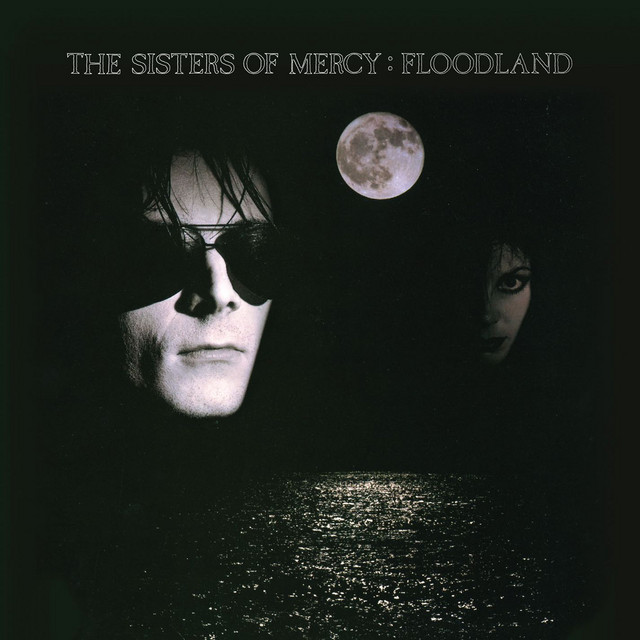
The Sisters of Mercy – Floodland
The music gear and equipment used by the artists, producers, engineers, and more involved in the making of the 1987 album Floodland.
Music from Floodland
Artists on Floodland


Gear Used On Floodland
Explore the instruments, equipment, software, and production tools used in the making of The Sisters of Mercy – Floodland (1987). Click more on each item to see exactly how it was used.
Studio Equipment used by Andrew Eldritch on Floodland

Avg price: $108.76
Unfortunately the midi retrofit was expensive. By the time 'Floodland' was being written, Andrew had spent all the ready cash on a computer and a sequencer, and was looking for a reasonably priced midi drum machine with a tighter snare drum. So he got a Yamaha RX5 for the snare sound (the kick was quite tight too) and wrote the album with that.
"Having already abused the sampling delay units of that era (and some very complicated chains of painstakingly-tuned Drawmer gates) to trigger captured drum sounds, the first dedicated samplers were a godsend. Until then, even the AMS delay unit had a maximum seven seconds of memory, and that cost a fortune. A rare treat. Mostly we had only had access to Bel units with a couple of seconds at 8 bit resolution. Both had to be triggered by hand or audio key."


Akai S900 MIDI Digital Sampler
Avg price: $691.64
"By the time 'Floodland' was recorded, we had an Akai S900 sampler. Like manna from heaven. Most of the drums on 'Floodland' came via the Akai. The DMX toms were resampled from the drum machine and off tape. Resampled RX5 kick, snare and hats formed the rest of the skeleton crew. We've been creating samples ever since, but we don't collect much any more; one encounters the same old samples circulating the globe under different names. Some of them sound suspiciously like they've been sampled off Sisters records. It's been a long time since we changed one of the Doktor's standard voices. We've created and collected a lot of "special effects" drum sounds, but we don't use them live because the sound would vary too wildly from song to song. It's not a practical solution unless you have everything submixed with automation - or running off a tape machine, like certain electronic bands we know (and all of the very famous ones we don't know). They might as well just play the record. We like a bit of risk, and we like to be able to tinker with things from concert to concert. The Akai S900 is still a perfectly fine drum sampler. Its grainy sound can be an advantage."

Avg price: $193.83
"Yamaha SPX90, SPX90II and SPX1000 effects units because they're cheap, cheerful and easy to use - and because that original SPX90 nonlinear reverb sound is a bit of a classic. The graininess still sits well with the Doktor's snare drum. Check the kick and snare on 'Flood I' for the SPX nonlinear reverb in overkill mode. Or the whole of 'Gift'. The SPX1000 also provides a standard long plate which was reasonable value for money at the time (and it interfaces digitally with the dead-end MEL2 format used by our old Yamaha DMR8 digital multitrack tape system)."
Keyboards and Synthesizers used by Andrew Eldritch on Floodland

Avg price: $800.00
"One keyboard version for working at home or in the studio, and one rackmounted version for live work. A long time ago, after futile holidays in various repair shops, the rack unit went back to Texas. When it came back the hard drive was just as broken as before. It still is. The Emax is great for orchestral sounds and mutations, but the Emax II file format isn't even recognised by later Emu equipment, so our Emaxes are at a dead end. When both units have gone to that great pawn shop in the sky, we'll lose access to our whole library of Emax II sounds - unless we buy more dodgy old kit. Having access via another sampler to the raw samples isn't the same as having the loops, crossfades, filters and all the rest, - even if we can get the Emaxes to talk to the Macs and persuade our translation software to translate all the raw samples (which is a long and tedious job in itself, with so many samples to load into the sampler first, one floppy at a time). This means we'll train the Nord Lead to variously replace that one Emax sound which we use for so many live songs, e.g. the motif arpeggios on 'Giving Ground', 'Temple Of Love' and 'More'. And it means we'll try to "use up" loads of groovy mutant sounds before our Emaxes give up the ghost altogether. Which sounds like a job for the Leeds Underground. "