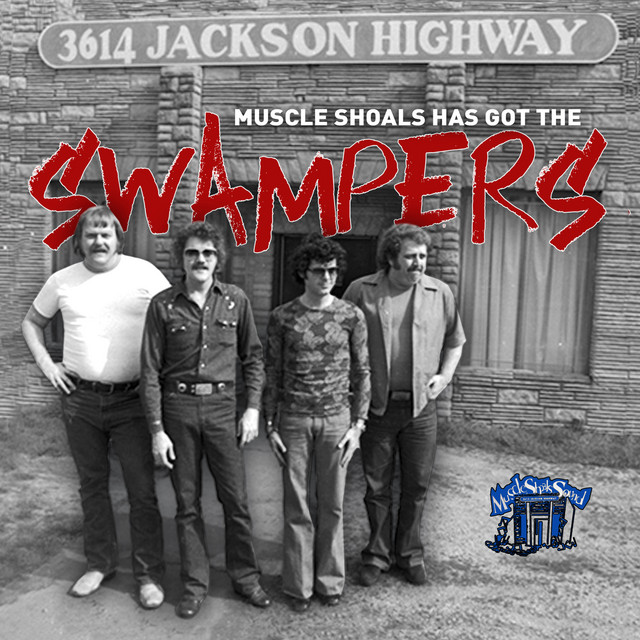
The Swampers – Muscle Shoals Has Got The Swampers
The music gear and equipment used by the artists, producers, engineers, and more involved in the making of the 2018 album Muscle Shoals Has Got The Swampers.
Music from Muscle Shoals Has Got The Swampers
Artists on Muscle Shoals Has Got The Swampers
Gear Used On Muscle Shoals Has Got The Swampers
Explore the instruments, equipment, software, and production tools used in the making of The Swampers – Muscle Shoals Has Got The Swampers (2018). Click more on each item to see exactly how it was used.

David Hood
Roles:
Amplifiers used by David Hood on Muscle Shoals Has Got The Swampers

Fender 'Brownface' Bassman 6G6A/B (1962-1964)
Avg price: $2,707.49
A 6G6 cabinet is featured in this March 2, 2019 al.com interview.
The resulting recorded tone is, “more in the bass and my hands,” iconic session musician David Hood says.
That said, the bass amplifier rig Hood used for his classic Muscle Shoals Sound Studios work is a Fender Bassman amp head and blonde Fender speaker cabinet.
In 2016, Muscle Shoals Sound reopened at original Sheffield location 3614 Jackson Hwy. and restored to retro ’60s/'70s prime. Hood’s rig was returned to the same spot it was during many vintage sessions. Against the studio wall, just left of the drum booth.
"My father was in the tire business and got hooked up with a purchasing-agent-type place who would connect you with people to buy things wholesale," Hood says. "They hooked us up with Manny's Music in New York, on 48th Street. It's no longer there, but it was a famous music store. I would call and order things from them. I could hardly talk to them because they spoke so fast, but I started buying amps and would sell them to somebody and buy another one, things like that."
(...) From Manny’s, Hood purchased the blonde cab, containing two 12-inch speakers, originally to use as an extension cabinet with the bass amp he was using. He ended up selling that amp. Now he had an extra cabinet. He then purchased a black Tolex-covered Bassman piggyback amp. “And I can’t remember why I did it, but I brought the blonde cabinet to 3614 (Jackson Hwy.) and we started recording that and using the black Bassman head with it, to monitor myself. Sometimes they’d mic it and sometimes we’d go direct. But I used it always as a monitor. In a studio full of loud guitars and keyboards and everything, you just can’t hear the bass well, even with the headphones. It’s getting where nowadays they have so many channels on the recording stuff they can use several channels for a bass. A long time ago you were lucky if you’d get one channel.”
The same interview states that an original 6G6 was used during Hood's days as a session musician for FAME Studios.
As a bassist, Hood is known for infectious nimble grooves and soulful touch. Earlier in his career, working at Muscle Shoals' FAME Studios on such R&B hits as Etta James' "Tell Mama," Hood used a house rig FAME producer/owner Rick Hall kept there. "It was one of the original Bassman piggyback amps that just had one 12-inch speaker, inside the cabinet," he recalls. Hood was part of the Muscle Shoals Rhythm Section, also featuring guitarist Jimmy Johnson, drummer Roger Hawkins and keyboardist Barry Beckett, later known as The Swampers, following a shout-out in Lynyrd Skynyrd's 1973 southern-rock hit "Sweet Home Alabama."
(...) Hood thinks he played his vintage Fender amp rig, the one now back at Muscle Shoals Sound, during classic sessions including Staple Singers’ soul hit “I’ll Take You There.” Again, that bass signal may have been recorded direct, instead of via a mic-ed amp, but he’s pretty sure he was playing through the amp too during the session. “Whatever it is,” he says, “it sounded good.”
The FAME stack is also mentioned in [this May 17, 2013 Bass Player interview(https://www.bassplayer.com/artists/hell-take-you-there-david-hoods-legacy-as-the-muscle-of-muscle-shoals), which discusses how it was recorded.
Hits by local favorites Sledge, Arthur Alexander, Clarence Carter, and others started to catch the attention of the national music industry, most notably Atlantic Records’ Jerry Wexler. Hood played trombone—not bass—on Aretha Franklin’s “I Never Loved a Man,” but he played bass on sessions for such R&B stalwarts as Wilson Pickett, Johnnie Taylor, and Etta James. He later played bass on Franklin’s “Call Me” and several other tracks.
“FAME had an old [Fender] Bassman amp that had only one speaker in it. We would record it with one of those old RCA 44 mics. When they learned about going direct, they started running me direct and miking me. Inevitably, they’d run out of tracks, so they would lose one of those. Usually the one they would keep was the direct track, so nowadays, I go direct. If I can, I like to have an amp, and they can mic it if they want.”


