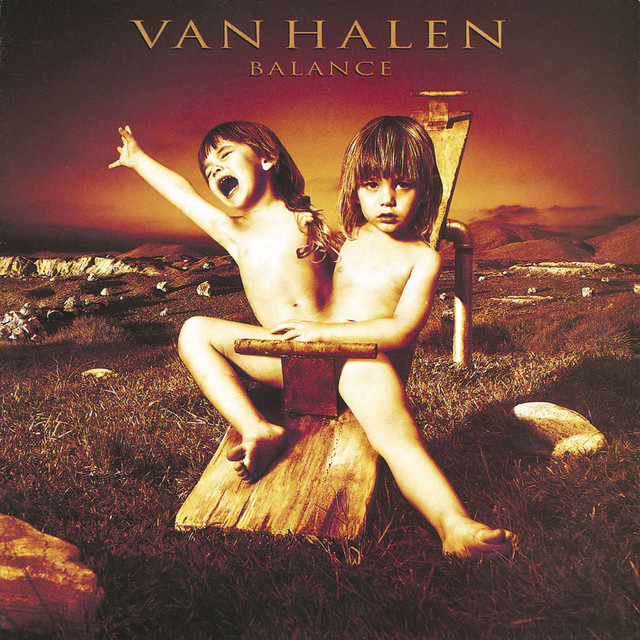
Van Halen – Balance
The music gear and equipment used by the artists, producers, engineers, and more involved in the making of the 1995 album Balance.
Music from Balance
Artists on Balance


Gear Used On Balance
Explore the instruments, equipment, software, and production tools used in the making of Van Halen – Balance (1995). Click more on each item to see exactly how it was used.

Eddie Van Halen
Roles:
Guitars used by Eddie Van Halen on Balance

Peavey EVH Wolfgang Electric Guitar
Avg price: $1,200.00
Eddie Van Halen switched allegiance in the mid-'90s, starting afresh with Peavey as his deal with Music Man ended. (Music Man continued to make the Axis, very similar to the Van Halen signature model.) Ed had already teamed up with Peavey to produce his 5150 amp and cabs in 1992 and a combo version in '95. Jim DeCola was supervisor of guitar design engineering at Peavey, where he'd been since 1988. He'd worked on Peavey's Steve Cropper signature model, introduced in '95, along with a number of regular instruments for the product line. Jim first met Ed back when Peavey was courting the Van Halen guitarist for the amp deal, at which time Jim made a guitar—a one-humbucker Strat-style with a Floyd—to show what they could do in that department. In fact, when Ed visited the plant in 1990 to talk amps, the guitar he seemed more taken with was the firm's new Peavey Odyssey, a sort of hybrid Tele–Les Paul model. Anyway, the idea went no further because, as we've seen, Ed decided to go with Music Man for his first signature guitar. Come 1995, however, with the Music Man deal at an end, Jim made a copy of the Music Man to show they were capable of producing an instrument at the quality level Ed would expect. In March 1995, he showed Ed this guitar during rehearsals in Florida for Van Halen's Balance tour. Ed agreed to go ahead with Peavey on a new signature guitar. Jim went back to the Peavey plant and mulled over the various ideas he wanted to incorporate in his design and present to Ed for approval. They began to-ing and fro-ing on the details, a process that lasted most of '95 as Ed took protos out on the road to test proposed features. An early decision was to continue with a basswood body but to make the maple top contoured, in contrast to the flat, thin Music Man top (and perhaps harking back to that carved maple–mahogany Odyssey that Ed had liked). "Basswood does sound great," Jim tells me, "but sometimes it can be a little lackluster, and I think the hybrid basswood–maple really shined."
Jim made the body shape somewhat more asymmetrical, which meant the neck could be pushed a little deeper into the body, in turn improving balance. "It didn't neck-dive as much as the Music Man, because the tip of the horn was closer to the 12th fret," he says. "And because the neck was deeper into the body, when you're reaching for an open E or an F chord, it didn't feel as far out. It almost felt like a shorter-scale guitar, but it was still a full twenty-five-and-a-half."
Peavey continued with a maple neck, too, adding carbon fiber reinforcement rods, which Jim had tried already on a couple of Peavey basses. "I thought it had a lot of virtue," Jim says, "benefitting the feel and tone of the wood with the added harmonic potential and sustain of the carbon fiber, as well as extra stability. I put the rods in the first prototype I sent to Eddie, and he liked it, so we ended up keeping that feature." Ed wanted a small version of a Flying V head, but Jim told him that was impossible, because it still counted as a copy of the Gibson original. Jim remembered a three-and-three staggered headstock on a guitar he'd built for himself, so he shrunk that a little, added a Peavey-like tip, and showed a rough to Ed. "Hmm," said Ed. "I see where you're going—but I still like the V." Jim repeated his Gibson warning. Ed then made a drawing of a sort of V-notch idea, which Jim said was too close to a Washburn '70s style. Another drawing. Any good? Nope, too Dean-like. Then Jim told Ed to give him a few minutes while he went off to the workbench. "I took my headstock I'd done, which had a black-painted face, went out to a spindle sander, and sanded a scoop into the tip of the headstock. I took it back to him, said why don't we do that? It had the V shape he was thinking about, and the scoop thing, and it still had the Peavey profile on the outside. And he's like, 'Oh yeah, I kinda like that.' We tried to honor Eddie's vision while keeping the Peavey identity."


Amplifiers used by Eddie Van Halen on Balance

Avg price: $1,667.03
Eddie Van Halen used the Peavey 5150 120-Watt Head during the recording of the "Balance" album, as evidenced by images found through Google search.
