
Steve Rogers (Beeflin)
Guitar, songwriting, singing, bass, recording
Follow
0 Followers Contributed to 3 artists
Every rig tells a story. Start yours.
Catalog your gear, wishlist what's next, and share the setups behind your sound — free.
Create your EquipboardGear 41

This (well, a pair of these) is all I've ever needed for room miking or overheads - and only £150 each.
-m.webp?v=1784890818)
I read a lot about how higher quality mikes can be better for singing, but I've always found THIS to be the one. A historic classic for an amazing bargain price.

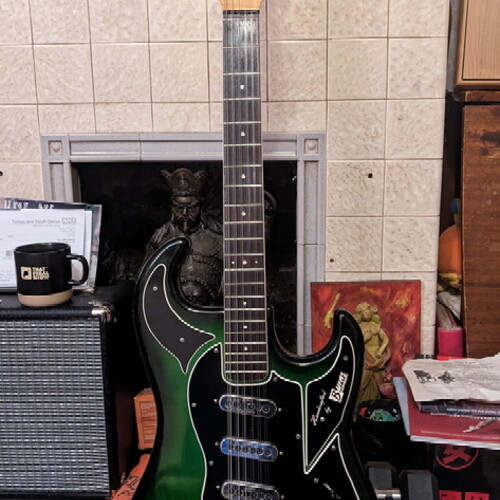
This Strat has a decent neck and everything works. Mine was particularly good value for money since I got it on a slow day on eBay for only £36 including a soft case and a curly lead. It now has two vintage Tokai pickups and a Wilkinson bridge pickup, Wilkinson two-hole tuners and I've finally got the very basic vibrato system to balance after a long time blocked. Now the only difference between me and Hank Marvin is my guitar is blue!

I used the original T-Racks for many years before I splashed out and got the full package. What a joy to work with. So many models of both vintage and modern compressors, limiters, EQs and a fine reverb kit. One special feature is an amazing optical compressor modelled after real hardware designed by IK Multimedia's COO, absolutely great for vocals.

I was a Pro Tools LE user for 10 years, but when new hardware forced an upgrade and I realised I was going to be asked for another £300 just to continue, I decided to switch to the then £140 Logic. The transition hasn't been seamless because of Logic's confusing approach to timing and markers, but I'm knocked out with the vast array of instruments provided where Pro Tools provides none.

The Shadow SH075 kit was originally advertised as being as quick as any MIDI pickup can be - it takes 1.5 cycles to determine which note you're playing. Since that's as quick as physically possible, it tracks as quickly as any newer unit and is thus just as useful. I still haven't got round to hooking it up to anything except its own little floor-pedal synthesiser, the SH22, but since it's MIDI it can end up sounding like absolutely anything. Oddly enough, only one of my many guitars is the right shape for it - the Eccleshall Scimitar, which was designed to host it. But It does work on Telecasters and Les Pauls, which I don't have.

When I bought this guitar its action was far too low and the truss rod adjustment was completely wrong, so it buzzed and choked everywhere. I had it professionally set up, but the luthier had to do quite heavy levelling on the frets. After setup it's a joy to play, sensitive at low volumes but really loud when hit hard. Still a bargain, but it's not really a £200 guitar - it's actually £300+ if you want it playable.

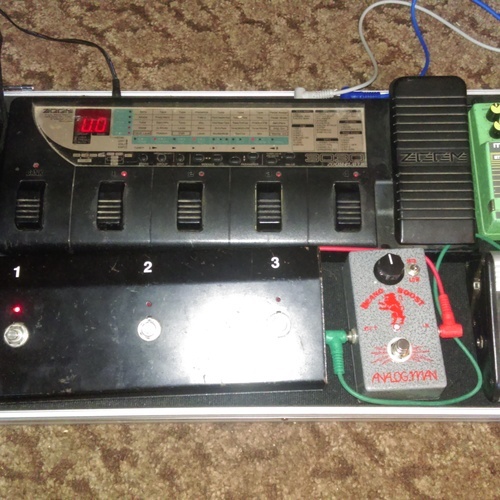
Analog Man's Beano Boost pedal is a hand-made Rangemaster with three modes - treble boost, mid boost and bass boost. But it doesn't just make the guitar louder - it gives a special, edgy and roughened sound that cuts through like a refined cheese grater. The Rangemaster is part of the classic sound of Marc Bolan, Tony Iommi, Rory Gallagher and Brian May and is rumoured to be the secret behind Eric Clapton's revolutionary tone on the Bluesbreakers' "Beano" album (hence this pedal's name).
By the way, my particular Beano uses the 2N527 transistor.

No need for overdrive pedals, this heavy little combo can give you five generations of Marshall sounds from clean to super overdrive.

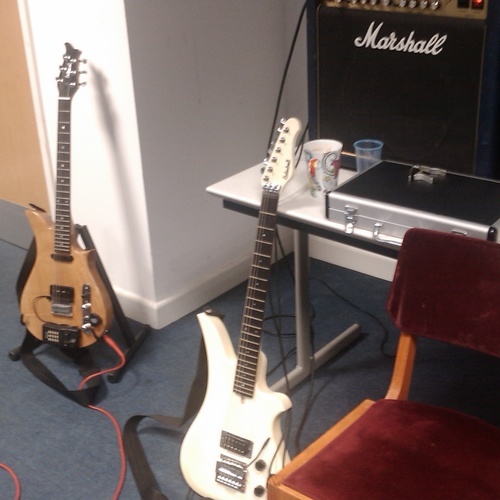
This is Chris Eccleshall's take on the Superstrat, featuring a Kahler vibrato system and a single humbucker. It's unusually refined for its type and has the sweeping, tulip-like lines of Chris' own body design.

Chris Eccleshall was a violin maker before becoming a luthier and has made many fine acoustic guitars and mandolins. So it's unsurprising that his solid-bodied instruments tend to have a fine tone too, strong on mids. The 24.75" scale Scimitar, along with the 24.5" scale Barracuda and Excalibur bass, are his only original designs since he normally sticks to classic designs, especially Gibson patterns.

The Variax's simulations of 12-strings, banjo, acoustics and especially Danelectro sitar guitar, and its ability to store many different tunings with the help of a computer app, make it a great studio tool. It can also imitate many classic solid-body guitars, but I find that side of it a bit geeky. Some of them do stand out, but many solid-bodies don't really sound as distinctive as their historical aura would suggest. The neck is rounded and of medium fatness, a good compromise since it has to serve for so many different guitars. The neck can be replaced by one made by Warmoth if it dies.

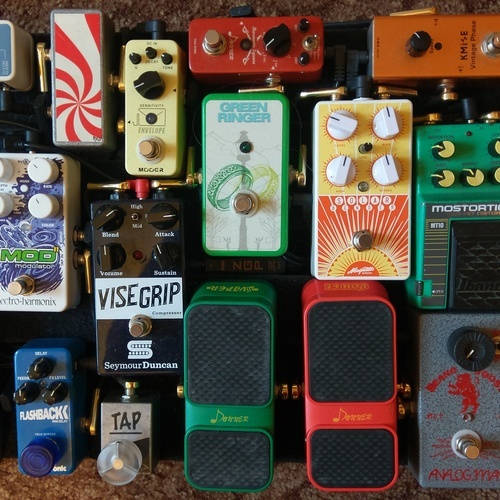
A smooth sounding overdrive which, with gain set low, sounds very close to a Marshall crunch channel. It also has tone controls which can boost treble, scoop or boost bass to create different tones.

Makes a similar sound to an Electric Mistress, but doesn't reduce volume as much. Still a little quieter than the bypassed signal and loses bass. But practical and quiet. Identical to the Mooer ElecLady.

This programmable pedal has many interesting effects and facilities including flanger, through-zero flanger, chorus, reverse and kill-dry as well as all kinds of hardware emulations - digital, analog emulation, tape emulation, etc.
But it's risky to assume you'll be able to change programs during a gig without hassle, because you'll need your phone and you know what phones can be like. Probably best to pick a setting for the whole gig. And if you do need to reprogram mid-gig, you really must mute your sound if you don't want your audience to run away thinking aliens are attacking, because the burst of programming chatter sounds very nasty.
So the pedal is inspiring because of the incredible versatility for a very reasonable price, but you should probably think of it as a fixed setup that you can choose from an infinite set of possibilities, and then stick with, rather than an editable setup.

This pedal is tiny and light, taking up less than half a full treadle wah's board space. It is always switchable from active volume/swell to wah with a click of the footswitch, which is in the normal position for wah pedals, under the treadle's front half.
The wah is a little fierce and rough sounding with distortion, but it is reasonably good with clean sounds. It's excellent value for money.

I decided to get an envelope filter after seeing demos of the Source Audio Spectrum, but when I actually tried one I found it didn't have the fundamental feel I was looking for, despite all its options and controls, so I radically downsized to this little devil. It rocks! It has a little tiny bit of overdrive and dirt to smooth its way, and perfect controls for whatever response you want. The only thing it lacks is a reverse setting, but I can live without that.


I really like the volume taper of this pedal and use it extensively for volume swells. Being passive it makes no noise.I use it as my board's main mute switch, at the end of the drive section. It's also featherlight but strong.
I haven't tried it as an expression pedal but I am sure its good quality pot will work well in that mode too.
Wishlist 9
Gear Photos 4

Top artists 3
The artists Steve Rogers (Beeflin) has added the most gear to.


