Every rig tells a story. Start yours.
Catalog your gear, wishlist what's next, and share the setups behind your sound — free.
Create your EquipboardGear 40

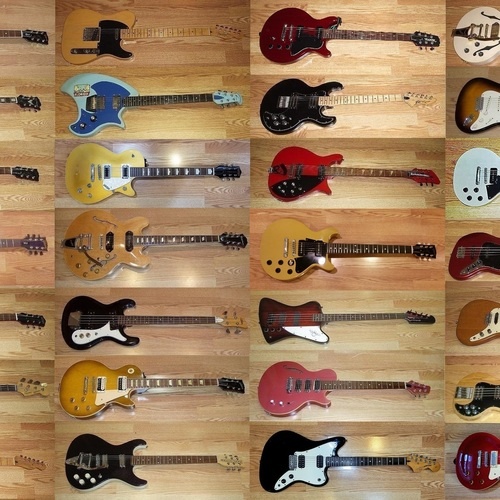
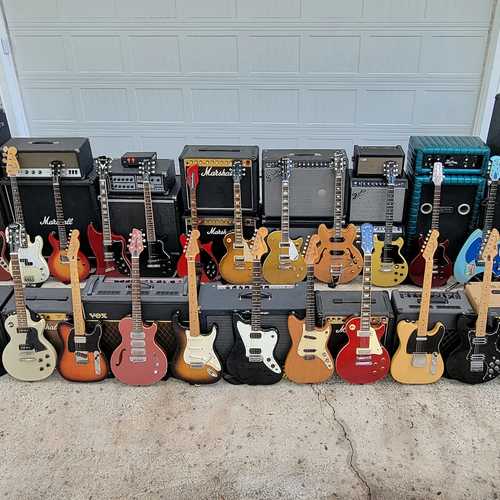
This is a classic, iconic guitar. The butterscotch blonde is gorgeous when paired with a black guard, having been seen played by the likes of Keef, the Boss, and other people with only one name. That said, the small frets do not lend themselves well to big bends a modern player might be used to.
The '50's wiring scheme, with the usual "neck" position replaced by a pseudo-bass setting, the "neck" setting shifted to the middle notch, and no setting for both pickups, is downright weird, but the guitar comes with a "conversion" kit to change the settings to the usual 3-way of neck, both, bridge. I left mine stock though, the weirdness is kind of endearing, and you can get both pickups if you position the selector at "2 1/2" in between the middle position and the bridge setting.

I managed to pick this up used for a GREAT price. The pickups were originally the stock blacktops, but the bridge was later replaced with a Seymour Duncan, and 'zebra-tized with Bobbin Toppers. Thus the current pickups are a Seymour Duncan Custom V bridge pickup and the stock Gibson 496R neck pickup. This is my most expensive guitar and one of my favorites. I often use it for important gigs.

After owning a series of cheaper import Fender and Squier Strats, as well as a US-made Peavey Predator Strat, I found this used at a GREAT price (I think the seller thought it was a Mexican-made Standard rather than a CS '50s; the latter street for about $800 rather than $500 for the Standard). This is about as good as it gets without paying for Fender USA. Finally found "my" Stratocaster.

A bit neck heavy. Picked up a used one for a Benjamin, even. Mine's actually much better looking than this stock shot. Darker. To me this shape screams "rock and roll."

First, this is not the solid white "Royale" version with gold binding. It's a short-run white blonde color.
Although these look like a semi-hollow, technically they are chambered solidbodies. There's no "niche" for that here, so I've put it under semihollow, but it is not the traditional maple laminate like an ES-335 or Casino. It's a chambered mahogany body with f-holes in a thick maple cap. So it's more like a Les Paul Florentine than it is like a 335. As such, it's great for louder or higher-gain situations where a Casino or Riviera might feedback.

I love Les Paul Specials, and have owned several by Gibson and one by Epiphone (a setneck P-90 LP Special in TV White, not the ubiquitous $99 boltneck "Special"). This USA Hamer is as good or (in some cases) better than any of the Gibsons. I added a pickguard. Because of differences between the Hamer and Gibson, I used a singlecut pickguard, and had to slightly reduce the "tab" between the pickups. Easy mod via 2 straight cuts with an electric tabletop mitre saw.

Despite Gibson's ridiculous model name, this is a Les Paul Special. Not a "Junior." Mine has a satin ebony finish and a bound baked maple fretboard, which honestly is virtually indistinguishable from rosewood. P-90s rock! Would've preferred the gloss model, or TV Yellow, but bought on closeout.

I bought this for peanuts used. This is a model made for 2 or 3 years in the '90's. Fender Mexico. Neckbucker coil splits for cool five-way switching, one of my most tonally versatile guitars (along with my Peavey T-60, which also coil-splits, and adds a phase switch too).
I actually gig this guitar more than I do my Fender AVRI '52 Telecaster, despite that the USA guitar is much more expensive.

I picked up this Les Paul Deluxe very affordably, used. I love the more tightly focused sound of mini-humbuckers in a Paul, but the Gibson version, even used, is too expensive for me. The metallic red color is great looking too. Another giggable fun cheapie!

First the SGJ is not an "SG Junior," it's just another of Gibson's recent dopey and confusing model names.
Like Juniors, the SGJ (and LPJ for Pauls) are stripped-down models. However, "Junior" traditionally means P-90s, and the SGJ (and LPJ) had humbuckers. The buckers in the SGJ 2013 were Gibson 490s, but with a goofy black plastic cover that made them look like EMGs.
SGJs also didn't have a pickguard.
So I modded mine by adding a pickguard. I also put Bobbin Toppers on the black plastic pickup covers, which makes them look like open-coil pickups with white bobbins, to match the guitar's worn white finish.
Speaking of which, the "worn white" finish is cheap and ugly, close up. Looks ok when not close up, or under stage lights. I may try some white rubbing compound on it to buff it up a bit.

Bought used w/ohsc. Prior owner swapped the original scratchplate for a black one. Made in Mexico, '90's. I played this bass at a gig playing bass for the late great Bo Diddley!

The T-60 was the first flagship guitar of the Peavey company, and the first mass produced guitar using CNC (Computerized Numerical Control). The two humbuckers can be coil-split using the tone control (after 7 the humbucker splits), and there's even a weird out-of-phase switch. Highly versatile if you know how to use the controls. Study up and have fun!

-m.webp?v=1784332110)


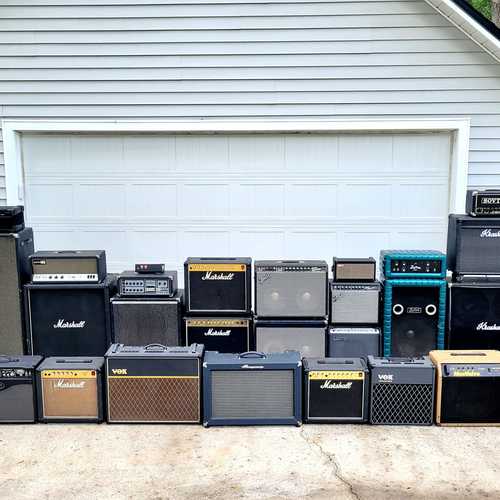
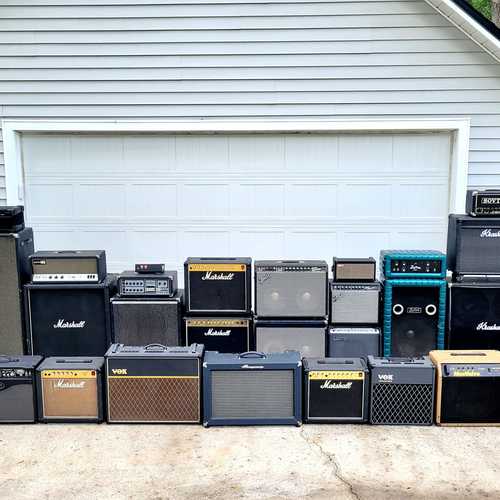
50W of old school rock. I dime this and play with no pedals. Straight into the amp. Paired with either a Risson 4x12 or a ported '69 Kustom tuck-and-roll 1x15.


I love the Marshall '80s solid states. This is the smallest I have. I also have two 1x12 combos (50W and 75W) and a Lead 100 Mosfet head.
One correction to the above specs. This is not a closed-back amp. It is open-back.
Wishlist 0
Nothing here yet.