
compilerbau's Reviews
2 reviews Back to compilerbau's Equipboard

208
A simple specialist
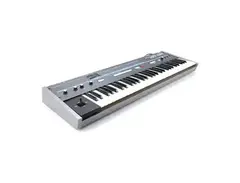
The Korg Poly 61 is a versatile synthesizer that excels at crafting lush pads, thick basslines, and evocative leads reminiscent of the Blade Runner era, all without relying on built-in effects. While it lacks onboard effects, connecting it to external gear can elevate its sound to even greater heights. Its technical architecture bears resemblance to the Roland Juno 106, featuring DCOs (Digitally Controlled Oscillators) and Voltage Controlled Filters (VCF), characteristic of the iconic early '80s synth sound before the DX7 era.
While the Juno offers superior parameter control and flexibility, skilled individuals with a knack for electronics can easily modify the Poly 61 to enable external control through variable resistors, sliders, or even external CV/Gate signals.
Unfortunately, many used Poly 61 units suffer from battery leakage, which can corrode the circuits on the CPU board and connector pins inside the plug. This corrosion may also spread to neighboring boards through cables. Hence, it's advisable to thoroughly inspect all connectors, cables, and circuitry if purchasing or servicing one.
Preferred Settings + Usage:
Critics have occasionally pointed out that the Poly 61 doesn't quite match the sound quality of its predecessor, the Korg Polysix. However, I find its sound to be unique and commendable. While it lacks a dedicated Unison Detune knob like the Polysix, achieving thick bass tones is still achievable through creative techniques. For example, tweaking the LFO pulse width or employing slight detuning in Chord Memory mode buffering two notes at different octaves while setting DCO1 to SAW, DCO2 to square, both at the same octave but detuned 3-4 pitches against each other. By buffering two notes of this sound with an octave difference in hold mode and then switching to chord memory mode, you can achieve a four-voice unison sound, with two slightly detuned voices serving as its own type of sub-oscillator akin to the Polysix (which only has one suboscilator). The slight detuning between the saved notes is facilitated by the Poly 61's inherent detuning, which increases slightly as notes ascend, adding to its sonic character as stated in the manual. This trick leads to a unique kind of sound with its own character, while also evoking the iconic warmth of the Korg Polysix. It is noted, that in comparison to this method which leads to 4 detuned notes at a time, buffering the same note 6 times does make a full unison sound which is limited to the 2 oscilators beeing detuned to each other.
208
A great Piece of History
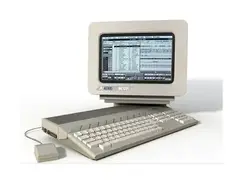
I Acquired an Atari ST 1040 circa 2021, complete with CLAB Notator/Creator Software and Dongle, previously owned by Manuel Göttsching. The Atari runs great and boasts excellent MIDI timing. Ive ensured the Atari's optimal performance by having its power supply unit revised, just as a precaution. Additionally, an ACSI external hard disk emulator has been added for enhanced convenience. I've hooked it up to a compact TFT monitor via a VGA adapter box for easy viewing.
It remains an invaluable tool for MIDI sequencing hardware synthesizers, proving its worth even in 2024. I incorporated it into my hybrid setup, which blends both modern and vintage equipment.
