
Pricing and availability
We compare 600+ stores and found this item at 1 store. Prices updated .
Store
Reviews
Price




Average Price: $568
Standard/Professional
$500
$1501+
Price Tier
Budget
Standard
High-end
* Product prices and availability are updated by Equipboard every 24hrs and are subject to change. Equipboard may receive compensation for purchases made at participating retailers linked on this site. This compensation does not affect what products or prices are displayed, or the order of prices listed. For more information, please refer to our affiliate disclosure.
Description
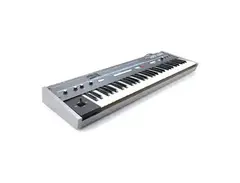
Experience a harmonious blend of vintage charm and modern functionality with the Korg Poly 61 synthesizer. Emerging from the golden era of analog synthesis, the Poly 61 offers musicians a classic 61-key interface equipped with a rich, warm sound palette that is both inspiring and versatile. This synthesizer is a perfect choice for those who appreciate the lush textures and expressive potential of analog sound, combined with the ease of digital control.
With its intuitive interface, the Poly 61 allows musicians to dive into sound design effortlessly. Its dual DCOs (digitally controlled oscillators) provide stable tuning while delivering a wide range of tonal possibilities. The built-in chorus effect adds depth and dimension to your sound, making it ideal for both studio production and live performances. The Poly 61 also features a simple yet powerful arpeggiator, perfect for creating intricate musical patterns with ease.
Musicians will appreciate the straightforward panel layout, making it accessible for both beginners and seasoned synthesists. The combination of tactile controls and digital presets means you can easily store and recall your favorite sounds, ensuring seamless transitions between songs or sets. Whether you’re crafting ambient soundscapes or driving bass lines, the Korg Poly 61 is a trusty companion in any musical journey.
Key Features:
- 61-key synthesizer with a vintage analog sound
- Dual DCOs for stable tuning and diverse sound options
- Built-in chorus effect for added sound depth
- Arpeggiator for creating complex musical patterns
- Easy-to-use interface with digital presets for sound storage and recall
Product specs
| Brand | Korg |
| Model | Poly-61M Polyphonic Synthesizer |
| Year | 1980s |
| Categories | Digital Synthesizers, Keyboard Synths |
| Analog / Digital | Digital |
| Key Size | Full Size |
| Keyboard Action | Synth Action |
| MIDI I/O | MIDI Input, MIDI Output |
| Number of Keys | 61 Keys |
| Polyphony | 6 Voices |
FAQs
-
Is the Korg Poly 61M synthesizer polyphonic or monophonic?
-
The Korg Poly 61M is a polyphonic synthesizer, capable of playing up to six voices simultaneously.
-
Does the Korg Poly 61M have MIDI capabilities?
-
Yes, the Korg Poly 61M includes MIDI input and output, allowing it to integrate with other MIDI-compatible equipment.
-
What type of keyboard action does the Korg Poly 61M have?
-
The Korg Poly 61M features a synth action keyboard, providing a smooth and responsive playing experience suitable for various playing styles.
-
How many keys does the Korg Poly 61M have?
-
The Korg Poly 61M is equipped with a full-size, 61-key keyboard, offering a wide range for playing complex pieces.
-
What distinguishes the Korg Poly 61M from other synthesizers of its era?
-
The Korg Poly 61M offers 64 programmable memory slots and dual oscillator banks, allowing for rich interval and detuning effects, setting it apart from contemporaries like the Juno series.
Videos

AnalogAudio1
KORG POLY-61 Analog Synthesizer 1983 | CUSTOM PATCHES
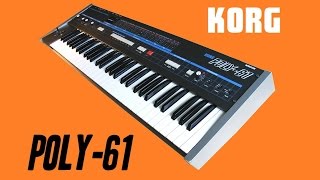
KORG POLY-61 Analog Synthesizer 1983 | CUSTOM PATCHES
AnalogAudio1
5 MINUTES WITH A KORG POLY-61 SYNTHESIZER

gstormelectro
Korg Poly-61 | A Raw and Beautiful Synth | 64 NEW PATCHES BY ESPEN KRAFT

Espen Kraft
Korg Poly 61 // Why I'm Selling // Underappreciated or Undervalued?

Jorb

Why I LOVE the Korg Poly-61

Fuzz City Records
Korg Poly-61 - Demo of a few patches

roboticrealm
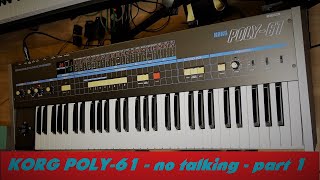
Korg Poly-61 - no talking - part 1/2

The Synth King
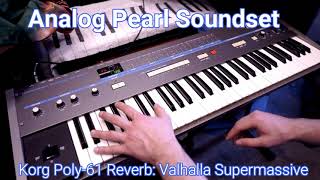
Korg Poly-61 "Analog Pearl" Ambient Sounds

LFOstore
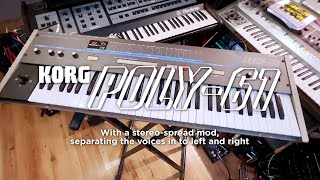
Korg Poly-61 Stereo Spread Demo

Lackan
Reviews
PROS
-
Vintage gear sound with unique character
-
Excels at lush pads, thick basslines, and evocative leads without built-in effects
-
More interesting sonic character and punchier sound than other DCO synths
-
Can be modified for external control flexibility
-
Digitally storable soundbanks offer a wide range of applications
-
Fun and engaging arpeggiator function
-
Easy handling on stage, especially with MIDI-equipped versions
CONS
-
Lack of external control for filter cutoff limits expressiveness
-
Parameter programming less intuitive than knobs/sliders
-
Prone to battery leakage and circuit corrosion in used units
-
Amateur grade keybed even by 80s standards
-
Limited MIDI implementation compared to modern standards
Owner Insights
We analyzed real musician discussions from forums and Reddit to find what players love, question, and tweak about Korg Poly 61.
Setup and maintenance
-
Capacitor and battery leaks are common maintenance issues; replacing the original NiCad battery is crucial to prevent corrosive gas damage.
Source -
Replacement CPU boards are available but costly; careful inspection for PCB damage is advised due to potential battery leaks.
Source -
Erosion on key contact pads is common; using an eraser can help restore functionality.
Source
Mods and upgrades
-
Removing the joystick spring allows it to stay in place, offering additional modulation options akin to having two LFOs.
Source -
Adding MIDI to the Poly 61 can cost around $200, providing a relatively easy upgrade path for enhanced connectivity.
Source -
Insert 100k potmeters into the ribbon cable for smoother control over filter cutoff and resonance, eliminating the stepped filter effect.
Source
Features and functionality
Comparisons
-
Described as having a "slightly dirty charm" compared to the Juno series, appealing to those seeking a unique vintage character.
Source -
The Poly 61 is often described as "too static" compared to other synths, suggesting it may not have the dynamic sound qualities of its contemporaries like the Polysix.
Source -
The Poly 61's two DCOs per voice offer a more complex architecture than the Juno 60's single DCO, yet at a fraction of the price.
Source
Use cases and applications
Value and pricing
-
The Poly 61 is viewed as potentially overpriced given its limitations, suggesting potential buyers should carefully consider its value for their needs.
Source
Critic Reviews
4.5 out of 5
Based on 7 Reviews and 28 Ratings

208
A simple specialist
The Korg Poly 61 is a versatile synthesizer that excels at crafting lush pads, thick basslines, and evocative leads reminiscent of the Blade Runner era, all without relying on built-in effects. While it lacks onboard effects, connecting it to external gear can elevate its sound to even greater heights. Its technical architecture bears resemblance to the Roland Juno 106, featuring DCOs (Digitally Controlled Oscillators) and Voltage Controlled Filters (VCF), characteristic of the iconic early '80s synth sound before the DX7 era.
While the Juno offers superior parameter control and flexibility, skilled individuals with a knack for electronics can easily modify the Poly 61 to enable external control through variable resistors, sliders, or even external CV/Gate signals.
Unfortunately, many used Poly 61 units suffer from battery leakage, which can corrode the circuits on the CPU board and connector pins inside the plug. This corrosion may also spread to neighboring boards through cables. Hence, it's advisable to thoroughly inspect all connectors, cables, and circuitry if purchasing or servicing one.
Preferred Settings + Usage:
Critics have occasionally pointed out that the Poly 61 doesn't quite match the sound quality of its predecessor, the Korg Polysix. However, I find its sound to be unique and commendable. While it lacks a dedicated Unison Detune knob like the Polysix, achieving thick bass tones is still achievable through creative techniques. For example, tweaking the LFO pulse width or employing slight detuning in Chord Memory mode buffering two notes at different octaves while setting DCO1 to SAW, DCO2 to square, both at the same octave but detuned 3-4 pitches against each other. By buffering two notes of this sound with an octave difference in hold mode and then switching to chord memory mode, you can achieve a four-voice unison sound, with two slightly detuned voices serving as its own type of sub-oscillator akin to the Polysix (which only has one suboscilator). The slight detuning between the saved notes is facilitated by the Poly 61's inherent detuning, which increases slightly as notes ascend, adding to its sonic character as stated in the manual. This trick leads to a unique kind of sound with its own character, while also evoking the iconic warmth of the Korg Polysix. It is noted, that in comparison to this method which leads to 4 detuned notes at a time, buffering the same note 6 times does make a full unison sound which is limited to the 2 oscilators beeing detuned to each other.

41016
worth the buy in
This is like a jx3p if korg made it. Same filter and sweet but hissy chorus as the later DW6000. Same fun joystick for switling through pitch bend and LFO mod. If you like that sound and can deal with the amateur grade keybed (even by 80s standards), 2 digit parameter selection and data slider interface but want regular DCOs with regular shapes? Bingo. Highly recommended. Get an M with MIDI if possible. Limited implementation but usually the upcharge for an M is less than a MIDI retrofit and how many features do you need anyway?
This is not anything to do with the polysix.... just 6 voices and a similar name. DCOs, no SSM filter chip (I think the korg filter has more character anyway, SSs were ubiquitous in the 70s like CEMs in the 80s anyway)... 2 oscillators, more robust architecture. Its really a DCO DW6000. The enxt evolution was wave memory oscillators and the the DW8000 with digital delay and 2 more voices.

27237
I wish I knew of this PolySix successor 10 years ago. Thanks for helping me integrate the 61 into my mental map of every 80s polysynth.

164
Classic analog synthesizer from 1981
The KORG Poly 61 is one of the first polyphonic synthesizers in the history of electronic music. It impresses with the sonorously dynamic synth sounds of the 80s. This synth has been used in many internationally successful productions. With its digitally storable soundbanks it offers a wide range of applications for the lover of vintage analog keyboard sounds. On stage it impresses with its easy handling. Retrofitted with MIDI or in the factory equipped version with MIDI it is also a very interesting sound supplier within the wide synthesizer family.
41016
I think its more like in the 2nd or 3rd run of polyphonics LOL, just in korgs you have the polysix prior... also prior are the CS80, prophet5 prophet600, 2 voice, 4 voice, 8 voice, OBX, XA, OB8, jupiter4 and 8, juno6 and 60, Akai AX series was earlier or contemproary as was the Teisco/Kawai SX series and the Elka Synthex if I recall... but great review. Love mine too.

Poor man's Juno
Really cool anolog synth with digital clocking, parameter adjustments and preset saving. Fixed one and almost sold it, glad that didn't happen. The arpeggiator function is tons of fun, especially at faster speeds with sounds that have a quick attack.
164
Poor man's JUNO ??? ... I don't realy think so! ... when I Bought this f***ing K'board at the age of 19! ... it was very expensive to me: 2.100 DM ( in 1981 it was nearly the same as my fathers monthly netto-earnings as an engineer!)

You never forget your first...
The Korg Poly-61 was my introduction to analogue synthesizers. The first time I turned on the arpeggiator I was hooked for life. An underrated classic.

Still fun after all these years.
First keyboard I could afford. It still is a lot of fun to tinker with after 30+ years.

Artist usage
Add artist
On Description of 'Korg funk 5' , Poly 61 is Mentioned.

.jpg)
In this Instagram post in the picture the Korg can be seen on the right where there’s two synths on a rack, it’s the upper one. In the post It says Poly Dog 61 which would refer to Korg Poly 61.
The same post is on Facebook https://www.facebook.com/photo?fbid=800304761455822&set=a.291826632303640


"I have a Korg Poly-61 that I mostly use for pads."
.jpg?v=1784214499)

Cookie is shown playing a Poly-61 during the recording of Cyboogie (segment begins at 4:30)


Zoe: What kind of synth do you use? Is there a specific one you prefer?
Peter Sagar: The main one I use is a Korg Poly-61. I like that one a lot.

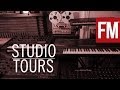
At 1:01:20 in the video Legowelt shows a synth to the camera and says "Over here we have another one of my favourite synthesizers which is the . . . Korg Poly 61 which is an early 80s analog polyphonic synthesizer".


At 0:31, a friend of Peter can be seen using the Korg Poly 61.

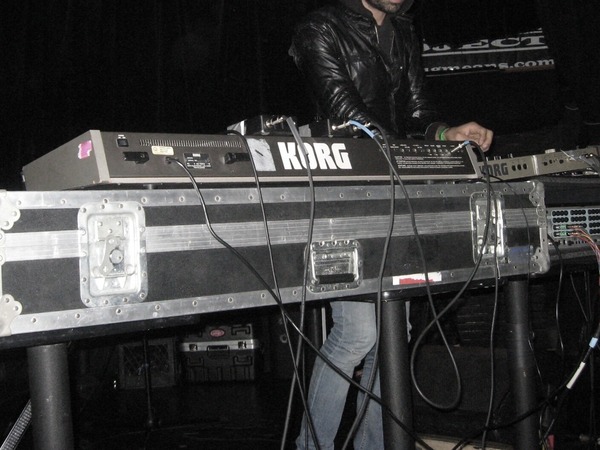


"The Polysix and the Mono/Poly in particular have a warmth you don't find in most Japanese stuff, although with the Poly 61 it was back to the cold Japanese digital sound."


Album Usage
The Korg Poly 61 has been featured on the following albums:

Genre Usage
Based on how artists on Equipboard use this gear, it is most commonly found in the following genres.
Used With
Based on how musicians on Equipboard use Korg Poly 61, it is most commonly used with the following gear.
-s.webp?v=1784300206)


-s.webp?v=1784300262)


Community setups
Show yours

More Korg Synthesizers

$469.00 - $699.99
in Synthesizers Rank


$411.00 - $699.99
in Synthesizers Rank


$379.00 - $528.00
in Synthesizers Rank


$494.09 - $899.99
in Synthesizers Rank


$220.00 - $749.99
in Synthesizers Rank


$29.95 - $69.99
in Synthesizers Rank


.jpg?v=1784225997)


-m.webp?v=1784300421)
$425.00 - $749.99
in Synthesizers Rank


-m.webp?v=1784300207)
$119.99 - $159.99
in Synthesizers Rank


$273.00 - $449.99
in Synthesizers Rank

.jpeg?v=1784219222)


$113.31
in Synthesizers Rank
.jpeg?v=1784214915)


$247.00 - $449.99
in Synthesizers Rank


$1,550.00
in Synthesizers Rank


$99.99 - $1,100.00
in Synthesizers Rank


$42.00 - $69.99
in Synthesizers Rank


$173.65
in Synthesizers Rank


$441.00 - $749.99
in Synthesizers Rank


$53.80
in Synthesizers Rank


-m.webp?v=1784127447)

.jpeg?v=1784219222)


-m.webp?v=1784300207)


$1,905.44 - $3,399.99


$475.00 - $839.00


-m.webp?v=1782831536)


-m.webp?v=1784271740)
$1,290.00 - $1,699.99


$77.00 - $119.99


Accessories & Related Items


Similar


Gear Guides








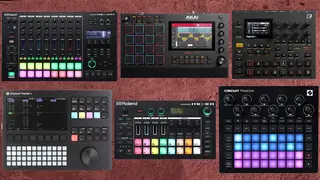

Most Popular Synthesizers
Most Popular Brands
-
Added to Equipboard on by
 wearepresidents
GearIQ 48
-


