Every rig tells a story. Start yours.
Catalog your gear, wishlist what's next, and share the setups behind your sound — free.
Create your EquipboardGear 9

«Bon Voyage» - is the first vintage guitar in Doff’s model range, which has received it’s own name because of excellent design and amazing sounding. We carefully controlled the process of making, chose the highest quality of used materials, created a unique design of the body and technique of sound board "tuning" for this guitar. Thanks to all done work, we managed to receive surrounding, sated with basses sounding. We are sure that everybody, who will take this guitar in hands, won’t be able to leave it.

Paying attention to Folk Vintage guitar series, you involuntarily will have the feeling of something very familiar, as if you’ve seen it before, and you'll completely right. Creating Folk Vintage guitars series, we have completely turned to the experience of Russian masters as Krasnoshchekov and Paserbsky (because originally “folk” means “originating among the common people and reflecting the traditional forms”). We have created our Folk guitar based on shapes of their instruments. The elegant body lines, characteristic cut-in rosette with ivory insertions, incredible vivid and rich sound of maple body, bridge bone width 48 mm - all this is our Folk guitar of Vintage series.

The aspiring musicians and experienced bards were flattered by Folk guitar, our most popular model. We succeeded to maintain the bright and deep sound despite of the small guitar body size (even less than the classical guitar size). All this has been achieved thanks to our exclusive know-how in the design of guitar body.

Dreadnought is probably the most popular guitar model and most likely, each producer has his or her own Dreadnought model. Our guitar appeared in 2015. We decided not to experiment with the classic form of Martin’s guitar, but added a memorable detail, in particular, we changed the shape of the bottom deck (made a dome), and more than that we changed a springs scheme a little bit. It is hard to say whether guitar became better, anyway, we can promise that powerful bass, thick and rich sound of our Dreadnought will fascinate you.

Creating the Classic Master series, for the longest time we were deep in thought about turning to the experience of the Spanish masters, the classical Guitar Building School leaders, or basing on the experience of Russian masters such as Akopov, Mikhailov, Homyachkov. It was difficult to decide, we had many disputes and disagreements. After all, we decided to create a classical guitar based on the Russian masters’ example. Our series Classic Master has not only carved head, in the best traditions of the great Russian master Akopov and the light and elegant form of Mikhailov’s guitar, but also velvet, soft sound of Homyachkov’s guitars. Taking precious knowledge of Russian masters, our experience and new technologies, we have created a classical guitar, but only you can evaluate our results.

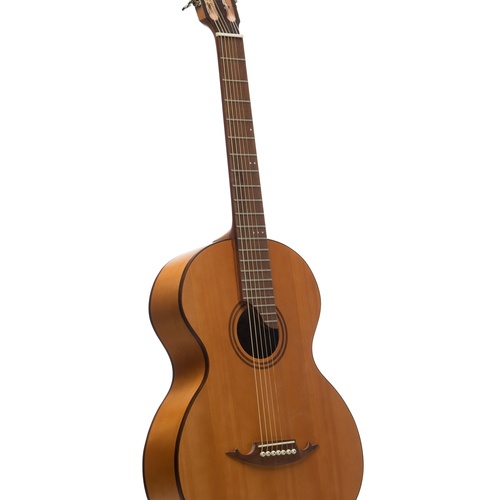
Creating this guitar, we tried to repeat the same sound as the antique seven-string guitar has. The museum Muller’s factory guitar of 1900 was taken as a basis. Of course, we did not just blindly copy the instrument; on the contrary, we tried to add some modern knowledge about the creation of the guitar. We have increased the size of the body to the classic dimensions, used contemporary cover, the rest was left the same as it was 110 years ago. We cannot say that we easily succeeded at once. The first two models we have just rejected, because there was not the same sound as the antique seven-string guitar has. Now, finally, after the half a year of experiments, in our opinion, we succeeded. For sure, the new guitar, we created, makes interesting impression. Only you can evaluate our results.

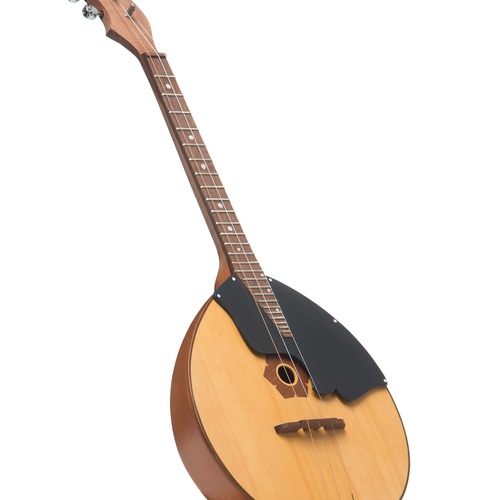
No one knew in XIX century No one knew about Domra Prima existence. Only in the end of century the first orchestra leader of Russian-folk instruments,
Musician explorer Vasily Andreev has done the most difficult painstaking work of restoration and improvement of Russian folk instruments.
Together with Semen Nalimov they developed the design of domra, based on the form and structure of unknown instrument with a hemispherical body, which was found by Andreev in 1896 in Vyatskaya province.
Historians still argue whether the instrument, which has found Andreev, was actually old domra or not. Nevertheless, the instrument was renovated in 1896 and was called "domra". The round body, the average length of the neck, three strings, quart system – it was the look of reconstructed domra.
Later, thanks to the closest Andreev’s associate, pianist and composer Nikolai Petrovich Fomin, domras family was created: piccolo, small, alto, bass, contrabass, which became part of the Russian Orchestra.

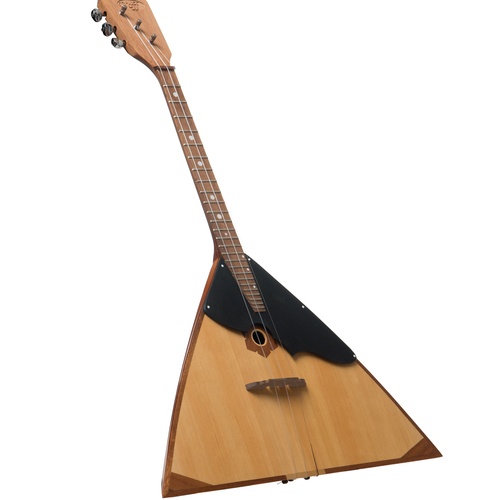
Balalaika is probably the most traditional Russian-folk instrument. Music school teachers were involved in the creation of the Model Doff BPS.
A definite point of view about the time of origin of the balalaika does not exist. It is believed that the balalaika became popular from the late seventeen century. Probably balalaika comes from the Asian dombra. Present-day view balalaika acquired with help of the musician and educator Vasiliy Andreev and masters V. Ivanov, Franz Paserbsky, Semen Nalimova and others.Andreev suggested making out a deck of spruce, and the back of the balalaika made of beech, and shorten (up to 600-700 mm). Made by Franz Paserbsky family of balalaikas (piccolo, prima, alto, tenor, bass, contrabass) became the basis of Russian folk orchestra. Later, patent for the invention of the balalaika, was received in Germany by Franz Paserbsky.
We also took into account all suggestions of musicians in regard to neck thickness and width, height of strings over neck and more other details for comfortable playing on the balalaika.
Our main idea was to create ideal instrument for students of music schools with good quality-price ratio. Doff Balalaika Prima School comes with wonderful bass, attack and beautiful sounding.
We hope that this instrument will give you quite a few pleasant hours of communication with music.

Model Doff RG - Russian seven-string guitar. Frankly speaking, we spent a lot of time to revive undeservedly forgotten Russian seven-string guitar. Going back to 2010 and seeing what kinds of seven-string guitars were presented in music stores, we were surprised to find out the Asian versions of seven-string guitar, where the seventh string was just added to the six strings, or very expensive professional instruments. In that moment we decided to return the original seven-string guitar with a body conscience silhouette, elegant tripod, typical layout of strings and of course the bolt-on neck (as in original instrument). The most interesting thing is that concurrently with the appearance of our guitars there was an increase of interest to seven-string guitars, to the ancient Russian romances, to the genuine Russian tones, and we hope there’s our merit as well.