Join music gear discussions on Equipboard. Talk about guitar gear, electronic music production, get help identifying gear, ask for feedback on your music, suggest ideas to improve Equipboard and more.

Guitar Recommendations?

her name's Yan-Pin'gelico

GEAR:
  • Roland Juno-6
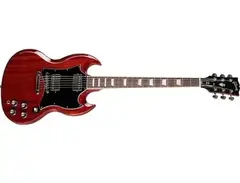
  • Gibson SG Standard
  • Vox AC30 Guitar Combo Amp

Haha, very funny. She's actually Indonesian but honestly, I don't care.

So I got my 11-54 strings on her and oh my does she roar, I'm really amazed at how powerful these humbuckers are. Tremolo is just a little bit loose, but it's not too much of a problem. Apparently coil-tapping is with a switch rather than a push-knob, but oh well. I'll say it again, she roars, and the sound is just fantastic, It's blowing my mind.

By the way, she's heavier than a Paul.

Edit: Not nearly as close to a D'Angelico, but quite regal anyways. Second, SHE'S FOREST GREEN, IT'S SO SUBTLE YET STUNNING!!!!11!11

welp, I translated to the wrong eastern language, shouldn't have gone with Mandarin I guess.

You are probably going to want to take about a 1/4 turn of relief out of the neck to hold up to the heavier string gauge. Maybe less, but I wouldn't do nothing with the truss when gauging up. The factory setup was probably with 10s or 9s. In the next couple of days I would expect the neck will bow in a little bit which may or may not effect playability.

far east humbuckers tend to be very high output for various reasons. They tend to wind them a bit hotter because they think that's what humbucker fans want. They also usually use poly insulated wire which seems to engender a little more output per wind. And you usually get ceramic, alnico 8 or (if you are lucky) alnico V, strong magnets that give more output than the ever popular A II.

Some pauls are heavier than others.There's literally no standard for a standard. In non-weight-relieved LP style guitars an ideal weight seems to be ight around 8.5 lbs, too much over 9 lbs seems to sound 'blocky' and lifeless. I would be surprised if she is heavier than 9.5 lbs. Its the rare paul type guitar that weighs more than that and most of the ones that are have multi-piece backs or are 70s pancake bodies (particularly the pancakes thata re more like sandwiches, with a sheet of maple between 2 slabs of mahogany). I used to own an '88 standard with completely traditional 50s type construction that weighed in right around 10 lbs. My silver one is barely 8.5 lbs but is not weight relieved (not that I'd care, I don't believe some subtle weight relief effects tone). Point is there's just no rule.

forest green... kinda gretschy with the bigsby... speaking of the bigsby, try replacing the spring to tighten it. Its a motorcycle part (or should be) and the length of the spring directly effects the response of the mechanism. I like a very big spring for stiff response (that sounds dirtier than it actually is).

you gonna get a picture of yourself playing it or what? do we have to beg?

GEAR:
  • Roland Juno-6
  • Gibson SG Standard
  • Vox AC30 Guitar Combo Amp

I will keep an eye on the neck, because I just played it today and only just realised how heavy these strings are. It's good, but maybe not for the neck. I wouldn't say these are too terribly high-output, but like I said, they certainly roar.

http://i.imgur.com/k9V5lot.jpg

Yes, as you can see, this was shot with a potato. It's called an iPhone 4s. Yes, I look like an idiot, I'm tired and no one is in the house that can take a photograph of me playing. The guitar itself looks sort of grey and black, but look at it in the light and it's a sort of slate green.

As for spring, I saw that. Never got to look more closely. It feels fine, but perhaps a tighter spring would work better.

well, unless the neck profile is slim I would expect she can handle 11 gauge strings, you just might want to tighten the truss a 1/4 turn in the next couple of days and then reset the intonation.... in the long term, the main problem I see with LP type guitars running 11s or 12s is that the modern hardware doesn't handle it as well as 60s and 50s hardware... the heavy strings tend to wear the saddles down and bend the center of the bridges, especially affordable copies... the guitars with thinner necks have tendency to twist under the wound strings too, but thick necks will easily take 12s or 13s... the LP design is from the era of heavy gauge flat wounds and the design should be stable under pretty heavy strings. Your worry is proper maintenance (more is needed with more tension) and also whether your hardware is up to the challenge. If your hardware takes a crap and you are really attached to 11+ gauges then call Callaham for a steel bridge/saddle and tail set... steel sounds really good in addition to being stronger than the zinc alloy you run into these days, the callaham stuff is stronger than vintage and clearer sounding to boot (if you like that)

nah, you don't look like an idiot, you and the Swede look sharp together in a Weezer sort of sense

GEAR:
  • Roland Juno-6
  • Gibson SG Standard
  • Vox AC30 Guitar Combo Amp

Weezer? I could do better.

It's been about a day and a half or more, and so far, still looks good on the neck. No visible curve of any sort. As for parts, I always heard of All Parts, but not Callaham... noted. Saddle on the list, just in case current hardware isn't working. Hella expensive for just one bridge and nail, so I expect quality must be up there. Odd that they don't list by parts, but rather by guitar... none of those are known for having Bigsby bridges. So I checked All Parts and found one spring for a good $9. Found another on Amazon that's a full inch. Interesting... probably going with a one inch or more if I get the chance.

You want to know something? Ever heard of the song Zentrifuge by Einstürzende Neubauten? It's on the third Strategies Against Architecture collection. I don't know how they do it, but I always had the imagination that perhaps that loud crushing and gravelling bass sound was really a bass with an extremely tight tremolo. I imagine he'd play one distorted note and push the tremolo arm down fast enough to play a few notes down to which the effect is a crushed and gnashing distortion sound. For some reason, I imagine that a tight tremolo pronounces the effect.

I'm probably wrong anyways, but hey, here's to imagination.

Edit: While I love this band, I'm constantly confused by how much material they have as well as some inconsistencies to the actual songs on the album in comparison to the colelctions. Case in point, which is a different version of Headcleaner.

the curve won't be visible, to measure neck relief you will need to capo at fret 14 and employ a set of feeler gauges while depressing various frets, primarily fret 1 on the high E strings... if you can spot the bow with your eyesthen its out of control and a serious problem.

allparts will be import stuff much like what you have.... the heavy duty bridges come from Callaham.... tonepros are a little better than stock as well, but I think they use vintage style aluminum, so you are not looking at stuff that will hold up under 11s and 12s FOREVER like milled steel.... different sound though, aluminum will be very retro whereas steel is very modern I guess... both Callaham and tonepros will SOUND better than what you have which is likely made from mostly zinc.... I personally do not bother changing parts with Gibsons though I should, but I play 10s across the board, so the resons for upgrading for me are just tonal.

1" springs will add a nice tension to a bigsby and make the arm feel nice and stiff.... I generally have used 1" in the past. If you intend to use it aggressively or subtley, 1" rules. Its a spring size that favors extremes. YMMV though

Its possible the sound in question is a bass guitar, EN sometimes uses a traditional bass or guitar (they do live), but many compositions have NO traditional instrument and there is no way to know. Headcleaner has like a dozen versions/movements.... don't question it, just enjoy. Personally I have been more of a "Silence is Sexy" guy these days, but I am getting old and afraid of loud pummeling jackhammer music.

GEAR:
  • Roland Juno-6
  • Gibson SG Standard
  • Vox AC30 Guitar Combo Amp

Odd, I still post here. Just a few things I noticed since I've never had a guitar with humbuckers and two volume knobs.

Switching to just one humbucker and turning down the volume all the way will still allow some sound from the opposite pickup to go through. As in, if I choose the neck and turn off the volume for the neck, the bridge still sneaks in just a bit of sound.

Something might be up with the electronics, a few times I noticed a problem that would easily be fixed by using the old Nintendo 64 trick for cables. One moment, I'm in the middle position and turning down the neck volume cause all the volume to go away, and immediately switching to the bridge causes the volume to suddenly swell (think turning on a tube amp, when it heats up and the volume swells to normal).

Odd...

Also, let me tell you it is so damn scary and amazing to go from one to two volume AND tone knobs. Middle position has so many options!

quality far east components. Gut it and rebuild the internals.

the volume swell is really weird... I wonder if they put a cap on the switch to prevent clicking/popping or something. You might need to do that with some on-on-on 3 way designs that aren't like the Gibson and fender switches. Why you wouldn't just use the traditional switch though is beyond me. A no-name switch like that is cheap.

GEAR:
  • Roland Juno-6
  • Gibson SG Standard
  • Vox AC30 Guitar Combo Amp

Gut it and rebuild the internals.

You say this like I have the time, money, and knowledge to perform such a delicate operation on such beautiful and fragile instrument!

Okay, but in all seriousness, It's not causing problems, It's just odd occurrences that will be dealt with. Once I have the know-how, I'm pretty sure I'll rip out her organs and have everything replaced. Heart surgery for the modern guitar!

wiring an LP is SOOOO easy.... a tele or LP is most guitarists' first project... though yours has a coil tap, but still super easy... and cheap too, you just need a decent switch, four 500k CTS pots and a pair of caps, some people are finicky, but even ceramic discs (which cost a few cents each) sound fine if you don't do a lot with your tone control.... oh and some solid core, cloth covered wire (maybe 2 bucks cost).... total cost for basic, serviceable parts will be about 30 bucks I would guess

here's how I do my gibsons: http://www.throbak.com/uploads/2/6/7/4/26749242/_7083654_orig.jpg

I vary between the early 50s and 59 ground scheme based on the guitar though it doesn't seem to make any difference! But even in my fenders I wire my tone caps and pots this way, it sounds better to me. Even my fenders are rewired with 50s Gibson wiring instead of stock Fender style wiring.

I would lose the coil tap personally, its not that cool... it will never sound like a fender single because of the bar magnet versus fender's polepiece rod magnets, and its never going to be a P90 because of the dimensions of the coil - its a leftover 80s thing from when dimarzio's early super distortions were called "dual sounds" because of the 'innovative' 4 conductor wiring. Coil tapping is like cloning dinosaurs, in the 80s people were "so concerned with whether they could they didn't stop to think about whether they should." I have tapping on my washburn and carvin, its just okay.... I never use it.... I am thinking about ditching it on the washburn in favor of new pots (I used the old electronics when I swapped the stock 80s super distortions for the Duncan set I made because they were good enough, but non pushpull pots always seem to have better taper with buckers to me)

GEAR:
  • Roland Juno-6
  • Gibson SG Standard
  • Vox AC30 Guitar Combo Amp

Personally, I really like the coil-tap, in fact I have a slight preference to a tapped humbucker over the regular sound. Even if I wanted to lose it, that'd leave a tiny hole in the guitar where the switch used to be. If I could have it covered in some way, I suppose I could remove, and replace tone pots with these. 500 kilohms and the DDPT switch just like a Fender S-1. Then, replace the regular volume pots with the 500 kilohm taper pots.

Few questions (because I'd do the research myself, but you already know and I'm heading to work right now). First, what determines the set value for pots on certain pickups? I'm wondering because 500k seems the standard for humbuckers, while 250k is standard for single coils.

Second, are you saying these pots are NOT 500k or that they are low quality 500k pots? I'm sure it's the latter, but one can never be too sure.

If you prefer the tapped sound then you like low wind single coils with a bar magnet and got the wrong guitar. But I think a good set of PAF or filtertron style style buckers that are more in the single coil range of output would totally change your tune. Your guitar would probably play well with a pair of Lollar's Lollartron pickups that are Gretsch style in a Gibson case/mounting. Either that or maybe go Neil Young and put a firebird pickup at the bridge and put something P90ish at the neck like a Fralin P92. But I digress. If I were wiring our guitar I would put a phase switch in place of the coil tap to avoid the gaping hole. You could repurpose the existing switch for the job and it will work with a 2 conductor pickup.

1) Gibson and Fender determined the values for their pickups. Even Gibson single coils always got 500k whereas Fender used 250k until the 70s when they started experimenting a bit with really high values like 1meg. The higher the value the more treble it passes when wide open. A 250K pot loads the treble more than a 500K. Fender pickups are inherently brighter than Gibsons because of the magnet placement so Leo went low to smooth the top a bit. A lot of modern Gibsons and Gibson style guitars have 300K. Gibson experimented with lower values on certain guitars values in the 70s and gauged down to 300k some time in the 80s or 90s just to split the difference. Recently Gibson has started using 500k againin some of their nonhistoric models, but not consistently. Some of my Gibsons came with 500k and some 300k or 350k. No rhyme or reason at all. Its a mystery. A lot of far east sub-contractors build both Gibson and Fnder styled guitars so they only use 300k pots in their guitars to split the difference between the 2 camps and save on costs. Some old Japanese guitars have really wonky pot values, others are historically accurate in every detail right down to the Sprague caps! As a rule an LP style guitar with alnico humbuckers of low to medium output will sound most right to the most people with 500k pots across the board but YMMV.

2) Your guitar may have anything from 250k to 1meg, who can say?! Even if Hagstrom specced for one type of pot there is no guarantee the factory they contracted in Indonesia slavishly followed Hagstrom's instructions.Buying pots without markings helps these subcontractors to fool the big guitar companies who hire them by keeping their parts cost way down. Its just cheaper to buy 10 million 300k pots than 5 million 250k and 5 million 500k.... but I promise you that the pots are not of stellar quality. I tend to like CTS and Bourns pots though the feel is different on both when adjusting. I can tolerate Alphas but I have definitely broken them before, they do make a lot of good options in switching pots though at a VERY good price compared to CTS. Bourns just started doing high quality push-pulls but I've not tried them. I have CTS in most of my guitars, Alpha push-push pots in my strat and I tried the bourns pots in my SG if I recall. All these guitars sound better than stock and the controls are easier to adjust accurately while playing. In my opinion CTS upcharge heavily for the name and the look (they were Fender's vintage pot of choice and they still make the vintage model that looks the part in a fender cavity for sticklers... my esquire came with 250k CTS "dish" pots and if I replaced all the caps with some PIO or tropical fish type ones it would look vintage inside, but who cares). You could also experiement with a lower bridge value and higher neck to better balance the treble response of your 2 pickups. 300 to 500K bridge and 750 k or 1meg neck? I have been considering doing a 1meg on the neck pickup of my silver Les Paul to make the neck chimier and more usable for non-jazz playing... its a good sounding pickup, but once I have an amp setup for a good bridge crunch tone using the hot and bright Duncan Hybrid in the bridge the Burstbucker at the neck sounds a bit dull and boom thru those settings.... I digress

don't buy the Warmoth pots, they are not so hot. Better than what you have but not the best taper and a stiff throw when turning them quickly while performing. I tend to order my parts from Mauser in bulk (which is why I have spare Bourns pots sitting arund, Mauser stopped carrying CTS if I recall). Or if I am not buying just to keep my stock up I will purchase the exact parts I need for a project from a guitar only vendor with the stuff I want. For switching pots and such I tend to look at GFS as they have great deals on Alpha pots and little toggled and sliders. I have also dealt with Specialty Guitar and Mojotone.

Feel free to ask more questions about the magical world of guitar guts. I took the day off today and have no specific plans (I actually might do some soldering later, heh... I am thinking of modding my fuzzface for more treble and clearer bass, the Hendrix sound is okay, but mushy with Gibsons)

here's a wiring scheme I think will be ideal for your guitar if you are dead set on keeping the stock pickups: http://www.skguitar.com/SKGS/sk/Images/diagrams/CoilSel_phase.jpg

different push/pull combinations control which coil you have active and you can flip the phase on one of the pickups regardless of which coil(s) are active, so you have access to every possible tone but neck and bridge in series and humbucker in parallel.

I can't find a good wiring diagram for 2 standard 1 way coil taps, 2 phases and a master parallel/series switch so I will have to draw you one if you are interested. That will get you every tone known to man but parallel wired humbucking which is highly overrated though it produces a REALLY pronounced strat-type quack if you are into that.

GEAR:
  • Roland Juno-6
  • Gibson SG Standard
  • Vox AC30 Guitar Combo Amp

Jesus, Jim, that's quite a bit of text.

I've been thinking about it and honestly, I do like the 'buckers, but I can experiment later. Wiring is something that can be done sooner and it make sense to have everything upgraded. On account of the phase switch, it seems to be a good alternative, but if we're doing that, then must go ALL THE WAY! SIX WAY TOGGLE! BLEND SWITCH!

But seriously, a phase would be nice to really get less bass and add some treble. So let's run down the list and take stock:

Pickups into two 500 kilohm push-push pot and two 500 kilohm audio taper pot, into phase switch and three-way toggle, right to the jack. That' discounting different wiring methods, of course.

Okay... I'd form questions, but I just realised that perhaps we should make a new thread with more opinions, or just stay here?

for a lot of versatility but easiest wiring just do 2 push pull 500k audio tapers on the volumes for coil taps, then do 2x 300k pots for tones so you have a little smoothing when tapping coils.... the phase switch I would stick on whatever pickup is closest to it to keep the wire run as short as possible. Looks like neck pickup?! You could probably just clean up the stock switch and use it for phase.

GEAR:
  • Roland Juno-6
  • Gibson SG Standard
  • Vox AC30 Guitar Combo Amp

Clean up? Then I suppose the stock switch isn't so bad, but perhaps it wouldn't hurt to get a new one in higher quality? I'll think on it.

Off-topic, but does it hurt to be trying different tunings on one guitar? Like, say I tune from standard to Open C and back, does that hurt an acoustic guitar neck at all?

1) just get a new switch that's right for the job, forget I said anything about reusing the old coil tap. Its probably the only acceptable component in the thing, but its a pain to desolder a mini toggle switch.

2) Alternate tunings are fine as long as you are not going very far UP from standard on the wound strings strings.... when going DOWN you may even want to gauge up from 11. They make special mixed gauges for drop tuning guys now. Look up Mastodon's methods, they pull the drop tunings off well. But for open tonings for lside, the preffered one for electric guitar is typically open G with the E as a D or removed. Keith Richards anyone?

GEAR:
  • Roland Juno-6
  • Gibson SG Standard
  • Vox AC30 Guitar Combo Amp

Very busy week, but still thinking about this and something just came up today.

Fiddling around with Boss RC-3, switched to neck pickup, NOTHING. Hardly any sound. I've been trying to fix it, then, suddenly, turn off delay and reverb, and IT RETURNS.

I think Indonesia screwed up with the wiring somewhere... I'll make a purchase soon, but I'd rather do it Friday, paycheck comes in then.

EDIT: It works, then suddenly stopped. Tried plugging straight into the amp, it works. None of my pedals are in bad condition, and they never had this problem with the telecaster...

could be related to your pedals if turning off the delay helped.... lots of stuff means more places for breakdown....

GEAR:
  • Roland Juno-6
  • Gibson SG Standard
  • Vox AC30 Guitar Combo Amp

Like I said, it never had this problem before, and it only fixed itself once when the delay was turned off. Next moment, delay did nothing, everything is fine... Very odd, I hope it is something to do with the wiring.