
mattlefevers's Reviews
7 reviews Back to mattlefevers's Equipboard

284
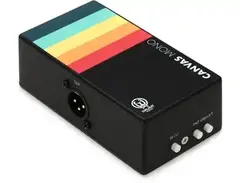
A versatile and useful DI
I've been waiting for more companies to enter the line-isolator space. Only a few intrepid builders have figured out there is a huge market for DI boxes that don't lower your signal down to mic level, only help preserve it at line level until it can reach the sound board. Walrus, as far as I can tell, is the second one to take a crack at this, so I was an early adopter.
I love that this is switchable between DI and LI modes. The technical difference between these is boring and perhaps a bit beyond my knowledge set anyway, but where a classic DI lowers your signal down to mic level and sends it to the sound board, a line isolator keeps the hotter, line level signal while still providing the other benefits of a DI box (balanced cable, conversion to XLR, protection from phantom power). But the signal the sound board receives is much hotter, and you therefore don't have to compensate by cranking up the input gain on that end.
I will point out that almost the entire live sound industry is still using DI's, so if you pick up something like this make sure to have a chat with any sound guy you're working with, since they are likely expecting that quieter, mic level signal. But the great thing about this having a DI mode is if you needed to you could always switch it back down.
The intended use for this is to allow guitar modelers like Walrus's own ACS1 or the Strymon Iridium to send direct signal to a sound tech, but I could see it being useful for keyboards and other things as well.
I docked a star only because I am a bit suspicious of the durability. My Radial DI is build like an iron brick, and by comparison the Canvas feels very dainty and light. The buttons on the outside are also quite delicate. I wouldn't throw this in a gear bag loose, without keeping the box it came in to protect it a bit. I think it's meant to be mounted onto a pedalboard like a guitar pedal, though, and in that case it'd be fine. I just like my DI boxes to feel like a river stone that I could hurl at an oncoming enemy if needed.
-s.webp?v=1784127430)
284
The best all-around octave pedal
I'm embarrassed, because the Micro POG was my first octave pedal, and I then embarked on a seven or eight pedal quest to find something better, only to have to re buy this one again at the end. It really is the winner.
The tracking is impressive and clean, even on chords and strange intervals. Dissonant chords or minor second intervals, which are usually the bane of octave pedals, even track well on this one.
The sound of the lower octave is pretty good, and if you needed to 'fake' a bass signal by pitching down a guitar, this is the octave pedal I'd choose. The high octave is a bit obnoxious on its own, but I don't think anybody really plays the high octave by itself. Mixed in with the dry signal at ten or eleven o'clock, it sounds perfectly good.
Do yourself a favor and skip the seven or so other octave pedals I tried before having to re-purchase this one again, and just start here.
Preferred Settings + Usage:
I basically always have this set with Dry all the way up, Low all the way down, and High at about ten o'clock.
284
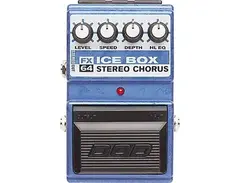
Honestly terrific
I've been playing guitar for twenty-five years and have gone through hundreds of pedals at this point, but I recently got nostalgic for the first pedal I ever owned. It was a DOD Ice Box that my twelve-year-old self bought at Guitar Center and held onto for a few years, then must've sold or gotten rid of (I honestly don't even remember). So for Christmas my wife tracked one of these down and gave it to me, and I was thrilled. I loved seeing it again after all that time, and having it around made me happy.
But let's be real: I had a Boss Waza Craft CE-2w on my board already, one of the best and most iconic chorus pedals money can buy. What was I gonna do, shoot it out against a strange nostalgia artifact from the '90s and then decide which was better?
Then I did that, and here's the surprise: the Ice Box won.
The secret weapon of this DOD chorus is the high end knob, which on mine is called "Freeze" because DOD couldn't just name any knob a clear or comprehensible name back then. With this knob at noon or higher, the chorus effect is very bright and cold and sparkly. It's perfect for that chilly Metallica's "Sanitarium" tone or so many other clean parts from metal songs. But it's also lovely for strummy, ringing chords with open notes, like '80s pop or the modern pop that is currently borrowing from it. Both of those are tones the CE-2w really can't manage, with its warm and gritty tone. But if you roll that Freeze/Hi-EQ knob back, the Ice Box can do the warm subtle thing, too. So that's Ice Box 1, boutique Waza Craft pedal 0.
The other thing that pushed it over the edge is that the Ice Box sounds like it's maintaining a clean blend as well — the whole time I was using it, no matter how rich and lush I made the chorus signal, I could clearly hear my guitar's natural tone as well. The CE-2w has no blend knob, and wherever I set the controls, it substantially changes my guitar's tone, and not always for the better. Ice Box 2, CE-2w 0.
I know this is ultimately a preference thing, and if you want your chorus sounds warm and thick and almost flanger-y, you can't do better than the expensive Boss one. But in a head to head comparison I kept preferring the shimmery high end and clarity of the Ice Box, and how my normal guitar tone still carried through. I'm frankly shocked but that's where I landed.
Preferred Settings + Usage:
It sounds basic but all the knobs at noon turned out to be just the sound I wanted. Then lower the Freeze/Hi-EQ back to ten o'clock or so for a darker, subtler chorus if needed.
284
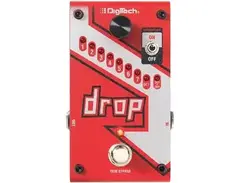
It's the best available, but that bar is pretty low
Right off the bat, I should say the Drop pedal performed much better than the EHX Pitch Fork, the most similar pedal I could find to compare it to. The Pitch Fork was rife with audio artifacts, adding weird metallic high end and making my entire guitar signal sound like a poorly compressed mp3 file. The Drop, by comparison, is quite clean and free of strange artifacts.
Unfortunately, the biggest issue with it is that it removes quite a lot of treble from your signal, especially the lower you drop tune down. At even three semitones down, my guitar sounds dull and lifeless. If you have a pedal later on in the chain that has EQ adjustments, you can sometimes compensate by boosting the highs later on -- and it's definitely less noticeable going into a heavy distortion than it is clean -- but it's by far the most irritating down side of this pedal.
If you can live with the loss of brightness, everything else about this actually works quite well. The tracking is great, none of the glitchiness I've run into with some octave pedals. The build quality is good, and ease-of-use couldn't be better: one knob, one switch, and then a momentary mode that is fun to mess with but I haven't used much in real life.
It's staying on my board for now, if only because the convenience of the thing is hard to argue with. When a song gets thrown at you in Eb or F# or some key that is * almost * a convenient guitar key, rather than re-voicing all the riffs and losing all your open strings, you smash this guy on and play in E or G voicings to your heart's content. Also, throwing your standard tuned guitar down to C-standard and shredding some metal riffs is fun every time.
284
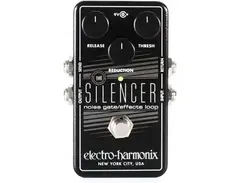
Surprisingly great
This was a pretty affordable noise gate, so I honestly expected to have to temper my expectations here. But I've had it for some years now, and have absolutely no complaints. The gate closes in a natural way, where I never hear it cutting off my sustain or anything. And as long as I keep the threshold in the right place, it doesn't trim off my quiet playing either. (I have noticed I need to adjust the Threshold when I switch guitars. The place it needs to be for my noisy P-90 pickups will cut off other guitars too high.)
And it's very small, so I was able to mount it underneath my pedalboard and never have to look at or think about it too much again after that.
284
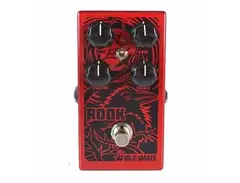
My favorite drive, after years of searching
I adore this pedal. I've made a twenty-five minute YouTube video just talking about how much I love this pedal.
I've been happy with my clean tone for quite a long time, but the search for a good medium-gain overdrive has been grueling. I've been through bluesbreakers (multiple), tube screamers (multiple), distortions, $30 Boss drives, rare boutique drives you have to order from the builder... none of it clicked for me. Then I found out about this guy and gave it a shot and everything changed.
It's got the thickness of a tube screamer but without subtracting all of your low and high end. It can do just a hint of grit, or all the way up to hardcore and metal distortion. It sounds good stacked into stuff; with stuff stacked into it. The EQ knobs have so spoiled me that I don't think I'll ever buy a drive that doesn't have both a bass and treble EQ now. I can't believe I got by for so long on drives with only a single "tone" knob.
No exaggeration, I've legitimately considered buying two of them, one for lower gain and one for higher, and just setting them up next to each other. I adore this drive.
Preferred Settings + Usage:
My preferred toggle position for most things is the upwards one, though the down toggle (higher gain) is great for hardcore punk. I boost the bass and treble up to, say, one or two o'clock, and the drive similarly.
284
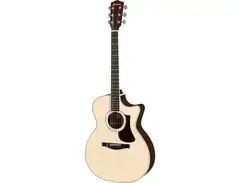
Gorgeous handcrafted guitar for an unbelievable value
I've been playing the same entry level acoustic guitar for sixteen years, and finally decided to make the jump to a pro quality one. I had my eye set firmly on a Taylor, something like a 314ce, but was open to other brands. After trying out a number of guitars at different stores, my local shop steered me over to the Eastman AC422ce. I played it for a while, compared it carefully to a Taylor and a Martin at the same store, then drove home and spent the next month thinking about it obsessively before finally buying it.
This guitar is a work of art. It looks absolutely stunning, both at first sight and the more time you spend inspecting the little details, like its clean white binding and the ebony bridge pins. It's clear that care and attention went into everything, down to the smallest piece of hardware.
Sound-wise, it has a crisp high end, but also a degree of warmth, and much more projection than my cheaper laminate guitar. The neck is comfortable and it's a joy to play. The Fishman pickup sounds great live, I've gigged with it a few times now and it needs a lot less post-processing than my cheaper guitars did.
In terms of body woods, specifications, measurements, and details, this guitar is functionally identical to a Taylor 414ce, but for much less than half the price. I had barely even heard of Eastman before and they certainly weren't on my radar when trying out guitars, so I am immeasurably grateful to the employee at my shop that handed me this one.