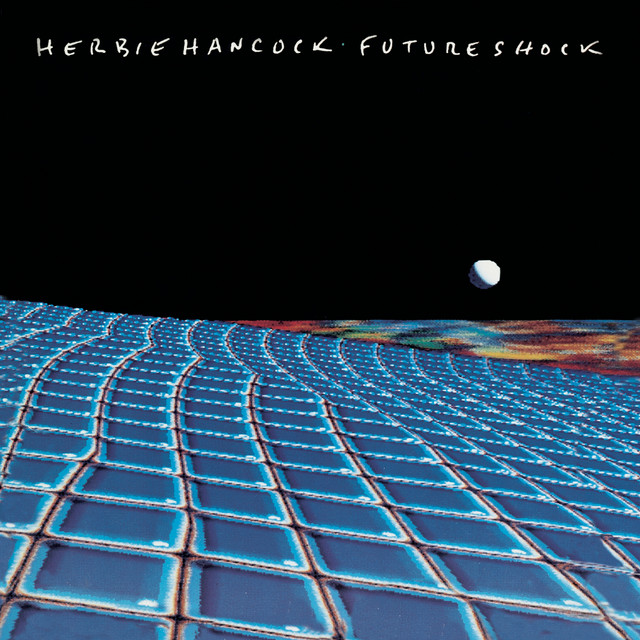
Herbie Hancock – Future Shock
The music gear and equipment used by the artists, producers, engineers, and more involved in the making of the 1983 album Future Shock.
Music from Future Shock
Artists on Future Shock
-

Roles:
Groups:
Artists United Against Apartheid Miles Davis Quintet Various Artists for Children's Promise The Headhunters The Rockit Band Future 2 Future Artists United for Nature Orquestra Was Bahia Black The Herbie Hancock Sextet The Herbie Hancock Quintet The Herbie Hancock Quartet The Herbie Hancock Trio V.S.O.P. Herbie Hancock (band) Herbie Hancock & Chick Corea Herbie Hancock & John McLaughlinProducer -

-

Gear Used On Future Shock
Explore the instruments, equipment, software, and production tools used in the making of Herbie Hancock – Future Shock (1983). Click more on each item to see exactly how it was used.
Keyboards and Synthesizers used by Herbie Hancock on Future Shock

Avg price: $11,702.37
In the YouTube video "I Love Quincy," Herbie Hancock can be seen using the Fender Rhodes Chroma synthesizer. Additionally, the liner notes of his album "Future Shock" and other albums mention this instrument, highlighting its significance in his work.


Used on "Rockit", as specified in Herbie Hancock’s Electronic Instrument Glossary from September 14, 2016. It features in a 1983 Sesame Street episode and this excerpt of I Love Quincy at 0:09 and 0:34. Clive Smith gives the story of its acquisition in this August 4, 2019 For the love of the Fairlight interview.
Herbie Hancock’s Electronic Instrument Glossary
Fairlight CMI – This digital sampling synthesizer, released in 1979, was the first digital sampler of its kind and offered complete synthesis and editing of sampled sounds. Herbie used this on the tune “Rockit” for the album Future Shock in 1983.
Clive Smith Interview
Because of Liquid Sky, the US branche of the Fairlight company asked if he would work for them. He left PASS and became one of their consultants, from 1983 ’till about 1989. Clive: ”That was incredibly great. I had access to the equipment, I promoted their product doing demos, and I was doing session work on the side.” So, how did he end up with Herbie Hancock on Sesame Street? Clive: ”Alexander Williams, he did sort of what I was doing, on the West Coast. When Herbie Hancock purchased his Fairlight, he had Will training him on how to use the machine. When he wanted to capture his ideas, in a session, on the fly, Will was able to help him out with the technical side. When Herbie visited the East Coast, I kind of did the same thing for him. Will and I knew each other, and it turned out Herbie and I had some mutual friends. So, that worked out nicely. I think, if I remember correctly, Herbie didn’t travel with his Fairlight, so he used mine for the Sesame Street-session. The show went pretty much as shown; the children were very excited about this new technology. Just like the kids are today. We didn’t do anything different. That clip was pretty much the entire take. People were always very curious about it. And It’s very inviting; something that looked like a ‘60’s tv-screen, a bit of a retro sci-fi-look, a huge white keyboard, playing melodies with barking dogs… It looked accessible, more ‘friendly’ and less intimidating than a modular synth with patch chords, knobs and sliders.”
“I’m really glad I got the opportunity to work with Herbie Hancock. Up until then, I never realised what an amazing musician he is. It was great to see the ideas running in his brain, coming out. Always, his first ideas were immediately great. Watching him listening to a musical piece he’d never heard before and then, coming up with this great keyboard part. Very enlightening to see. And he’s a very nice, very friendly down to earth kinda person. You know, formally trained musicians often want to play tunes on a synth using their keyboard technique. Herbie, he was very open to coming up with interesting sounds, being Interested in things that had some internal movement on the things he was playing. I think, that’s what we have in common: having this split personality between being a trained musician, using structured forms, and being able to work with textures, creating sounds, the approach a non-musician might have. The more creative approach by just going in and thinking: ’What would i like to happen?’.


Used for "Rough", as specified in Herbie Hancock’s Electronic Instrument Glossary from September 14, 2016.
alphaSyntauri – A digital, polyphonic synthesizer released in 1980. It was the first electronic instrument to be based off a home computer and also resembled one. Herbie used this instrument on the 1983 album Future Shock for the tune “Rough.”

Avg price: $8,900.00
Used on "Future Shock", as specified in Herbie Hancock’s Electronic Instrument Glossary from September 14, 2016.
Memorymoog – This polyphonic synthesizer was first made in 1982 and offered greater preset storage capacity and better sound than its competitors. This instrument was used by Herbie on the tune “Future Shock” for the album of the same name.
-m.webp?v=1784337427)
Used on "Earth Beat", as specified in Herbie Hancock’s Electronic Instrument Glossary from September 14, 2016.
Yamaha CE-20 – A digital synthesizer released in 1982 that featured fourteen preset monophonic sounds and six preset polyphonic sounds. This was used by Herbie on the tune “Earth Beat” for his 1983 album Future Shock.

Used on "Earth Beat", as specified in Herbie Hancock’s Electronic Instrument Glossary from September 14, 2016.
Yamaha GS-1 – Yamaha’s first digital polyphonic synthesizer, released in 1981, included features such as velocity sensitivity and three band equalizer. This was used by Herbie on the tune “Earth Beat” for his 1983 album Future Shock.
Studio Equipment used by Herbie Hancock on Future Shock

Avg price: $1,950.00
Was used on "Future Shock" album (1983), according to Herbie Hancock’s Electronic Instrument Glossary (2016-09 from liner notes of 2013):
Oberheim DMX – A programmable, digital drum machine released in 1981 that featured 24 individual drum sounds and eight-sound polyphony. Michael Beinhorn used this instrument on the 1983 album Future Shock.