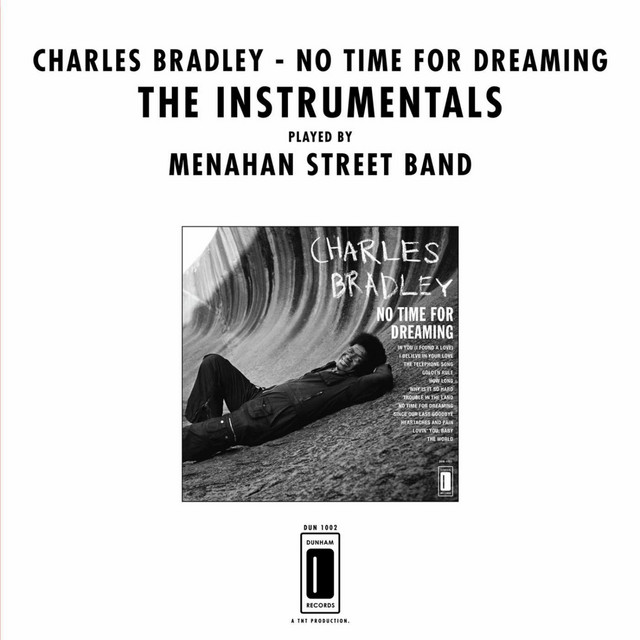
Menahan Street Band & Charles Bradley – No Time for Dreaming (The Instrumentals)
The music gear and equipment used by the artists, producers, engineers, and more involved in the making of the 2011 album No Time for Dreaming (The Instrumentals).
Music from No Time for Dreaming (The Instrumentals)


Gear Used On No Time for Dreaming (The Instrumentals)
Explore the instruments, equipment, software, and production tools used in the making of Menahan Street Band & Charles Bradley – No Time for Dreaming (The Instrumentals) (2011). Click more on each item to see exactly how it was used.
Microphones used by Thomas Brenneck on No Time for Dreaming (The Instrumentals)

Avg price: $126.71
Used for practically everything on Charles Bradley's No Time For Dreaming and Menahan Street Band's Make the Road by Walking, as mentioned by producer Thomas Brenneck in this October 11, 2016 Electronic Musician article.
“When I first started making records, all I had was a Shure 565—an older version of the SM57. I made two records using only that microphone: Charles Bradley’s first record, No Time for Dreaming, and Menahan Street Band’s first record, Make the Road by Walking. I had literally bought these microphones really cheap on tour, and went home and made those records on an 8-track in my apartment. And then I mixed them at Daptone [Studios]. People like Mark Ronson would ask me, ‘Man, how did you get those drum sounds?’ I was like, ‘Well... [Laughs] one mic and a half-inch 8-track.’ With the limited gear that we had, we couldn’t do anything fancy. So it was really about capturing a great performance.”


Avg price: $112.64
Used on Charles Bradley's No Time for Dreaming, as mentioned in this March 15, 2011 Electronic Musician article.
High-octane performances are at the heart of Bradley’s long-overdue debut album, No Time For Dreaming (Dunham, 2011). Started in 2005 in Brenneck’s former bedroom studio, the album is a reverent throwback to the days of Muscle Shoals, Stax, and Studio One, when entire bands would cram into a room with just a couple of microphones—in this case, Brenneck’s own six-piece Menahan Street Band, with only a Shure SM54 and an SM57 going into a TASCAM 12-channel mixer—and lay down a barrage of rhythm tracks that were bounced, squeezed, and compressed to make room on the tape for the wailing lead and background vocals.


Used on Charles Bradley's No Time for Dreaming, as mentioned in this March 15, 2011 Electronic Musician article.
High-octane performances are at the heart of Bradley’s long-overdue debut album, No Time For Dreaming (Dunham, 2011). Started in 2005 in Brenneck’s former bedroom studio, the album is a reverent throwback to the days of Muscle Shoals, Stax, and Studio One, when entire bands would cram into a room with just a couple of microphones—in this case, Brenneck’s own six-piece Menahan Street Band, with only a Shure SM54 and an SM57 going into a TASCAM 12-channel mixer—and lay down a barrage of rhythm tracks that were bounced, squeezed, and compressed to make room on the tape for the wailing lead and background vocals.

-m.webp?v=1785236411)
Avg price: $101.95
Mentioned and visible in this January 26, 2021 Instagram post.
It was nothing short of magic recording what would become Charles Bradley’s debut album No Time For Dreaming in a bedroom on 250 Menahan street many years ago. It’s hard to believe it’s been 10 years since it’s release. I had set up a humble recording situation consisting of a 1/2” 8 track tape machine and an sm58. For years in between tours with Sharon, Budos, El Michels, Lee, Amy, etc I would record as much music as possible at the crib. At some point I invited Charles over and played him what would become Menahan Street Bands debut Make The Road By Walking. He loved the music which meant the world to me and instantly asked if he could sing on it.
True story: The first time he came to that apartment i played him the instrumental of The World Going Up In Flames. He immediately asked for a mic and started singing. Within the hour we recorded the vocals to it. After that he would come back once or twice a month to share stories of his life which we would turn into songs.

Guitars used by Thomas Brenneck on No Time for Dreaming (The Instrumentals)
Semi-Hollowbody Electric Guitars

Avg price: $1,100.00
Used on Charles Bradley's No Time for Dreaming (as mentioned by Brenneck in this March 15, 2011 Electronic Musician interview) and with The Budos Band, as is visible in this Dec 13, 2011 documentary by Daptone Records. A photo of Brenneck with the guitar can also be seen in this Reverb.com feature about Daptone's House of Soul at 3:00.
“Some of these tracks have the crunchiest organ and Rhodes sounds,” Brenneck explains, “because they were getting bounced with the guitar [a ’66 Harmony H74 through a ’68 Ampeg Gemini amp], and of course every time you bounce, you get another generation of tape compression. You don’t really need outboard gear when you do that, and you can end up with some really tough-sounding shit. Then you’ve got Bradley and the horn players just pinning the needles with tape distortion; there’s no way I’m gonna record it again if what they just did is magic. It’s all about commitment and hard work beforehand, and I think the sound just comes naturally as a result of that.”
Amplifiers used by Thomas Brenneck on No Time for Dreaming (The Instrumentals)
-m.webp?v=1785164550)
Avg price: $570.00
The in-house G-12 at Daptone's House of Soul was used for Charles Bradley's No Time for Dreaming, as mentioned by Brenneck in this March 15, 2011 Electronic Musician interview.
“Some of these tracks have the crunchiest organ and Rhodes sounds,” Brenneck explains, “because they were getting bounced with the guitar [a ’66 Harmony H74 through a ’68 Ampeg Gemini amp], and of course every time you bounce, you get another generation of tape compression. You don’t really need outboard gear when you do that, and you can end up with some really tough-sounding shit. Then you’ve got Bradley and the horn players just pinning the needles with tape distortion; there’s no way I’m gonna record it again if what they just did is magic. It’s all about commitment and hard work beforehand, and I think the sound just comes naturally as a result of that.”
The specification of a G-12 is made in this November 1, 2007 Electronic Musician article by Daptone founder Gabriel Roth (a.k.a Bosco Mann), who describes how he acquired it.
Ampeg Gemini G-12 guitar amp: “About 10 years ago, I was walking down the street on my way to the studio,” Roth says, “and as I passed a building that was being demolished, I felt a bang against my leg. They were gutting the building and one guy was throwing all the garbage out the door over the sidewalk to another guy on the street who was tossing it into a dumpster. That Gemini is what hit me in the leg on its way to the dumpster. How's that for fate? Didn't even need to repair it.”