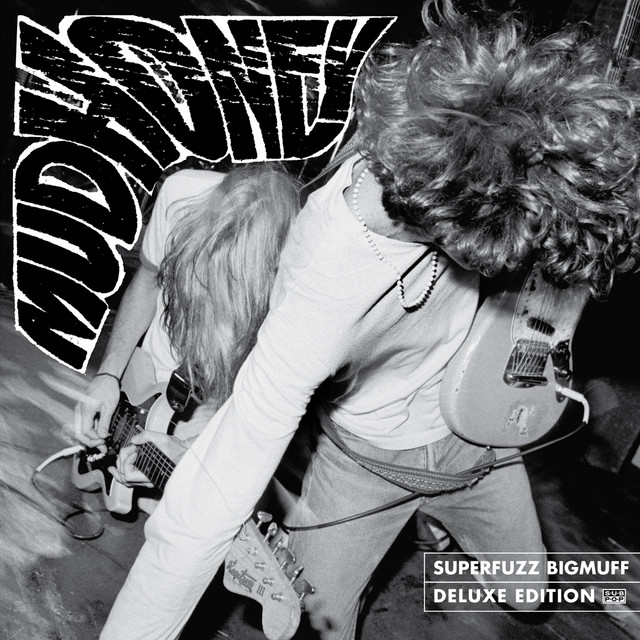
Mudhoney – Superfuzz Bigmuff (Deluxe Edition)
The music gear and equipment used by the artists, producers, engineers, and more involved in the making of the 1988 album Superfuzz Bigmuff (Deluxe Edition).
Music from Superfuzz Bigmuff (Deluxe Edition)
Artists on Superfuzz Bigmuff (Deluxe Edition)
Gear Used On Superfuzz Bigmuff (Deluxe Edition)
Explore the instruments, equipment, software, and production tools used in the making of Mudhoney – Superfuzz Bigmuff (Deluxe Edition) (1988). Click more on each item to see exactly how it was used.

Matt Lukin
Roles:
Amplifiers used by Matt Lukin on Superfuzz Bigmuff (Deluxe Edition)

Acoustic control corporation 270 Amplifier Head
Matt Lukin used an Acoustic Control Corporation 270 Amplifier Head throughout his tenure with the Melvins and during the early years of Mudhoney, as evidenced by an image on Equipboard, the head is behind him in the amp stack.


Bass Guitars used by Matt Lukin on Superfuzz Bigmuff (Deluxe Edition)

Avg price: $1,285.37
Matt Lukin is used a 1970s Fender Precision Bass in both Mudhoney and Melvins. Originally a stock Sunburst P Bass with a Maple Fretboard, then the Pickguard was painted White and Red. When he was thrown out of the Melvins and joined Mudhoney, the P Bass returned was painted Sonic Blue to match Mark Arm and Steve Turners Guitar and was given a Black Pickguard and later a Middle Finger sticker was put on. In 2015 at the Sonic’s Show at Easy Street the P Bass Returned now back in a Sunburst finished, but with the black pickguard.


Steve Turner
Roles:
Effects Pedals used by Steve Turner on Superfuzz Bigmuff (Deluxe Edition)

Electro-Harmonix Big Muff Pi V6
Avg price: $280.00
Turner's first Big Muff Pi. It is specified in Stompbox: 100 Pedals of the World's Greatest Guitarists and this November 1, 2018 Premier Guitar interview. Along with the Univox Super-Fuzz, it was the namesake of Superfuzz Bigmuff, which Turner reflects upon in this September 6, 2018 Vice interview. It is also visible in this May 2, 2007 photo and this excerpt of Live At El Sol at 5:08, which show that the original knobs were later replaced. According to this October 13, 2017 Red Bull Music Academy interview, the pedal was irreparably damaged when a van ran over it. The remains became part of the collection of the Museum of Pop Culture.
Maximumrockandroll, August 1990 (as archived on this Open Computing Facility fan page)
MRR: And you use the Big Muff.
Steve: Yeah. Fuck! I just got a Mosrite Fuzz Rite which is what Davie Allan of Davie Allan and The Arrows used.
Guitar Player, February 1992 (as archived on this Open Computing Facility fan page)
Turner and Arm don't break stylistic stride with their pedal choices either. "We use a lot of different fuzz boxes. On the road I use a Big Muff, a wah-wah pedal, and a Memphis distortion box, which looks like an MXR. I've never paid more than $15 for one - they break easily, but they're cheap."
Excerpt from I'M NOW: The Story of Mudhoney (at 0:39)
By the time that Mudhoney started, I was playin' the Big Muff 'cause it had more of that sustain, kinda like Blue Cheer, Stooges kinda thing going, and so Mark used the Super-Fuzz.
Red Bull Music Academy
“The Big Muff...has permanent status in guitar lore and gear,” says Steve Turner, guitarist of Seattle grunge trailblazers Mudhoney, who immortalized the pedal in the title of their 1988 debut EP Superfuzz Bigmuff. “It’s gonna be one of those boxes everyone has to know about if you get into guitars. You’re gonna know about the Big Muff. I mean there’s just so many clones of it...it’s everywhere.” (Turner’s original Big Muff, which was run over by a van after a show, now sits in Seattle’s Experience Music Project Museum).
Vice
How important were those two titular pedals to the sound of the record?
I think they were very important. We only named it that because it was a bad pun. But the pedals were a big deal. Me discovered the Fuzzbox was a big deal. Mark had already loved feedback and fuzz. At the time I was so into the Stooges, Blue Cheer, and some of Neil Young’s guitar sounds, not to mention the mid-80s post-hardcore stuff like ANTi-SEEN, Pussy Galore, and Drunks With Guns, which was some really ugly stuff. Those two pedals really were the basis for our sound: Mark on the Superfuzz and me on the Big Muff.
Premier Guitar
You guys are obviously huge fuzz connoisseurs—you named your debut album after the two you just mentioned, Steve—but it’s interesting that the Nano Muff remains your favorite at a time when there are so many painstaking boutique clones of vintage fuzzes fetching pretty serious money.
Turner: I’m kind of trying to get the sound of my original Big Muff. The one I used on all of the earlier records is one of the last production Big Muffs, I think. I got it new in 1984 on closeout. Going off memory and feel, to me the Nano sounds the most like that.
Stompbox: 100 Pedals of the World's Greatest Guitarists (2020)
"I bought my first one brand new in 1984, most likely at Seattle's American Music store," Mudhoney guitarist Steve Turner recalls of the latter pedal. "I'd heard it was supposed to be cool—probably from [Pearl Jam/Green River guitarist] Stone Gossard, who I was in high school with at the time. Now, Stone was a metalhead then, and I was a punk, but mostly what appealed to us, as with most of Mudhoney's gear, is that it was cheap. Hard to imagine today, but there was literally a huge pile of them for $35 each. I should've bought them all. It turned out mine was the very last of the original run, and Electro-Harmonix discontinued it shortly afterward."