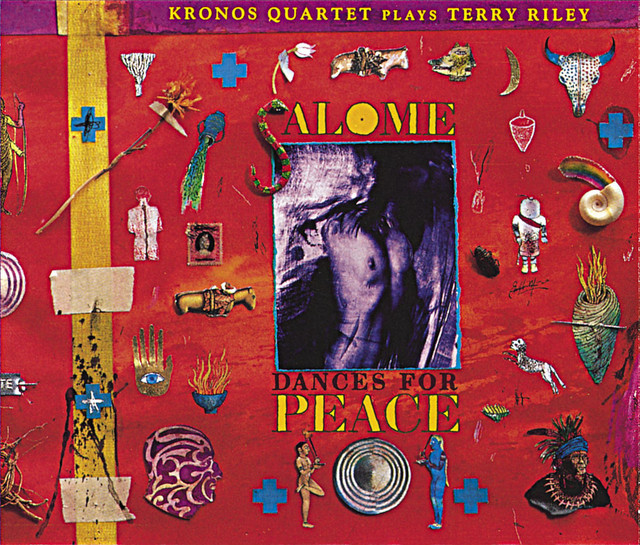
Terry Riley – Salome Dances for Peace
The music gear and equipment used by the artists, producers, engineers, and more involved in the making of the 1989 album Salome Dances for Peace.
Music from Salome Dances for Peace
Artists on Salome Dances for Peace


Gear Used On Salome Dances for Peace
Explore the instruments, equipment, software, and production tools used in the making of Terry Riley – Salome Dances for Peace (1989). Click more on each item to see exactly how it was used.

Terry Riley
Roles:
Keyboards and Synthesizers used by Terry Riley on Salome Dances for Peace

Korg Triton Studio 88 Workstation
Avg price: $299.00
Terry Riley selected by the London Times as one of the 1,000 ‘makers of the 20th century’ is regarded as the father of the minimalist movement with his “IN C” from 1964, which set the stage for the New Age movement. He is also recognized for bringing Eastern Indian music to Western audiences beginning in the ’70s.
Riley, the third of the three cooperative founders, spends half the year working in his Camptonville home studio and the other half touring. He writes for film, chamber, orchestral, jazz, rock and world music ensembles. In the last 23 years, Riley has produced 15 major works for the Kronos Quartet.
Riley’s “Salome Dances for Peace” (1989) was selected as the No. 1 classical album of the year by USA Today and nominated for a Grammy. His “Cadenza on the Night Plain” (1985) was chosen by Time and Newsweek as one of the 10 best classical albums of the year. The song “Baba O’Riley” on the “Who’s Next” CD honors Riley and the late Indian mystic Meher Baba.
A new version of Riley’s “A Rainbow in Curved Air” from 1968 using a Vox Continental Combo Organ, Baldwin electronic Harpsichord and Rocksichord (an early electronic keyboard), dubec and tambourine will be performed Monday.
The updated “A Rainbow in Curved Air” featuring modern technology, original sections and new sections switches from Western scales to scales Riley recently created with Eastern music influences.
This time, Riley will play a Korg Studio Triton 88 and Mikail Graham will play keyboards and percussion, and mix components from both versions.


