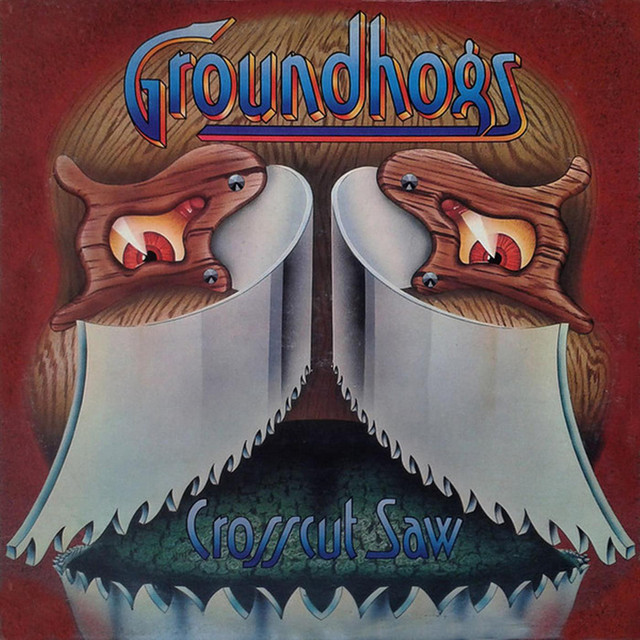
The Groundhogs – Crosscut Saw
The music gear and equipment used by the artists, producers, engineers, and more involved in the making of the 1976 album Crosscut Saw.
Music from Crosscut Saw
Artists on Crosscut Saw

Gear Used On Crosscut Saw
Explore the instruments, equipment, software, and production tools used in the making of The Groundhogs – Crosscut Saw (1976). Click more on each item to see exactly how it was used.
Studio Equipment used by Tony McPhee on Crosscut Saw

Used live, on Solid and on Crosscut Saw. By June 1978, it was being used to boost his Guild amp.
Ca. 1973 photo of McPhee on stage (pictured), via Easy on the Eye, "Tony McPhee & The Groundhogs" (April 2013)
https://easyontheeye2.wordpress.com/wp-content/uploads/2013/04/tony-ts-mcphee.jpg
Tony TS McPhee with The Groundhogs, photographed on stage at the Sheffield City Hall.
Effects using:
A Synthi Hi-Fli, Audio Design Phaser, Vari-Pitch Revox
1974 footage of The Groundhogs performing "Light My Light" at The Marquee (visible; prominent at 2:46)
Beat, March 1976, "Tony McPhee: The Hogs Return" by Chris Simmons, pg. 25
Amps
In the amplification department, Tony is still undecided as to what he will use for the gigs. "I used to have a big Laney cabinet, and I'll probably end up using that. I have been in the studio with a Davoli amp (with a 15" speaker) which is great for straight things, but as soon as I put my Hi-Fli through it it just breaks up. Perhaps I'll end up driving the Davoli through the Laney cab, but I'll have to experiment more fully first. Actually, the real problem is not amplifying the guitar but my synthesizer.
Distort
"You need a system that won't distort the sound and still has enough poke behind it to carry. On certain gigs you will find that the set-up you have is perfect and on others you will hate it. Then, another problem is that I need a whole lot of top as I use my fingers instead of a pick. Recording is obviously a different bag; I use a pick in the studio to pick out definite notes clearly. It doesn't matter on stage but when you use your fingers some notes are a little down on others. Anyway, if one note's a bummer so what? The main thing is feel."
One might guess that with his penchant for sound experimentation, Tony supplements his guitar with various effect units, but surprisingly he sticks to his Hi-Fli and Echoplex only. He explained his feelings. "The Hi-Fli is a pretty underrated instrument — I've seen a lot for sale secondhand which means that people buy them and then get rid of them. The Echoplex I find very versatile, and that's what appeals to me particularly. What I really want is an amp to handle all the different sounds properly. Earlier on I was trying out a system using either an HH or JBL 2x15 cabinet, with Gauss speakers, and little Eagle tweeters for top. The amp was 100 watt HH. This was ideal for some things but once again it was quite difficult to get a straight sustain."
Beat Instrumental, June 1978, "Don't Mention the Gr**ndh*gs! says Tony 'T.S.' McPhee. Peter Douglas apologises" by Peter Douglas, pg. 18
In line with this begin-all-over-again approach Tony has ditched a lot of the equipment he accumulated with the old band through some remains. "I'm still using the EMS Hi-Fi, mainly because I use it as a power supply. Let me explain: when this band got together, I thought right — I still had the Laney cabinets and all that sort of stuff I used to use — you can't walk into a pub with that stuff. So I thought I'd look around for some smaller gear. I'd got a fifty watt Marshall, but I found that was too loud — I couldn't get it to scream without It deafening everybody. Anyway, I was round at a friend's house and he brought out this amplifier — it was an old Guild, circa 1960 I should think. He said it didn't seem to work, and I didn't have any tools with me at the time, so I couldn't look inside it.
He told me he'd had a bit of an accident with it — he'd plugged it in and smoke had poured out of the back. Apparently there was a fuse missing and they'd forgotten it was a 110 volt amplifier. It had never been changed from the American voltage. So I walked off with it, bought myself another transformer and a few resistors, stuck 'em all in, and it worked fine. It's the sort of amp where the inputs are marked 'organ' or 'accordian'!
"I took the speaker out, 'cause I blew it. Anyway, it was obviously quite low sensitivity, so I knew I'd have to have to put something in front of it to wind it up. Now for some time I'd been using a transmitter/receiver, and that boosts the signal up a bit, but with the receiver it was always awkward to know exactly where to stick it. So I stuck the receiver on the pole of the Hi-Fli and plugged it into the Hi-Fli using the power supply. And the Hi-Fli boosted the signal up a bit more so I can get a raw sound at quite a low volume. I just plug it in, turn it right up, and away it goes."
Paul Freestone, January 25, 2014 comment on Easy on the Eye, "Tony McPhee & The Groundhogs"
I think this was taken on 30th Nov 1973, during the band’s ‘Soldier’ tour. The effects unit behind TS is the EMS Hi-Fli, which he was using for the first time at these gigs. All details of line-ups, equipment, gigs, etc, are included in my book about Tony McPhee – ‘Eccentric Man: A Biography & Discography of Tony (TS) McPhee’.


Avg price: $16.50
The first Cadac console ever made, which was designed for Morgan Studios before heading to Majestic Studios, was purchased by McPhee in 1973 after the recording of Hogwash. It was used for Solid, Crosscut Saw and Black Diamond.
Recorded on 3M 8 track with Cadac desk and Ampex stereo machine.
Beat Instrumental, November 1974, "Home Studios: Tony McPhee" by Del Robinson, pgs. 28-29 (pictured)
Tony certainly has plenty of opportunity to develop his engineering now. For a start, the centrepiece of the crowded control room is the Cadac 8-track desk, which he bought second-hand from Majestic Studios in Clapham. 'It can be converted very easily to 16.' This is the second desk Tony's installed in his home studio. 'I did a deal with De Lane Lea, before they became Kingsway Recorders, and bought about £5,500 worth of gear, which was the basis of a complete studio.
'I used the original desk to do my solo album, but it didn't have the advantage of pan pots, so when this one came up I decided to take it. I've ordered an Ampex 16-track recording machine which I should be getting very soon.'
Beat, March 1976, "Tony McPhee: The Hogs Return" by Chris Simmons, pg. 24 (pictured)
Rock's Backpages audio, "AUDIO: The Groundhogs' Tony McPhee (1997)" by John Tobler (@ 53:38)
Tony "T.S." McPhee: So, by that time, I'd got equipment, 'cause my idea was it's cheaper to buy the equipment. Then you can, from that point, you can have as many albums as you'd like. Yeah.
John Tobler: Yeah. You mean recording it?
McPhee: Recording from it, yeah.
Tobler: Okay.
McPhee: So I actually bought out De Lane Lea... a eight-track,
Tobler: Yeah.
McPhee: which is what we did Thank Christ and Split on.
Tobler: Oh.
McPhee: And other assorted bits and pieces. And so, from that point on, I did my own albums. We did— I did Solid out there. [...] and built out to a sixteen-track. So, Solid was eight-track and then, uh... yeah, Crosscut Saw and Black Diamond were both on sixteen.
www.philsbook.com, "Majestic Recording Studios"
There were some differences of opinion about Newells acoustic design and choice of equipment so engineer David Hadfield from Maximum Sound studios was brought in as a consultant. He convinced Collier to abandon Philip Newell's ides and that he should basically start again with the studio. Eddie Veale was commissioned to sort out the acoustics; Hadfield contacted Clive Green who had just set up the Cadac company about the possibility of supplying a console. Clive Green was about to deliver a new console to Morgan Studios to replace their original Cadac, one of the very first desks built by Clive Green.
So when the studio finally opened commercially it was equipped with the Cadac 16:8 (with 3 built in Pye compressors) and an 8-track Ampex tape machine.
[...]
Trident B
In April 1973 Majestic went 16 track installing a Trident B desk.
"Majestic studios in Clapham had a Trident B Range desk. It was one of the earliest B Ranges ( John Kongos had the first one in his studio in Mortlake, Saturn Sound in Worthing had the second one ( clad in blue formica..) My friend Dougal and I wired the console frame (for Majestic). When I went down there to do some sort of mod shortly after it was installed, the engineer was Roger Wilkinson - and he played me the 2-track of Jimmy Helms "I'm Gonna Make You an Offer You Can't Refuse" which had recently been recorded there, so that would make it 1973". Gwyn Mathias.
The Morgan Cadac desk was put up for sale and bought by Tony McPhee of The Groundhogs for his home studio.