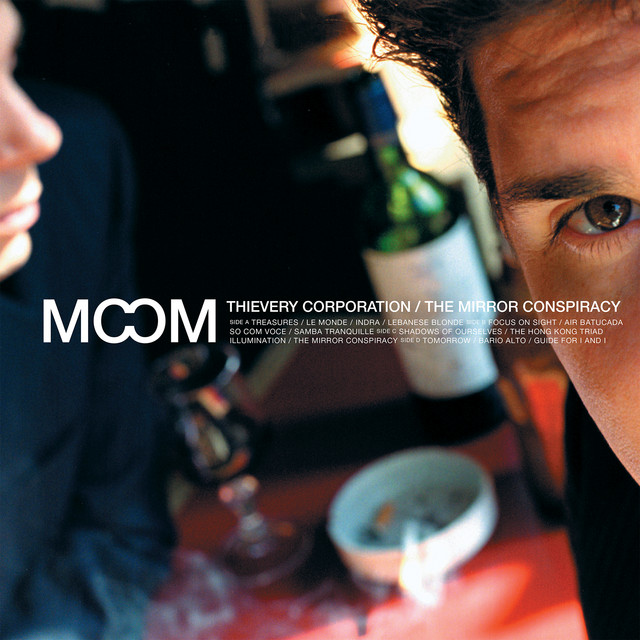
Thievery Corporation – Mirror Conspiracy
The music gear and equipment used by the artists, producers, engineers, and more involved in the making of the 2000 album Mirror Conspiracy.
Music from Mirror Conspiracy
Artists on Mirror Conspiracy
Gear Used On Mirror Conspiracy
Explore the instruments, equipment, software, and production tools used in the making of Thievery Corporation – Mirror Conspiracy (2000). Click more on each item to see exactly how it was used.

Rob Garza
Roles:
Keyboards and Synthesizers used by Rob Garza on Mirror Conspiracy

Avg price: $3,991.00
Used for Sounds from the Thievery Hi-Fi and The Mirror Conspiracy, as stated by bandmate Eric Hilton in this May 15, 2017 Music Radar interview.
Why did you adopt electronic music rather than just using acoustic instruments?
“It’s the power of the sampler … You can sample sounds like kicks and snares, chop up beats and make your own beats. That’s what gave birth to our music from the very get go. We were using an Akai MPC3000 as our main brain when we made our first two records and a couple of other workstations back then, which were keyboards that had samplers built in. Our music was heavily sample based, and that was exciting, and it’s still exciting to use snippets of things and treat them in a certain way.”
What workstation were you using?
“The Ensoniq ASR-10, which was like our tape machine because it had 270 seconds of mono sampling time. When we recorded a vocal, we would record it onto DAT and bounce pieces of it onto the keys of the ASR-10 and then the Akai would trigger the different keys in a sequence. That’s how we taped, which is kind of incredible – we’d store the vocals on floppy discs. The saddest thing is that my ASR-10 start-up disk is broken.”
(...) Did you combine gear with Rob initially?
“We did. Both of us had limited gear, but together it was enough. I think I only had the ASR-10, a turntable and a bunch of records. Rob had the Akai and I can’t remember what we used for monitors at the beginning; it wasn’t anything special. Eventually we bought a pair of the cheapest Tannoys, which we still use today as our main reference monitors because we know and trust them so well. We set up a studio in a friend’s bedroom and used that for a few weeks and made two songs. We hit it off and really liked working together, so we moved into what was, basically, the liquor room of Eighteenth Street Lounge – a club I’d started with some friends. Then we found a studio space right next to the lounge and rented that out for about ten years.”


Eric Hilton
Roles:
Studio Equipment used by Eric Hilton on Mirror Conspiracy
-m.webp?v=1783349871)
Avg price: $298.54
Used for Sounds from the Thievery Hi-Fi and The Mirror Conspiracy, as stated in this May 15, 2017 Music Radar interview.
Why did you adopt electronic music rather than just using acoustic instruments?
“It’s the power of the sampler … You can sample sounds like kicks and snares, chop up beats and make your own beats. That’s what gave birth to our music from the very get go. We were using an Akai MPC3000 as our main brain when we made our first two records and a couple of other workstations back then, which were keyboards that had samplers built in. Our music was heavily sample based, and that was exciting, and it’s still exciting to use snippets of things and treat them in a certain way.”
What workstation were you using?
“The Ensoniq ASR-10, which was like our tape machine because it had 270 seconds of mono sampling time. When we recorded a vocal, we would record it onto DAT and bounce pieces of it onto the keys of the ASR-10 and then the Akai would trigger the different keys in a sequence. That’s how we taped, which is kind of incredible – we’d store the vocals on floppy discs. The saddest thing is that my ASR-10 start-up disk is broken.”
(...) Did you combine gear with Rob initially?
“We did. Both of us had limited gear, but together it was enough. I think I only had the ASR-10, a turntable and a bunch of records. Rob had the Akai and I can’t remember what we used for monitors at the beginning; it wasn’t anything special. Eventually we bought a pair of the cheapest Tannoys, which we still use today as our main reference monitors because we know and trust them so well. We set up a studio in a friend’s bedroom and used that for a few weeks and made two songs. We hit it off and really liked working together, so we moved into what was, basically, the liquor room of Eighteenth Street Lounge – a club I’d started with some friends. Then we found a studio space right next to the lounge and rented that out for about ten years.”