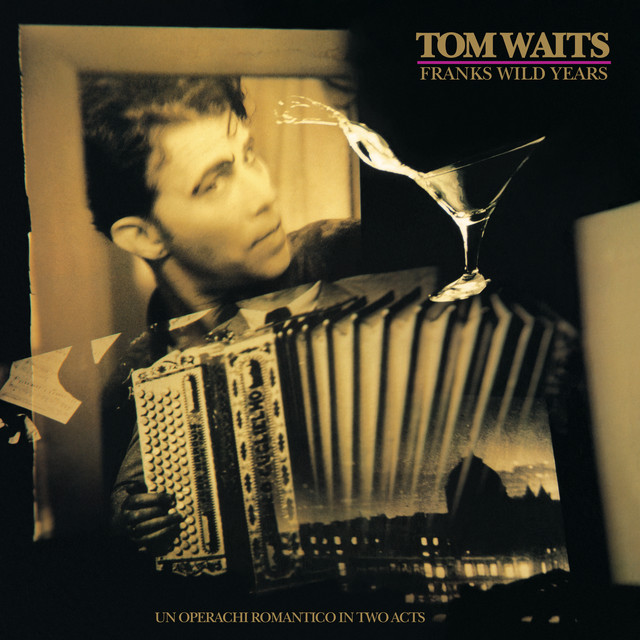
Tom Waits – Frank’s Wild Years (2023 Remaster)
The music gear and equipment used by the artists, producers, engineers, and more involved in the making of the 1987 album Frank’s Wild Years (2023 Remaster).
Music from Frank’s Wild Years (2023 Remaster)
Artists on Frank’s Wild Years (2023 Remaster)
Gear Used On Frank’s Wild Years (2023 Remaster)
Explore the instruments, equipment, software, and production tools used in the making of Tom Waits – Frank’s Wild Years (2023 Remaster) (1987). Click more on each item to see exactly how it was used.

Tom Waits
Roles:
Keyboards and Synthesizers used by Tom Waits on Frank’s Wild Years (2023 Remaster)

Used on "Earth Died Screaming", "The Ocean Doesn't Want Me", "In the Colosseum", "Crossroads", "The Last Rose of Summer", "Carnival", "Black Market Baby", "Everything You Can Think", "Reeperbahn", "Barcarolle", "Everything Goes to Hell", "Coney Island Baby" and "Starving in the Belly of a Whale", as documented extensively in this page from the website Tom Waits Library.
Derk Richardson (1992): One of the dinosaurs Waits reclaimed on Bone Machine is the Chamberlain, a pre-synthesizer keyboard that taps into analog tape loops of pre-recorded material. TW: "It's stunning, really, I have like 70 voices on the instrument, from horses to rain, laughter, thunder, seven or eight different trains, and then all the standard orchestral instruments. It's a good alternative if you don't like the sound of the more conventional state-of-the-art instruments - sometimes it's like they've had the air sucked out of them." (Source: "Composer, musician, performer, actor Tom Waits..." Pulse!: Derk Richardson. September, 1992)
Jim Jarmusch (1992): Explain the Chamberlain. The first keyboard sampling instrument. The Chamberlain 2000. TW: It's a 70-voice tape loop, it's a tape recorder, an elaborate tape recorder with a keyboard. JJ: What year was it made? TW: I think maybe '60, '61 or '62. Musicians were afraid it was gonna put 'em out of business, because it was too real. It was like, oh my god... And if somebody had one of these, why ever hire a band? It's too perfect... JJ: Yeah, but that's what they say about synthesizers now. And people would still rather hear the real instruments. TW: A lot of scores are done on a synthesizer. JJ: I like the Chamberlain because it sounds like it breathes somehow. Maybe it's the action of the keys that you once showed me that cause a delay, so that it changed the way you played. TW: It changes the physicality of your approach to the instrument, because the keyboard is not easy (to play). It goes down too far, your fingers get stuck down there and can't get back up. JJ: They were made in L.A.? TW: Yeah. By Richard Chamberlain. Not the actor (laughs). There's a bicycle chain in it, and if the tape gets on the other side of the chain it can damage the tape. Tchad Blake actually spent four or five hours working on it, repairing it. (That's why I say) there are no gamblers in 'Chamberlain Pass'. You get decorated for valor. It's like operating on a flamingo. You don't even know where the heart is, nothing. If you touch there, you know, the world will end. If you touch this tape here, I dunno, you may lose your hand. It has that kind of danger about it. JJ: How do you program tapes on it? TW: They just move to a different place on the tape. They give you about a 12-second sample that's the length of time it takes for the tape to move through the head, and give you about three feet of quarter-inch tape. JJ: You've got two of them, right? TW: I've got one Mellotron and one Chamberlain, and the Chamberlain I have is a prototype. So it's made with found electronic objects. JJ: How many were made? TW: Well, ultimately it was mass produced, and they were out there like Fender Rhodes, only on a much smaller scale. But they were marketed, advertised and sold in music stores, and they had displays, and everyone heard this name Chamberlain. JJ: Did you use it on 'Bone Machine'? TW: Only on two songs, on "The Earth Died Screaming" and "The Ocean Doesn't Want Me". JJ: What other stuff did you use it on previously? TW: I used it a lot on "Frank's Wild Years". (Source: "Tom Waits Meets Jim Jarmusch" Straight No Chaser magazine (UK) Vol. 1, Issue 20 Jim Jarmusch. October, 1992 (published early 1993))
Jim Jarmusch (1992): "You have a Mellotron, and of course, the Chamberlain 2000. TW: Ah, the Chamberlain. It has a full sound effects bank that's thrilling. It has the sound of Superman leaving the window. It has storms. It has wind, rain and thunder. There are three keys right next to each other. What I have is a prototype, so its got whatever he discovered. In fact on some of 'em even, at the end of the sample you hear, "Okay, that's enough." You hear the engineer. JJ: Seriously? Where did you find it? TW: I bought it from three surfers who lived in Westwood who had a full state of the art room filled with every current -- they had decambodeizers -- JJ: Deneutralizers. TW: They had the Tascam 299 with a 300 count back -- JJ: With a hertz shifter. TW: Yeah. JJ: Hooker Headers on it. TW: They were laughing at the Chamberlain. I would have none of it. JJ: Ridiculing it? TW: Ridiculing it. I said, "I will take this from you." I got it for three grand. JJ: They know who you were? TW: No. I was just a guy. They were playing it and laughing at all the sounds it made, and I let them laugh knowing it would soon be mine and I would treat it better. JJ: They probably laughed that you paid that much for it. TW: Yeah. JJ: Little did they know. But then, they'll never know. TW: They'll never know. It's got a variety of trains, it's a sound that I've become obsessed with, getting an orchestra to sound like a train, actual train sounds. I have a guy in Los Angeles who collected not only the sound of the Stinson band organ, which is a carnival organ that's in all the carousels, the sound from that we used on 'Night on Earth', but he also has pitched four octaves of train whistles so that I can play the train whistle organ, which sounds like a calliope. It's a great sound."(Source: "Tom Waits Meets Jim Jarmusch" Straight No Chaser magazine (UK) Vol. 1, Issue 20 Jim Jarmusch. October, 1992 (published early 1993))
Robert Palmer (1993): "Ever since his film score for Mr. Coppola's "One From the Heart" (1982) and his own ground-breaking album "Swordfishtrombones" (1983), he has been resolutely broadening his musical palette, gravitating toward odd instruments (including a wheezing old proto-synthesizer called the chamberlain and a percussive sound sculpture known as the conundrum) and sonic textures." (Source: "Tom Waits, All-Purpose Troubadour" Robert Palmer, The New York Times: November 14, 1993) Mark Richard (1994): "Yet here we are, in the control room where Mike Kloster, the second engineer, is patching in Waits' Chamberlain Music Master 600, a broken-lidded, organ-like contraption with over 70 sounds and voices on tape loops. Waits bought it from some surfers in Westwood who were making fun of the instrument. "I saw it and said, 'I'll take you home now, dear'," Waits recalls. Waits is hoping to coax a woman's voice from the machine, but its wooden pins and spinning chain-driven gears and tape loops are visibly dusty and brittle." (Source: "The music of chance" Spin Magazine: Mark Richard. June, 1994)
Tom Waits (1996): "In 1985, I answered an ad in The Recycler, and bought a Chamberlin Music Master 600from two teenage surfers in Westwood, California. The Chamberlin, created by Richard Chamberlin (not Dr. Kildare), is an early 60s analog synthesizer that stores all of its voices (over 60 in total) on tape loops, and with a series of pulleys and chains and springs plays an eleven second "memory" of prerecorded sound stored on the tape. Then a spring snaps it back to the beginning, and it's ready to play again. It's a keyboard instrument, and I believe I own one of the early prototypes, because the "preset" instrument menu is written in longhand. It contains some of the most haunting sounds I have ever encountered, including an operatic human voice (both male and female), Portamento trombone, pizzicato violin, chimes, gong, squeaking door, thunder and rain, train whistles and chugs, acoustic bass, cello, clarinet, applause and various birds and dogs. The Rube Goldberg mechanism inside is as fascinating as the curiously strange sounds it holds in its tape bank." (Source: "Sound Hound": Foreword by Tom Waits to Bart Hopkin's book/ CD: "Gravikords Whirlies & Pyrophones - Experimental Musical Instruments." Publisher: Ellipsis Arts. October, 1996)
NN: "I was just checking out your excellent Mellotron-related website when I came across the page about the Chamberlin Music Master. What a cool instrument. Tom Waits has a Music Master. Apparently he saw an ad in his local Recycler-type of paper and went to find out what this thing was. The previous owners were a couple of "surfer" types that would just turn the thing on a revel in the sound effects (there's a fireworks or FX tape on this one). Tom reportedly paid something like $400 for it. Tom uses it quite a bit! Most recently he put down some tracks using the Music Master's "vibraphone" sound, and you will probably hear it on Tom's releases in the Spring of 2002. Tom also has an M400 he likes very much, by the way." (Source: email as published on: Ken Leonard's Mellotron page. Subject: Music Master/Tom Waits Date: Wed, 2 Jan 2002 14:37:55 -0600)


Studio Equipment used by Tom Waits on Frank’s Wild Years (2023 Remaster)

Avg price: $1,700.00
Documented in this page from the website Tom Waits Library.
BF (1987): "Likening the sterile confines of the studio to an emergency ward, Waits seems intent on performing some very unorthodox operations. Take "Innocent When You Dream," which appears in two disguises on Frank's Wild Years. The "barroom version" puts across the melancholy melody (reminiscent of a mournful Irish drinking song) by way of pump organ, upright bass, violin and piano. A second version closes out side two, stripped down and scratched up enough to inspire visions of an ancient Victrola. Says Waits: "The '78 version' of that was originally recorded at home on a little cassette player ["the Tascam 244, the one with the clamshell holster"]. I sang into a seven-dollar microphone and saved the tape. Then I transferred that to 24-track and overdubbed Larry Taylor on upright, and then we mastered that. Texture is real important to me; it's like attaining grain or putting it a little out of focus. I don't like cleanliness. I like surface noise. It kind of becomes the glue of what you're doing sometimes."(Source: "Better Waits Than Ever" Music & Sound Output: Bill Forman. Vol. 7, No. 11. October, 1987)
BF (1987): "But don't expect '78 versions' of any of these new songs, for Waits' Tascarn four-track is gone, clamshell holster and all. "Stolen in New York," he shakes his head, suppressing a smile. "That's why I left - they beat me up." (Source: "Better Waits Than Ever" Music & Sound Output: Bill Forman. Vol. 7, No. 11. October, 1987)
Music Accessories used by Tom Waits on Frank’s Wild Years (2023 Remaster)

Documented extensively on this page from the website Tom Waits Library.
Tom Waits (1987): "When I finally discovered what a bullhorn can do to your whole sound, it was a big moment for me. I'd never sung through a bullhorn. I'd tried to get that effect in other ways. I tried cupping my hands, singing into tin cans, using those 7-dollar harmonica microphones, singing into pipes and there it was. A battery-operated bullhorn. Available at Radio Shack for $29.95." (Source: "From the set of Ironweed, Tom Waits talks with Rip Rense" New York Post: Rip Rense. Early 1987)
Tom Waits (1987): "Little opera line, there (Blow Wind Blow). Got a little carnival thing in it. Glockenspiel, pump organ. Used the bullhorn on it." (Source: "From the set of Ironweed, Tom Waits talks with Rip Rense" New York Post: Rip Rense. Early 1987)
Mark Rowland (1987): It's true you sang several of the new tunes through a police bullhorn? TW: "I've tried to simulate that sound in a variety of ways - singing into trumpet mutes, jars, my hands, pipes, different environments. But the bullhorn put me in the driver's seat. There's so much you can do to manipulate the image, so much technology at your beck and call. But still you gotta make choices. A lot of this stuff is 24-track; I finally allowed that and joined the twentieth century, at least in that regard." (Source: "Tom Waits is flying upside down (on purpose)" Musician: Mark Rowland. October, 1987)
Mark Rowland (1987): "The current apple of his musical arsenal, for instance, is a police bullhorn, through which Waits fashioned many of the vocals you hear on Frank's Wild Years. Not just any horn, of course, but an MP5 Fanon transistorized megaphone (with public address loudspeaker). "It's made in Taiwan," Waits adds proudly." (Source: "Tom Waits is flying upside down (on purpose)" Sidebar. Musician: Mark Rowland. October, 1987)
Bill Forman (1987): "Another innovation on Frank's Wild Years is the prevalence of the bullhorn, which Waits sings through on at least four cuts. TW: "Well, I tried to obtain that same sound in other ways, by using broken microphones, singing into tin cans, cupping my hands around the microphone, putting the vocal through an Auratone speaker, which is like a car radio speaker, and then miking that. Practically even considered at one point making a record and then broadcasting the record through like a radio station and then having it come out of the car and then mike the car ... and then it just became too complicated, you know? So a bullhorn seemed to be the answer to it all."(Source: "Better Waits Than Ever" Music & Sound Output: Bill Forman. Vol. 7, No. 11. October, 1987)
Tom Waits (1996): "Around 1982, my wife Kathleen encouraged me to try singing through a police bullhorn to make my voice stand out in relief when incorporated with instruments of the same color. Of course, it's possible to do the same thing with an equalizer, but nothing beats the drama of a bullhorn. My engineer Biff Dawes purchased me my first, and it was love at first sight -- I never record or tour without it. I also try to buy a new one every year, because they continue to "improve" upon them. I find the older 80s models (the Fanon is available at Radio Shack for about $29.95) superior; they're warmer to the ear. Also interesting to explore are the ones made for children, that can change a voice from monster to spaceman to robot. I found humming through them can give you a sound much like Blue Cheer's guitar sound on "Summertime Blues." In addition to these I also own a 1944 electric megaphone, issued by the Navy Bureau of Ships and made by the Guided Radio Corps of New York. The bell is 24 inches in diameter and it's battleship gray. If you want to feel "Federal", it's the one for you." (Source: "Sound Hound": Foreword by Tom Waits to Bart Hopkin's book/ CD: "Gravikords Whirlies & Pyrophones - Experimental Musical Instruments." Publisher: Ellipsis Arts. October, 1996)
Paul Tingen (2000): "Hitting a hotel room and recording this into a boombox, as Waits did, is clearly a low-fi approach, just as recording a group of musicians outside with an old shotgun mic is. Waits also sang a few things through an amplified megaphone on Chocolate Jesus, and through a two-foot long PVC pipe on Get Behind The Mule." (Source: "California Screamin'" Audiomedia magazine (UK), by Paul Tingen. February, 2000)