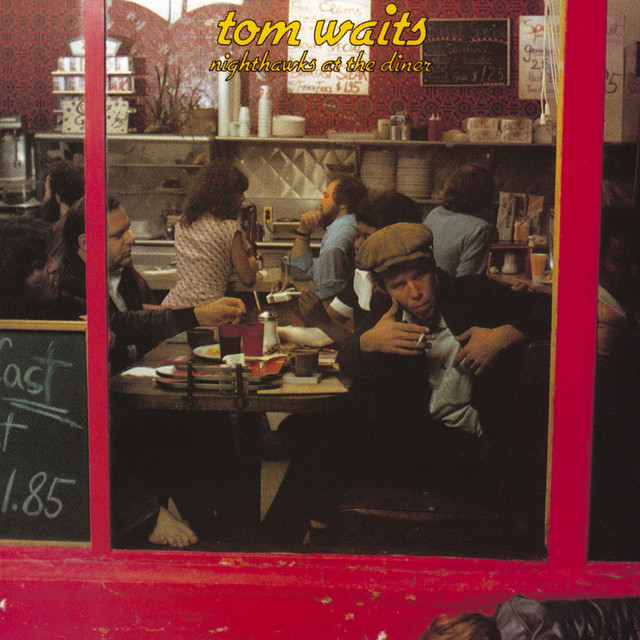
Tom Waits – Nighthawks At The Diner (Remastered)
The music gear and equipment used by the artists, producers, engineers, and more involved in the making of the 1975 album Nighthawks At The Diner (Remastered).
Music from Nighthawks At The Diner (Remastered)
Artists on Nighthawks At The Diner (Remastered)
Gear Used On Nighthawks At The Diner (Remastered)
Explore the instruments, equipment, software, and production tools used in the making of Tom Waits – Nighthawks At The Diner (Remastered) (1975). Click more on each item to see exactly how it was used.

Tom Waits
Roles:
Microphones used by Tom Waits on Nighthawks At The Diner (Remastered)

Avg price: $112.64
Used for vocals and piano on Nighthawks at the Diner, as stated by producer "Bones" Howe in this February 2004 Sound on Sound interview. The image shown from the interview is "Bones Howe's original layout diagram for the live recording that would become Nighthawks At The Diner."
For Waits' and Howe's first collaboration, it seemed logical to move up to the larger track configurations that were quickly becoming popular, and Heart Of Saturday Night and Nighthawks At The Diner, the first two albums they made together, in 1974 and 1975 respectively, were done on the 3M 16-track deck at Wally Heider's Studio 3. Nighthawks was an especially interesting project. (...) Howe used a similar microphone setup as for previous sessions, although he had to make a few exchanges based on what Record Plant had available those nights. Electro-voice RE16s replaced the Shures he was used to, and Howe set up a Shure SM57 for Waits's vocal. "It was easy to use as a hand microphone," he says. "I also had a RE16 for him to use if he wanted." Howe ran the 3M 16-track deck at 15ips. "I knew the high end sounded better at 30ips, but I didn't like how it emasculated the overall sound and thinned out the low end. All the jazz records I recorded I did at 15ips. I actually went from 15ips on tape right up to the moment I started working in digital."
An SM57 was later used for the electric guitar on Mule Variations, as stated by producer Jacques King in this interview from issue 9 of Audio Technology Magazine.
Acoustic guitars were miked with a Neumann KM84 or AKG 451, guitar amps were either a Shure SM57 or Sennheiser 421, bass amp with a Neumann U47, and acoustic bass with an Neumann M49, U47 or 582, routed via a Neve 2254 compressor.


Avg price: $219.99
Used for vocals and piano on Nighthawks at the Diner, as stated by producer "Bones" Howe in this February 2004 Sound on Sound interview.
For Waits' and Howe's first collaboration, it seemed logical to move up to the larger track configurations that were quickly becoming popular, and Heart Of Saturday Night and Nighthawks At The Diner, the first two albums they made together, in 1974 and 1975 respectively, were done on the 3M 16-track deck at Wally Heider's Studio 3. Nighthawks was an especially interesting project. (...) Howe used a similar microphone setup as for previous sessions, although he had to make a few exchanges based on what Record Plant had available those nights. Electro-voice RE16s replaced the Shures he was used to, and Howe set up a Shure SM57 for Waits's vocal. "It was easy to use as a hand microphone," he says. "I also had a RE16 for him to use if he wanted." Howe ran the 3M 16-track deck at 15ips. "I knew the high end sounded better at 30ips, but I didn't like how it emasculated the overall sound and thinned out the low end. All the jazz records I recorded I did at 15ips. I actually went from 15ips on tape right up to the moment I started working in digital."
The image shown from the interview is "Bones Howe's original layout diagram for the live recording that would become Nighthawks At The Diner."
