
Every rig tells a story. Start yours.
Catalog your gear, wishlist what's next, and share the setups behind your sound — free.
Create your EquipboardGear 20

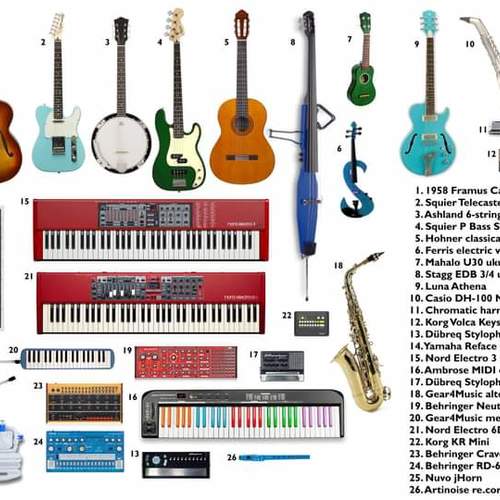
The Nord Electro 3 73 is a keyboard designed to accurately simulate the sounds of vintage electromechanical and electronic keyboards. It has a 73-key F-F semi-weighted keyboard with curved sharps and "waterfall" naturals similar to that found on a Hammond B3. It also has enough resistance and response to allow for expressive playing when using electric piano or Clavinet sounds. There are no synth-style performance controls - no pitch-bend or modulation facility, even via MIDI. But that's not what it's about.
The Electro's sounds are categorised into two sections; piano and organ. Only one sound can be used at a time.
Piano sounds include Fender Rhodes, Wurlitzer and Clavinet, all meticulously sampled to give the correct response. The Clavinet even has options corresponding to the D6's pickup and filter settings. Additionally, there are sections for acoustic upright and grand pianos, harpsichords and the rather vaguely-named "Samples". These include a wide range of Mellotron, synth and orchestral sounds which, along with alternative piano sounds can be downloaded from Nord's website for free.
The organ section uses digital modelling rather than sampling to generate the sounds of a Hammond B3, a Vox Super Continental and a Farfisa Compact Duo. The sounds can be modified in each case by a set of "drawbuttons" - each is a ladder of 9 LEDs with two buttons to "pull out" or "push in" the virtual drawbar. The Farfisa model uses the buttons as on-off switches rather than faders. The organ sounds can use two settings simultaneously via a keyboard split or an external lower MIDI keyboard.
There is a comprehensive set of digital effects including reverb and an equaliser. Arguably. the most important part of this section is the amp and speaker emulation which includes a very convincing Leslie simulator with adjustable overdrive and various speed options. It also has a "small speaker" setting designed to emulate the speakers on a Wurlitzer 200 electric piano and simulations of a Roland Jazz Chorus and a Fender Twin. This section can be used alongside two other effect sections, one offering tremolo, auto-pan, auto-wah, pedal wah or ring modulation, and the other providing phasing, flanging or chorus.
It's not cheap, but if you want access to a warehouse full of vintage keyboards, this ticks every box. Just remember - you're only allowed to use one instrument at a time!

I was looking for a 5-octave MIDI (not USB) keyboard to use as a lower organ manual for my Nord Electro 3 73 and also to control my Korg Volca Keys analogue synth. I saw the Ambrose keyboard on Ebay and couldn't believe the low price - nearly half the price of most other 5-octave MIDI keyboards. The brightly-coloured sharp keys (moulded, not painted) were an added bonus. The rear panel has a 5-pin DIN MIDI output, a USB port (which can actually be used to power it via any USB power supply), a 9v power input, two assignable pedal sockets and an on-off switch. The performance controls (all assignable) comprise a centre-sprung pitch-bend wheel, a modulation wheel, octave up and down buttons, an edit mode button, a slider and four continuous encoders, each of which can have two selectable functions. All assignment options are selected via the keyboard, with a handy guide printed above the keys. There are five velocity curves available, but no facility to completely disable MIDI velocity. Additionally, the keyboard has no memory, so you will need to reassign the controllers each time you use it.
For the price, you can't beat it. A fun, colourful and playable addition to any keyboard rig or studio.


I backed the re.corder as a Kickstarter project, so I was among the first to receive a production instrument.
The re.corder is a functional acoustic soprano recorder with embedded electronics that allow it to be used as a MIDI woodwind controller. It includes a mute plug that fits in the windway to silence its sound when used in MIDI mode.
The downloadable App (iOS or Android) is essential for configuring the re.corder. It also has learning and jamming facilities, and a dozen or so sampled sounds that you can play.
Connectivity is strictly via Bluetooth MIDI - the micro-USB port is only used for charging the battery (which allows many hours of play, and several days' standby).
Within the App, you can configure breath response, select from a number of fingering schemes ranging from recorder to trumpet, or create your own.
You can also configure MIDI CCs and response curves for breath pressure and three accelerometer axes - inclination, rotation and "z-axis". Breath pressure can also be sent as Channel Aftertouch. There is no facility for pitch-bend.
All parameters can be saved to the instrument, so you can then quit the App and connect to a DAW or a hardware synth.
The latter will require an extra piece of hardware, namely a Bluetooth-MIDI receiver such as CME's WIDI Master.
I got the re.corder to replace my Casio DH-100 Digital Horn, which I had used since the 1980s. The re.corder is smaller, lighter, easier to blow, and has more options for expression than the Casio, as well as being highly configurable.
The re.corder is the most affordable and portable MIDI wind controller on the market, and more versatile than its nearest rivals. Thoroughly recommended.
Wishlist 3
Gear Photos 1

Top artists 4
The artists butterfingersbeck has added the most gear to.


