
h_pr's Reviews
27 reviews Back to h_pr's Equipboard

1359
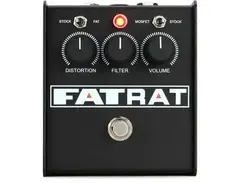
Classic RAT tone with extra options and better quality control
It's the classic RAT tone in a bigger box with bigger buttons, a bass boost switch, silicon diode or mosfet clipping, 9V or 18V operation, and a socketed opamp that can be replaced with a different opamp of your choice. The pedal is made in USA rather than China, which explains much of the price difference.
Apart from the added options, the main differences to the cheaper RAT 2 are:
I haven't tried too many Fat RATs, but overall, my impression is that there is much less difference in sound between individual pedals. While some RAT 2s sound great and others not quite as great, all Fat RATs I tried sounded great. It appears that ProCo pay better attention to parts tolerance than at the Chinese factory and not use components (especially capacitors) that are too far off the actual specs, resulting in more consistence.
The sweep of the Distortion pot allows more shades of clean and low-gain sounds. It may not be what most people buy RATs for, but it adds versatility. On my RAT 2s, I have about three millimeters between no sound and fairly crunchy distortion, whereas my Fat RAT has an area between 8 and 10 o'clock that goes from clean boost via light overdrive to crunch. Definitely better quality components here too.
The larger knobs feel nice, and the pots move smoothly. Good quality feel.
18V operation offers a bit more headroom, but not a radically different sound. The socketed opamp caters for those who want the mojo of the LM308 chip (which, for all intents and purposes, sounds near identical to the supplied OP07. BTW, if you shop for LM308s, beware of counterfeits and only buy from reputable dealers).
Is it worth the extra money? In the US, the Fat RAT ($199) costs twice as much as the RAT 2 ($99), which seems okay for the better build quality and extra options, but in Europe, the Fat RAT is currently sold at €268, which is a fairly ridiculous price tag and more than three times the price of the RAT 2. I only got mine because a local dealer was offering a substantial discount to clear out old inventory, and I wouldn't have bought it a the regular European price as I dont think it's three times better than the RAT 2.
Preferred Settings + Usage:
Using this with both switches at Stock position, Distortion at 11 o'clock, Filter at 2 o'clock, Volume at 3 o'clock. Replaced the opamp chip with a Motorola LM308.
1359
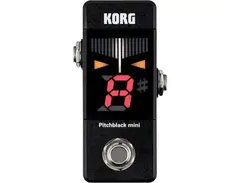
Decent tuner, but noise interference issues
This is a compact tuner with bright, readable display and solid functionality (including strobe and ultra-precision tuning), but there was a problem with noise interference with my setup (a faint chirping sound) that didn't go away no matter what power supply I used. As I didn't want to run it on batteries, I got a PolyTune instead, which had no noise issues.
1359
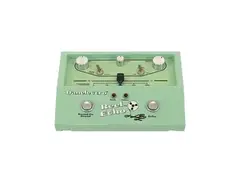
Unique tape-style delay
The Danelectro Reel Echo is a digital delay that simulates a tape delay and offers quite a few options to shape the sound. There's a toggle switch to simulate a solid state or a tube preamp and another one to simulate tape warble, and there's a "lo-fi" control to dial in the desired amount of signal decay, from none at all to a very unstable sound that disintegrates almost immediately. With the lo-fi control at minimum and the repeats knob at maximum, the delays will repeat infinitely (without self-oscillation), so the pedal can be used as a micro-looper with loop lengths between 0 and 1.5 seconds, which allows interesting possibilities in conjunction with the sound-on-sound button.
What are the drawbacks? First of all, I'm not a big fan of the footswitches, which haven't aged well. Sometimes they won't register when I step on them and occasionally one of them gets stuck (stepping on them again usually works though). It can also a bit of a disappointment for some that the pedal behaves more like a digital delay than a tape delay when you change the delay time: it will not create the sound of a tape speeding up and slowing down, but it will simply chop up the signal into smaller bits or add breaks to the signal. This can result in interesting effects and be very useful for experiments, but it's not exactly what a tape delay would do, and it also means that you can't create any "space ship" sound effects. Finally, the pedal is big and takes up a fair amount of real estate on your board.
Nevertheless, I like it a lot. It sounds good and sports a unique design with a very intuitive interface, and if you are aware of what it can do and what it can't do, it can be put to uses that other delays cannot offer.
1359
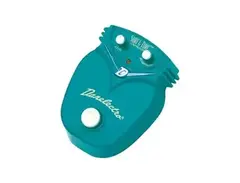
Clone of the 1970s Dyna Comp
This is a clone of the classic Dyna Comp, not the current version, but rather the original design, down to the CA3080 chip. As a result, it adds warm compression with a vintagey tone, easily on par with MXR's more expensive variants of the Dyna Comp, making this an excellent pedal for the money.
The downside is the overall build quality, not so much the plastic enclosure (which is actually sturdy enough), but rather the somewhat flimsy footswitch and the poorly situated 9V jack, which quickly broke on my unit. I got a MXR Custom Comp to replace it, and it sounded absolutely identical.

1359
Great Univibe, but the Mk.2 is better
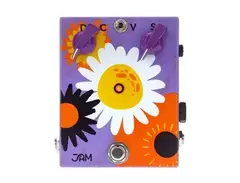
One of the best Univibes out there, with a particularly smooth organic sound that can go crazy if you want it to, but it lacks the Chorus/Vibrato switch that is key to this kind of pedal and also allows much subtler shades of vibrato (the RetroVibe is chorus-only). Jam Pedals included this switch and an expression pedal option on the Mk.2 version of this pedal, and I strongly recommend that you look out for that one.
1359
Fantastic Univibe
One of the best Uni-Vibes I've come across, from smooth and subtle to heavy and weird, but always organic. The Mk.2 version adds the chorus/vibrato toggle switch that was conspicuously absent on the Mk.1, and an expression pedal input to control the modulation speed. There's also an internal trim pot to fine-tune the maximum modulation depth. The Mk.2 comes in a variety of different enclosure designs and particularly the earlier, individually hand-painted builds exude a nice DIY workshop flair. However, don't be fooled into believing that this pedal is anything other than excellent. Not exactly cheap, but you get a perfect Univibe pedal for your money.
1359
Sophisticated Delay Machine
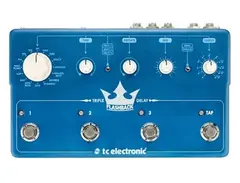
This is exactly what the name says: three TC Electronic Flashback delays in one enclosure. What makes this different from three single pedals is that you can not only use them in series, but also in parallel, which opens up a whole range of new musical possibilities. It also adds new delay types that the single Flashback II doesn't have: you can choose from Tape, Tube, Space, Analog, Analog mod, Reverse, Dynamic, 2290, 2290 mod, Slap, Lofi, Ping pong and four Toneprint slots. That's a lot of delay.
It also offers tap tempo with no fewer than 11 different subdivisions, which is quite remarkable. There's Midi in and through, and you can connect an expression pedal. It's full stereo. The delay time is up to 7 seconds, and in 2290 mode, you can set it to infinite repeats, so it can also be used as a kind of micro looper. An internal dip switch allows you to activate trails. The pedal will not go into self-oscillation with any of the delay types. Unfortunately, the "Mix" knob controls only the output level of the delay, but does not affect the dry signal in any way; if you want to go full wet, your only option is to activate the Kill Dry dip switch inside the pedal.
As it's more of a delay computer than a pedal, it works entirely via presets: you need to cofigure each of the three virtual pedals with the knobs and switches and then save the settings to the respective slot. This is all fine as long as you stick to your three presets, don't mind that you don't see what settings each slot has and don't have the habit of wanting to tweak or change your settings while you are playing. If you do, changing the settings is possible for the preset that is currently selected with the toggle switch, but if you disengage the delay and then switch it on again, it goes back to the saved preset rather than your most recent setting. This may be perfectly fine for many musicians, or it may run counter to your intentions and annoy you. It annoyed me to the extent that I sold the pedal.
Something else that takes some getting used to is that while the standard signal direction for pedal boards is right to left, the signal passes through this pedal left to right in serial mode, which may also take some getting used to.
Mind you, this is not a bad pedal. It's just not the same as three single pedals. It's extremely powerful and opens up a ton of tonal options, but you are to some extent tied to your presets as the tweakability while you're playing is somewhat limited. It's important that you bear this in mind before you buy it.
1359
Decent digital reverb
This is a compact digital delay that offers "studio" (room), "church" and "plate" reverb. It sounds good if it's mixed in subtly, but can become quite cold and metallic at long delay times or with the Mix knob approaching the full wet position. This may be exactly what you need if you are into experimental or dark ambient tones, or you may consider it a bit too digital. Still, it's one of the better digital reverbs in this price range and form factor.
1359
Cheap digital reverb with some unusual sounds
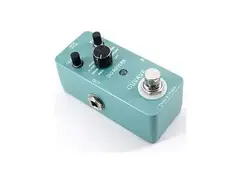
This is a cheap but pretty versatile digital reverb with no less than nine different reverb flavours - hall, room, plate, echo, tile, flanger, ducking, chorus and lo-fi. It's more of a novelty reverb for special effects than your standard run-of-the-mill pedal: while it can't really compete with more expensive pedals when it comes to simulating realistic hall, room or plate, it does have a few special reverbs up its sleeve that make it very interesting for use in ambient or experimental music: echo simulates "a sound reverberated in a valley", a very spacious, yet open reverb; tile is supposed to simulate "a bathroom environment", but it feels more like a super spacious bathroom in a haunted mansion - a very unique and exquisite sound. Flanger adds a phasing effect to the reverb and the dry signal, and "ducking" is like a slow gear effect for the reverb tail, also perfect for ambient. The Mix know lets you go full wet, which makes the tile sound even spookier and the ducking beautifully ethereal.
My main quibble is with the 9-position selector switch, which is just too cheap: it doesn't click into position as clearly as you'd want it to, so occasionally you may end up between settings. Also, on my pedal the knob doesn't properly align with the lettering on the pedal; it's a few millimetres off and can't be positioned correctly, so in some positions it's not immediately clear what setting is selected. I guess something like this is to be expected at this price, but it's still a bit annoying. Overall, however, this is recommended if you're into ambient or experimental and occasionally want some of these weirder reverb sounds. Well worth the money.
-s.webp?v=1773212902)
1359
Cheap fuzz with unique character
This fuzz is pretty much one of its kind. It's extremely abrasive, very gated, and its harmonics cut through pretty much every mix. The Gain knob doesn't seem to do much - neither can you make this pedal sound less abrasive at low settings, nor will it sound mushy at high settings. It's like ripping velcro, but in a good way: considering how much it breaks up your sound it will never sound nasty. I don't know of any other fuzz that sounds like it. It's selling at an incredibly low price too, so if you're searching for a fuzz sound that's powerful and has a unique character, there's no reason not to buy one of these.
Edit: This is actually a version of the Zvex Woolly Mammoth with a fixed Gate setting. Two versions of this pedal exist: an earlier version with a fairly high Gate setting that produces extremely harsh, ripping velcro-like tones (the one which I reviewed initially), and a later version with a much lower Gate setting that sounds more like a normal fuzz. If you bought the later version and want the original sound, there's a video on YouTube that explains an easy mod.
1359
Excellent digital delay for the price
This may be the best digital delay that you can buy for under €30. Clean, pristine sound, noise free, and well balanced tone.
The form factor and the knobs take some getting used to, and the plastic enclosure is probably how they got to the price point, but it's more solid than it looks. If you need a digital delay and are on a very tight budget, you can't go wrong with this one.
1359
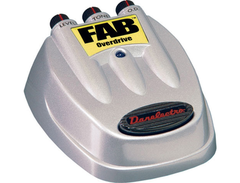
Brilliant boost/overdrive with quality control issues
Maybe one of Danelectro's best overdrive designs. This has been designed to break up your tube amp rather than provide much distortion by itself, so it gives a ton of volume to your sound. There's also a subtle, well balanced mid boost that adds presence and a touch of warmth to the guitar tone - I like this a lot, so much that for a while I used the PoT on a lower volume setting just to color the guitar sound a bit.
This would easily have been a 5-star pedal if two of them hand't given up on me (fortunataly still within the warranty period). After a few months of regular use, both started to make scratchy noises while and briefly after switching them on; later, one eventually started to switch itself on and off at random, wile the other one died completely. This seems to be a tragic case of a fantastic pedal manufactured under insufficient quality control.
1359
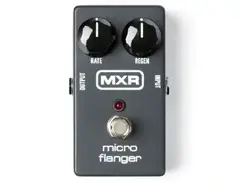
Solid, subtle flanger
This is a very subtle flanger. The range of the Regen knob goes from a faint effect to a restrained and tasteful, chorus-like sweep, but it doesn't produce anything like the swooshing jet plane effects that you may know from other flangers. As you'd expect from a full analog effect, the sound is warm and organic, and as you'd expect from a MXR pedal, it's built like a tank and surprisingly heavy.
The main caveat here is that it is a bit lacking in versatility. It really has just one kind of flanging sound, and that sound is gorgeous, but if you want a bit of variety, you're stuck. Othet two-knob flangers like the EHX Neo Mistress offer a much greater tonal palette (albeit at the price of more noise - the MXR Micro Flanger is dead quiet).
Buy if you want warm, tasteful, subtle flanging without noise or hiss. Don't buy if you want a wide variety of flanging sounds or jet plane effects.
1359
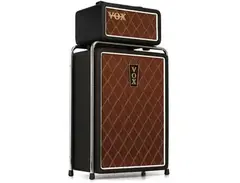
Small amp with great sound and good looks
This evolved out of the Vox MV50 series of small amps and seems to be an improved (and different sounding) version of the MV50AC in a much more attractive enclosure. The whole stack is actually much smaller than you'd expect and looks incredibly cute, but sounds pretty big. It's based on Korg's NuTube technology, so it's also very lightweight. There's some debate as to how it approximates a real tube sound; my take on this is that it's a fine sounding amp that sounds much more organic than any solid state or modeling amp I've owned, but obviously, it's no contender for an AC15.
As I want a bit more oomph than the 10" speaker in the cabinet gives me, I've combined this with a Vox BC112 cabinet (the same that Vox recommends for the MV50 series) with very pleasing results. With a 4Ω cabinet, it's actually very giggable at smaller venues, surprisingly more so (and better sounding) than my Katana 100 Head.
1359
Cheap copy of an obscure Japanese overdrive
Apparently this is a clone of the Nadine's Over Drive, an extremely rare and obscure pedal made in Japan for a music store in Hollywood called Nadine's. It sports a thick, muscular distortion sound with a slight mid hump, but less high end than a Tube Screamer. It sounds a bit too muffled for my taste, and it's a weird choice for a sub-€20 overdrive, but usually you get worse pedals for the money. The main drawback isn't the sound, which is actually okay, it's the cheap plastic look, even though the build is more solid than you might expect.
1359
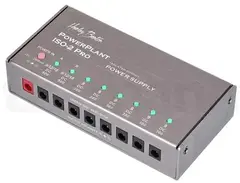
Cheap power supply that works well
This is a cheap, but very solidly built power supply. I have two of these powering my pedal board, and they do their job well and without creating any noise, hum or interference.
Two of the eight power outlets can be switched to 9V, 12V or 18V, and a Y cable adapter is included so that a third pedal can be operated at 18V by using two 9V jacks. The total power load is 2000mA; two outlets supply up to 500mA, whereas the other six theoretically supply up to 300mA, but in practice the sockets on the very right can drop to about 200mA even if some of the other pedals are not very power hungry, so it's best to connect the pedals from left to right in such an order that those who draw the most power are plugged in on the left and those who draw the least power are on the right. There are LEDs that indicate if the maximum power load for a socket has been exceeded.
I also noticed that for some reason the EHX Canyon, which supposedly only requires 150mA at 9V DC, only works properly when connected to one of the 500mA outlets. I have not had any problems with other pedals.
That said, I don't think that you can get a better power supply for a similar amount of money.
1359
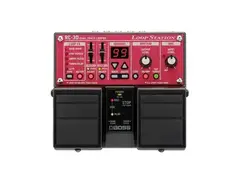
A ton of functions, but not very intuitive to use
I bought this as a second looper in addition to my RC-20XL and was instantly confused because Boss had made some changes that made the use of this looper very different from its predecessor. The most obvious of these was to change the left pedal default sequence from REC->PLAY->OVERDUB to REC->OVERDUB->PLAY, but I also found that the pedal combination that would previously delete a loop now added a second loop to the first one. Deleting a loop requires a two-pedal combination that I keep forgetting or using the small buttons, neither of which is very practical in a gig situation. I also found using this looper alongside a RC-20XL near impossible as they're operated so differently.
Some key functions like reversing the loop or fading the loop out only work with saved loops; you cannot use these with loops that you create on the fly. The built-in effects are a weird choice; not that I find them unuseable, but one does wonder why they were chosen, or why they included them at all. The looper offers two tracks, but these have to be the exact same length.
On the positive side, like all Boss pedals it's built like a tank, the stereo functionality is nice, as is the double-track option, and if this is your first looper, you get a ton of functionality out of it that few other loopers offer for the same price. However, it's no fun upgrading from the RC-20XL to the RC-30 as pedal operation is different and you lose some features that you may have become used to.

1359
Not the Timmy clone
This is the revised version of the Cool Cat Transparent Overdrive, issued after Danelectro discontinued the first version when they found out that the Chinese engineers they had commissioned to design a transparent overdrive had instead copied the Paul Cochrane Timmy pedal. This one has a modified circuit that sounds less like a Timmy and has four DIP switches in the battery compartment that let you switch between various clipping options to determine how "heavy" you want it to sound. As it is a "transparent" overdrive, it doesn't add anything interesting to your sound, so you need a good amplifier to start with. It's also designed to drive your amp so that the amp rather than the pedal does the distortion job, so don't expect much if you use ir on the clean channel of a solid state amp. If you know what you're looking for in a transparent overdrive, then it's an excellent one for the price, and a more than decent one regardless of the price, but it is not the fabled Danelectro Timmy clone. If you are looking for that one, expect to pay a bit more on the used market for version 1 (with the yellow label)
1359
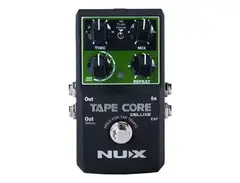
Digital Space Echo Simulation
This is essentially a poor man's digital version of the famous Roland Space Echo with only minimally reduced functionality. What's a bit annoying is that several options can only be accessed through a software app, for which the pedal has to be connected to a computer with a USB cable. It generally sounds good, a bit brighter than the original perhaps, even though it goes into self-oscillation rather quickly. This is fine if you want to create weird spaceship effects, but if you want slightly more stable delays, then you need to use the software to tweak some of the parameters. There is some faint signal noise if the pedal is in buffered bypass mode (Trails on), but nothing if it is in true bypass mode (Trails off). Quality control on these Chinese-made pedals seems to be quite poor, there are numerous stories of people going through several different one until they got one that worked. Using the latest firmware from the NuX website seems to resolve several issues. On the other hand, I haven't seen any other tape delay for under €100 that can compete with this one in terms of functionality and sound.

1359
Not the OCD clone
This is the revised version of Danelectro's Cool Cat Drive, made after they discontinued the first version because it was a bit too similar to the OCD. Like version 1, this is a MOSFET overdrive, but tuned differently and sounding somewhat more generic, lacking some of the guts and warmth of the first version. There's a "lo-fi" switch in the battery compartment that makes it sound a tad more interesting. It's a good overdrive, especially for the money, but if you want the fabled Danelectro OCD clone, you need to look out for version 1, not this one.