This page about Paquet Metronome de Maelzel (12 inch) is a stub. You can help improve it:


Pricing and availability




* Product prices and availability are updated by Equipboard every 24hrs and are subject to change. Equipboard may receive compensation for purchases made at participating retailers linked on this site. This compensation does not affect what products or prices are displayed, or the order of prices listed. For more information, please refer to our affiliate disclosure.
Description
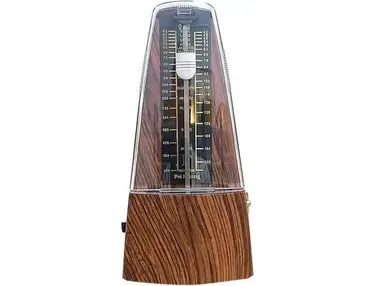
The Paquet Metronome de Maelzel is a timeless essential for musicians seeking precision in their practice sessions. This 12-inch metronome is a beautifully crafted homage to the original design by Johann Maelzel, offering a blend of historical charm and modern functionality. Renowned for its accuracy, it provides a reliable tempo reference, whether you're a seasoned performer or an enthusiastic beginner.
This metronome operates mechanically, requiring no batteries or power source, making it a dependable companion regardless of where your musical journey takes you. Its traditional wind-up mechanism ensures consistent and precise ticking, aiding in the development of rhythm and timing. The adjustable pendulum is easy to set, allowing you to select tempos ranging from 40 to 208 BPM, catering to a wide array of musical styles and pieces.
With its sturdy construction, the Paquet Metronome de Maelzel is designed to withstand the rigors of daily use. The classic aesthetic, combined with its practical features, makes it not only a functional tool but also a stylish addition to any practice room or studio.
Key Features:
- Mechanical operation, no batteries required
- Tempo range from 40 to 208 BPM
- Traditional wind-up mechanism for consistent accuracy
- Durable design for long-lasting use
- Adjustable pendulum for easy tempo selection


Reviews
Based on 0 Reviews and 0 Ratings
Artist usage
Add artist

Gifted to Beethoven by Maelzel, as sourced from the following.
Antique-Metronomes.com, "The Original Beethoven Metronome c1815"
We are pleased to have in our possession a totally original ( including the original upper & lower pendulum weight's ) and fully working example of a 12 inch French manufactured metronome. identical to the alleged metronome gifted to Beethoven in 1815 by Johann Maelzel, the inventor of the mechanical metronome. We also have a slightly later 9 inch version of the 1818 London manufactured metronome he received after his initial metronome had 'broken' or was dropped.
At the time his metronome patent (No. 3966 of 1815) was finally approved, he made a batch of just 200 to send out to friends, composers, musical instrument makers and the like for thier [sic] suggestions, comments and modifications. One of these composers was Beethoven, a friend who he later produced ear trumpets for when he neared complete loss of hearing.
It is recorded that Maelzel was one of the five people who forcefully entered Beethoven's house when they heard a loud crash from outside. They found him standing over his piano with a saw after cutting off the legs in the hope he might have heard it play when he placed his ear to the bare floorboards. He didn't.
Beethoven did however like the idea of a metronome and he made additional marks where he thought useful time points should be set. One of these was the lowest on the scale - 50. This was lowered even more into Largo by 1821 with a setting for 40. Even when deaf, he could still see when the maximum swing with each stroke was met.
Smithsonian Magazine SmartNews - "Was Beethoven’s Metronome Wrong?"
When great musicians play the classics, they often like to recreate the exact feel of a piece of music. But when playing Beethoven, many musicians completely disregard the tempo markings on his original sheet music. Sixty-six out of 135 of them have been regarded as “absurdly fast and thus possibly wrong,” writes Sture Forsen in a new paper published in the American Mathematical Society. Now, mathematic and musical detectives have discovered that perhaps Beethoven’s tempo was so strange for a simple reason—his metronome was broken.
It’s worth checking out the entire paper, but the premise of their work is to figure out the “possible mathematical explanations for the “curious” tempo markings.” Here’s the story they tell.
Beethoven got his metronome from a man named Johann Nepomuk Mälzel, who was something of a mechanical wizard. He made little musical automatons, tiny robots that could play music that the public very much enjoyed. Beethoven and Mälzel connected when Beethoven was looking for help in dealing with his hearing loss, and Mälzel made him several ear trumpets. The two most likely also discussed the issue of timekeeping, as Mälzel had been working on metronomes.
Mälzel went on to invent more automatons, like the famous Mechanical Turk who played chess, but he continued his work on metronomes, as well. In 1812 he heard about an invention by Dietrich Winkel, who had created a double pendulum device. Mälzel hurried to Amsterdam to meet Winkel and realized that his rival had a metronome far superior to his own. He tried to buy the invention, but Winkel refused. So Mälzel simply made a copy and patented it in London, Paris and Vienna.
Around the same time, Mälzel was trying to swindle Beethoven. There was a later debate between them over who owned the rights to a piece of music Mälzel suggested and Beethoven composed. They went to court over it. Historians think that, around 1815, Mälzel might have sent Beethoven a metronome as a sign of forgiveness and peace, and by 1817 Beethoven certainly had one of Mälzel’s devices—the one he used to write all the crazily timed pieces.
Fast forward to today, and music historian Peter Stadlen has actually located Beethoven’s metronome. But the heavy weight was gone so he couldn’t test its operation. Which brings us to the mathematicians on this paper. They looked at the mechanical properties of the double pendulum metronome, to figure out which parts alter the device’s performance the most.
What they found, in looking into the history of metronomes, the mathematics of their behavior and the music of Beethoven is that the master’s metronome was probably not working so well:
How could Beethoven not note the occasional odd behavior of his metronome? A thorough account by Peter Stadlen gives the impression that the master was not entirely comfortable with the new device, most especially in the process of converting from beat frequencies to actual tempi markings for half-notes, quarter-notes, etc. Obviously, it would be very helpful if we knew more about the actual design of his metronome(s). We suggest that one or more of the devices could have been damaged, perhaps accidentally during one of his well-known violent temper tantrums. Whatever the case, our mathematical analysis shows that a damaged double pendulum metronome could indeed yield tempi consistent with Beethoven’s markings.
Genre Usage
Based on how artists on Equipboard use this gear, it is most commonly found in the following genres.
Used With
Based on how musicians on Equipboard use Paquet Metronome de Maelzel (12 inch), it is most commonly used with the following gear.

Similar
Add recommendation2 alternative and related items for Paquet Metronome de Maelzel (12 inch), curated by the Equipboard community.


More Metronomes

$28.23 - $51.99
in Metronomes Rank

$95.20 - $119.00
in Metronomes Rank


$11.88 - $39.99
in Metronomes Rank


$134.70 - $199.00
in Metronomes Rank


$49.98 - $89.99
in Metronomes Rank

$47.00 - $59.99
in Metronomes Rank

$85.30 - $109.99
in Metronomes Rank


$29.00 - $49.99
in Metronomes Rank

$183.00 - $354.00
in Metronomes Rank


.png?v=1785070563)


.jpg?v=1784796217)




Community setups


Gear Guides









Most Popular Brands
-
Added to Equipboard on by
 eyeseeofficial
GearIQ 161640
-


