
jvml's Reviews
7 reviews Back to jvml's Equipboard
-s.webp?v=1784332394)

141
Excellent For Its Nature
the qy70 is a songwriter's tool above all else, the foundation of its workflow being a song sequencer with a complimentary pairing of step editor and real-time recording, all mocked up by a pretty decent General MIDI sound engine for previewing tracks not yet realized, creating shells of songs which are then output to your cans or (god forbid) monitors in facsimile. once you hook it up to MIDI devices, however, it works very smoothly, one channel per track and relatively solid timing in my experience, holding a decent amount of memory - although you shouldn't try to clog it up with too many sysex dumps or else you'll have to back its memory up to a different MIDI sequencer with greater note capacity, which is what i tend to do. not great for loop-building workflows however because its looping adds a couple bars at the end for some reason, but fantastic if you're doing something detail-oriented.
oh, one last thing and it's that the General MIDI sounds on this thing are great to record into samplers and then like, chop or play chromatically. they have the perfect amount of unconvincing cheese but are high enough in quality, especially with some transformative effecting through something like a Quadraverb, that you can get a lot out of them nonetheless. not to mention it's probably the cheapest thing that does what it does and does it well on the market, so overall, i'd recommend.
Preferred Settings + Usage:
the organ patches with heavy built-in reverb CAN and WILL utopianize your virtual if you know what i'm saying.
141
an absolutely spellbinding machine
(disclaimer: this review is from the perspective of someone who does not use jjos because she keeps forgetting to try it and is way too used to the most recent version of the akai os because it does its job. i still think the akai os is amazing but know that my review deals primarily with that experience rather than the souped-up jjos experience).
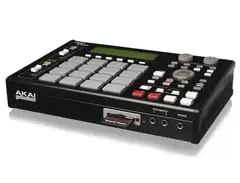
ok. i've been using this thing for a little under a year in the context of glitched-out raw beats and other compositions. i bought a unit off of reverb with the entirety of my first two paychecks out of a fascination with the sampler world and a need for something to sequence all my other midi equipment at once, and i could not have been more excited about it when it showed up in late july. i had come from owning a sp-404a for a few months and working in a computer daw and a hardware recorder for years beforehand, but trust me, this is a different beast from any of that. at any rate, everything about it was in working order, the blue-and-red case was alluring as hell, and with time, it proved to be the endless world of possibility i thought it was going to be when i placed that order. it did take a while to learn: my first few months with the machine understandably resulted in a lot of ooo-shiny moments where i couldn't see the simple beauty of the mpc1000, but soon enough, it started to shine through. what's beautiful about this machine, you might ask? it's raw. it puts you in direct, uninterrupted contact with the audio you record into it. from the get-go, there is almost nothing abstracting your editing experience. you sample something off your record player or synth, take it to the trim menu, move the sliders around, and cut up what you've recorded however you like. it makes chopping far more flexible than an auto-timestretched, tempo-synced format and allows for timings and loops far beyond the ordinary framework of the "chop" that you might associate with the mpc workflow. this machine is far, far more than it's made out to be in that regard; if you open yourself up to ideas like this, the trim and program features can take you just about anywhere you want to go. i've used creative trimming along with the programmable filters, envelopes, and lfos to create everything from novel melodies of colliding snippets of records i've collected to single-cycle oscillating digital tones that i can treat like tunable, malleable synths inside of the unit. all this time, i never have to worry about running out of memory even though i work mostly with stereo samples; 128mb is surprisingly spacious and lets you take your mind off of the technical side of things and almost forget that you're working with a machine to begin with. what about the sequencer, you may ask? equally amazing in its elegance and form. the midi/drum/whatever track system allows for complex, gradual variations in all sorts of sequence data and coexists beautifully with other live performance techniques, as the track-mute and next-sequence screens are only a single button-press away at all times. quantization also works like a charm, and the classic mpc variable swing combined with the sheer variety of options for time correction (or lack thereof!) is an excellent touch that allows for nuanced relationships between tracks and elements inside and outside the machine, with smooth looping that allows for like, an entire song with a complete progression within a single multitracked 8- or 16-bar loop (adding and subtracting elements via track mute), and thus also a whole live set within a few of those loops, readily accessible through the next-sequence menu. this brings us back to the idea of being in direct contact with your data: there are no abstractions here, only immediately accessible sequence events at 96ppq. beautiful, isn't it? i challenge you to find the same rawness and directness in a newer sampler.
overall, while i wouldn't say this machine (or any other given machine, for that matter) is for everyone, i would recommend it to just about any experimentalist musician who loves working with samples, is willing to commit to learning a new instrument (because that's what this is, a whole instrument!), and values raw functionality and capability. people like to discuss how "limitations breed creativity" when they work on this machine, but really, it's quite the opposite: the mpc1000 lays out previously unimaginable possibilities before your eyes, and it's up to you to discover them. god, what a wonderful instrument.
Preferred Settings + Usage:
mute groups are absolutely awesome. use your mute groups to the fullest :)
141
best daw ever
no other piece of music software is as utterly limitless as ableton live. i haven't used 11 but 10 and 9 are both incredible for everything. i can start with a single track, hit play while recording, and have a massive, expansive improvised piece within 40 minutes
Version: Ableton Live 10Preferred Settings + Usage:
black magic improv >:3
141
AWESOME
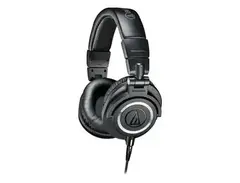
the fact that you can get these for under 200 dollars is utterly incredible. love the replaceable wire because i used to break hardwired headphone cables all the time and that sucked when it would happen to me and break the entire ass headphone. great sound and, contrary to what a lot of people say, great comfort.
141
rather brilliant piece of gear to work with
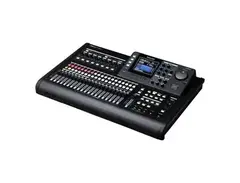
took me a very long time, like multiple years, to figure out how to get a reverb on there but this is really good if you actually know what music is. recording and editing are smooth and fast, and i work super quickly on this thing nowadays despite having used it improperly in the past. love the mixdown too.
Preferred Settings + Usage:
quarter inch jacks on A and B for synths and stereo effects, both of my XLR mics on C and D, two more matching quarter inch jacks on E and F for recording in mono or stereo, G and H i use for whatever