Every rig tells a story. Start yours.
Catalog your gear, wishlist what's next, and share the setups behind your sound — free.
Create your EquipboardGear 25

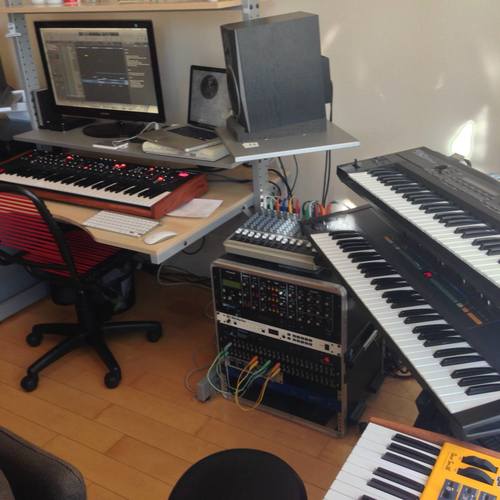
The oldest synth in my collection, and the newest addition to my studio. There's something about the Mono/Poly that makes it more than it's spec sheet — it just has so much soul and character, the kind of weird idiosyncrasies that draw you in and reward you for exploring. It's the kind of synth that you point to when explaining the difference between real analog synthesis and the digital emulation found in a plug-in. Beyond really loaded words like "character", what makes the M/P special? Well, you have four oscillators to play with, as well as a killer filter and some really interesting modulation possibilities. You can switch it from a monosynth to a 4-voice poly, which adds more options. But what really makes the M/P special is the arpeggiator. You can have it run as a traditional arpeggiator in Unison mode, but the fun really starts when you play with the arpeggiator in Poly mode. It will then use each of the four oscillators as a step in the pattern, and you can tweak each oscillator to use different waveforms, octave spread, volume and tuning. So you end up with an arpeggiated pattern that has a unique sense of motion. It's absolutely unlike most gear out there, and it's amazing.

Very few people seem to know that Akai made some pretty excellent synths back in the day, and not just samplers and MPCs. They didn't produce many, which makes them rare; and they don't have the status of competitors like the Roland Junos, which makes them affordable. If you find one, definitely take a look. What you'll find is a 6 voice analog poly synth with actual VCOs, lots of sliders, and arpeggiator and built-in chorus, basic MIDI capabilities and some pretty unique features. You can "split" two separate patches on the keyboard, and old Akai samplers (such as the s612) can be patched in to use as an additional oscillator. The sound is a bit more cutting than a Juno, closer to the sound of something like a Sequential Prophet 600 or Six Trax. You can make pads with it, but the synth shines in leads and weird effects, and can sound huge when all six voices are stacked in unison mode. Well worth searching out, and you can likely find one for under $500.

After years of collecting old synths, I wanted to get something new that would become a cornerstone of my studio. The Prophet 12 isn't cheap by any means, but it's an amazing instrument that sounds terrific and is a total blast to play. The controls are very intuitive and you can spend days just making interesting sounds.
-m.webp?v=1784213848)
I got my Juno way back in 1995, and it remains a favorite nearly 20 years later. it has a distinctive sound that really has no equivalent in modern synths or plugins — classic Rolands really have their own vibe.

Many people have never heard of Studio Electronics or the SE-1, as they were one of those smaller companies quietly making excellent analog synths before the current revival (and are still around today, by the way). The SE-1 is a 3-oscillator monosynth that can be described as a pseudo-minimoog with modern features (patch memory, MIDI) and some other interesting tweaks. Considering that Moog itself is making synths again, why should you bother with a SE-1? It sounds amazing, especially if you are looking for huge bass sounds, and it has lots of lovely knobs to make sound editing a breeze. And, unlike the Moog Slim Phatty that this replaced in my studio, the sounds fit very well with the other synths and gear that are being used. It's a lovely synth, and for under $500 used, a hell of a deal...if you can find one!
(The newer SE-1 models are called the SE-1X, and feature expanded patch memory, an audio-in port and some other updates.)

The D50 is one of those keyboards that, alongside the DX-7 and Korg M1, really helped to define the mid-late 1980s. This keyboard's strength is in creamy pads and strings, and it's really fun if you can find the optional PG-1000 programmer.

With a PG-1000, a D-50 suddenly becomes a poor man's JD-800. Yes, it's a digital synth, but sliders make programming anything so much better.

The Tetra is basically a 4-voice version of the Prophet 8, and as long as your chords aren't TOO complex you'll be very satisfied. Great sound and a small footprint.

There's not much you can do to program a Matrix 1000 unless you get a computer program to help, but with 1000 presets there's good chance you'll find something you like anyway. The Oberheim sounds really cut through a mix and can ad a unique flavor to a track.

The rackmount MKS-50, along with it's Alpha Juno keyboard equivalents, was one of Roland's last analog synths. It's famous for creating the hoover/"mentasm" sound that's been used in electronic music since the early 90s. I also have the separate PG-300 controller, which adds lots of lovely sliders to the experience. Purchased from a Richmond, Virginia pawn shop in 1994.

If you have an Alpha Juno or MKS-50, this will give you real-time control of parameters, and make programming a dream. Very useful...if you can find one.

I went to the RME from a MOTU 828, and the difference in quality was very noticeable. RME stuff isn't cheap, but it's well-made and has epic sound quality.

Way back before Apple bought them out, a German company named Emagic was known for its Logic software and high-quality MIDI interfaces. Mine is probably close to 15 years old, but still works great.

Great, clean sound and amazing comfort — they make a great pair of studio headphones.

I've been using Logic since Logic 5, so I've invested a lot of time into the program's workflow. And while Logic X is a notable improvement from 9, I wonder if Apple went far enough to keep the program relevant in an age of Ableton Live and other programs. I'm not saying that Logic needs to be an Ableton clone, but more attention needs to be paid toward simplifying and smoothing out the workflow, and updating ancient legacy instruments like the ESX24 sampler.

As an old-school dj with thousands of vinyl records crowding the shelves, it would be weird not to own a set of Technics 1200s. This is still the gold standard of dj turntables.

Considering how long I've been using the Serato SL1 box (7+ years now), it's well earned it's keep in my dj setup. It's a shame Rane is discontinuing the solid Scratch Live software for the buggy and bloated Serato DJ experience...maybe that works fine in a controller-heavy environment, but I proudly hold on to my Technics 1200s.

I know this is nominally a guitar pedal, but I use it mostly for my synths — and given how good the reverbs are, I use it a lot. This piece is so good that it made me buy two more Eventide boxes.

I only have one of these, as its twin fell into the San Francisco Bay after a boat party. It doesn't get used much.

These are really solid monitors — the operative word being "clean". The sound is very accurate and you don't have to do a lot to compensate for them.