
sean_chan's Reviews
13 reviews Back to sean_chan's Equipboard


171
NOT A FUZZ. It's a fuzz-tortion, a very warm and smooth (and quiet) one.
If you take its name seriously, you might be seriously misinformed, but one might feel slightly bamboozled instead of deceived at the criminally low price you could get this pedal. I personally got it for $25 USD during a promotional period, and was slightly (and pleasantly) surprised as I was on a hunt for a full-on fuzz pedal instead of another distortion.
Long story short, it's a distortion with certain characteristics of a fuzz pedal - serious clipping (offered in two modes, "quiet" and "library-friendly volume"), slight hints of overtones and a not very bitey sound. The clipping is not so aggressive that it produces the spitting, "gatey" qualities of a mature fuzz pedal, but neither does it track dynamics as much as a traditional distortion pedal, negating almost entirely any palm-muting business you have but giving soaring sustains when you try. It can be described as full sounding while being mild enough to be controllable.
Its singing qualities immediately positions it as a lead player's tool. Use it to solo and you'll achieve a creamy voice that sounds sweet and never spikey (the pedal is on the more mellow side, EQ-wise). The saturation beefs up the whiniest of guitar tones, and - not surprisingly - compresses notes to make them uniform in volume. Unsurprisingly a gain box like this adds a little bit of noise to your signal chain.
The huge drawback of this pedal, however, is the low volume. I am appalled by how underwhelming it is. At almost every setting, the volume of the pedal must be turned up all the way to the max in order for your signal to not suffer from a significant cliff dive in audibility. Worse yet, switching to the silicon (I assume that's what "SI" means) clipping mode drops the pedal volume even further, making it extremely unfavorable should you want it to be your lead sound (which, I suppose you want heard).

171
Decent Starter Guitar not worth too much investment in Upgrading
I was given this guitar, but not by a person who owned it previously, but by someone who picked it up from the dumpster. It was 2016, and the receipt included in the stock guitar bag indicated that this guitar was bought in 2001 alongside starter kits and amps. I have strong reasons to believe that this was someone's first endeavor of trying out electric guitars before eventually discarding their musical prospects in the trash. Tragic.
So needless to say, this guitar is a starter guitar, albeit at a slightly higher price range (think $300 USD) possible due to it being manufactured in Korea instead of Indonesia or China. Its basswood/maple/rosewood combo renders it the most generic of starter guitars, while its strat style "vintage" tremolo system sets it apart from most other Ibanez guitars, namely those with Ibanez's own variation of the floyd rose. The pickup combo is a standard HSH, with a 5 way toggle to give it a tonal range similar to that of a strat. The pickups are crunchy medium-output PAFs that have a flat sound, not too surprising for this range. The neck is surprisingly bound, giving it a nice aesthetic some may appreciate.
I find it a decent guitar best suited for modern rock and hardly anything else. The sound isn't too "open", in that the pickups appear to compress slightly the signal and tighten the guitar's voice; Flat EQ makes it difficult to shine in lead playing (though the 24 frets does allow a little more access to the high end) but on the other hand it lacks the punch, reducing the aggression that palm muting could have achieved on another guitar.
The neck, as Ibanez's standard approach, is fairly slim and eases fast playing. The finish is also notably durable without being a thick polyester mess - having been in the dumpster, I am surprised how little scratch and wear the finish endured. A little bit of dusting and cleaning and the finish was wiped mirror-clear. This guitar is also fairly light, for those who actively avoid their chiropractors.

171
Top notch feel and tone at an overwhelmingly underwhelming price
Alright where do I start? This guitar is one of the most surprising 6-string discoveries I've made over the years and I cannot overstate how much the quality It is said that Sapele is every bit a mahogany, except for minor grain discrepancies, coloring and a tiny bit more of high end etc. and is a LOT cheaper. Taylor has been using Sapele on their 300 series, GS mini, Baby and such, so let that be a reference point of how this guitar would sound - full, bright, snappy, mid-heavy, and the description on Chard's official website even states that the body chamber of the F4130 is based 1:1 on the Taylor 210 (don't bother checking though, it's exclusively in Chinese). It's a lot of Taylor reference we're getting here, but Chard takes it to a whole other level.
This guitar has a loud, snappy sound that offers lush detail when either strummed or fingerpicked. It picks up a lot of "touch" from your fingers (some might not prefer that, but it's a plus to me) and makes the lightest playing heard. Also, strings still sound bright and sharp enough after some time, I have no idea how that was achieved.
Possibly due to an elongated length (41'), I enjoy the string tension offered by this guitar very much (likely to be tenser). It doesn't hinder string bending as well, so it's basically the best of both worlds.
When I first got this guitar, the action was stunningly good with no dead spots, so naturally I was very skeptical about how well it could maintain that after some time (given its unassuming price tag I didn't expect much) or after changing strings. Turns out absolutely nothing changed after two years of playing - I still enjoy playing this guitar very much and not once did I have to adjust the truss rod to discipline this thing.
The fretboard is admittedly a little flat, so that playing larger chords can be a problem. I do a lot of leads, however, and that makes this a workable feature for me.
This guitar does not look cheap at all, coming with intricate binding and a gorgeous looking top - one would easily mistaken it for a $500 acoustic, or more (which I actually did, when I first stumbled upon this gem). The nicely inlaid "C" headstock is a classy but obscure reference to this covert brand, differing from the rest of the Chard line which have a printed "Chard" written all over it.
The top Sapele piece is fantastic. Originally I went along thinking this was a specially patterned mahogany, with similar color, grain and tone but also carrying a certain "quilted" quality, in the form of broad stripes of varying color depth. I'm not sure of the sonic contributions made by acoustic guitar tops, but the all Sapele construction has definitely given it a baritone voice strong in the low-mids yet pronounced in the highs.
I have complaints on only 2 things of this guitar. First are the tuners: not that it's a pain to tune this thing, but it goes out of tune almost too quickly. They feel flimsy, they look cheap, and they certainly don't stay in tune too well. However I still commend the black coloration echoing the pickguard. Secondly it lacks a pickup. I have played several other Chard guitars and they all have pickups, though not necessarily impressive. Considering that this is one of the better models they make, you'd think they thought of putting a pickup in there somewhere, but no such luck I guess. On the bright side, you can drill the hell out of this guitar without breaking a sweat because it's such a cheap dispensable gear.
Talk about price. This guitar is LITERALLY dirt-cheap - I got mine for about US$60. Brand new from a shop. Granted, it was an indie shop whose boss insisted on selling it to me at this price, but this retails for just under $100, affordable by the newest of newbies, yet delivers the quality and tone of a Taylor equivalent. Highly recommend for players intermediate or above, you won't regret it.
171
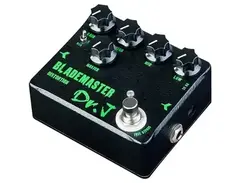
Bathing in filth.
Another unexpected buy. Rather than the bitey, tight sounding distortion I was hoping this to be, the Dr. J Blademaster is as sludgy, as fat and as filthy as a distortion could be without being a fuzz. In a good way, nonetheless, a blessing in disguise, but definitely not for the conventional.
The pedal is indeed very loud. The distortions are saturated and compressed, and could be difficult to adjust to your needs. This must have been an issue since the design stage, so three-band equalization knobs are added to shape your own wild wall of sound, particularly thin out unwanted screeches.
The first thing you would probably notice when engaging the blademaster is the omnipresent muddiness. It's just a generally muddy pedal, and it cannot be dialed out with the low knob. If you're a modern metal player aiming for a focused and defined sound......stay away from this pedal and screech away, as palm muting is nullified in any setting.
Doomy, sludgy metal players will find this pedal bliss. This pedal mashes notes together to form a gooey putrid mess, without clipping them so much that they thin out one another. I tend to play large chords and ring notes out one by one - in this context, the oozing notes build upon the last, saturating the passage with electrifying tension.
Then there's the "wow" switch. It takes mids away and back, suffering a considerable volume drop. I don't really find it necessary.

171
Works.
This "Musicman liscensed" OLP Chinese bass guitar is one with attitude, and I mean a harsh one, towards the player.
Performance wise, this bass is nothing short of average - light weight body, tone on the bright side, playable/comfortable neck, but the coupling cripples are not for the faint of heart.
The bass's inferior wood quality is complemented with a disastrous hardware selection. The truss rod is not particularly responsive, making set up a little difficult. Mine never had the privilege of reaching its full potential and lived a life of bad intonation, fret buzz and sudden-death sustains. As a side note: never have I had to replace the tuners on any guitar before, but one of the tuners on this bass literally snapped in two on one tuning occasion. It was amusing to say the least.
I am not certain of the electronic scheme for this bass, but I'm certain that it didn't work. A few days after purchasing this bass it stopped making a sound. I had to send it to a luthier, who I might add was astounded by the wiring in this bass, and had it rewired. Though now producing sound when plugged, it still occasionally cuts the signal off most possibly due to inferior wires.
The second pot never worked, by the way. It even came off after some time.
The most surprising redeeming aspect of this axe is the finish. Mine comes with a sparkling blue, which is actually quite pleasing to the eye. Paired with a blue pickguard, the bass looked beautiful when I got it, and it still does.
171
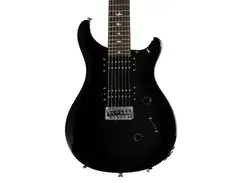
Not the average 7-string chug machine
The PRS brand has hardly disappointed any purchase. Across the entire spectrum of different prices, guitars sporting the iconic PRS double cut (or the slightly sketchy single cut) shape is almost an assurance of tonal goodness, playability and aesthetic elegance, capable of catering players from Jazz, rock to even metal. The go-to mahogany/mahogany configuration has rendered this modern workhorse as versatile as it could be, much to the protest of Gibson equivalents who arguably have inferior quality. PRS and its subordinate SE line are at the forefront of most guitar-oriented music genre, guaranteeing
While PRS are known universally for their state-of-the-art creations of sheer craftsmanship and daunting price-tags, the Korean-manufactured SE line is a gateway for aspiring boutique guitar owners as well as PRS's outlet for more innovative and daring ventures. Take the SE Torero for example: it is a floyd-rose ready, EMG fueled metal monster with distant relation to PRS's signature custom 22 and custom 24, yet it flourished carrying the unmistakable PRS craftsmanship and meticulous approach to details.
The PRS custom 24 7-String is another fine example of the SE line's bold attempts at catering to a fanbase beyond the confines of classic rockers, this time by reinventing their most popular designs and shoving another string onto it. Or is it just that?
In addition to the added low end, the 7-string rogue sports several slight deviations from the familiar custom 24 design. Instead of a mahogany body+neck wood config, PRS opted for a mahogany body/maple neck combination, possibly to prevent the mahogany meatiness from discouraging use of the bassy 7th string. The typical PRS 25' scale length is also extended by an underwhelming 0.5', pushing this guitar to Fender-scale and adding string tension to avoid flabbiness. Also notable was the lack of a vibrato system - where most if not all custom 24 guitars have a non-locking floating bridge, its 7-string cousin brandishes a complete set bridge. The reason behind this design is not known, as numerous 7-string whammy units have proven to be successful in other brands, but to each his own. Pickups are PRS SE HFS Treble (B) and PRS SE Vintage Bass (N), maneuvered by a 3-way blade switch and a push-pull toggle at the tone pot enabling coil-split.
This PRS is an atypical specimen in the 7-string world, especially when pertaining to pickup configurations. The names "HFS Treble" and "Vintage Bass" have already given the first and biggest hint - this is not a guitar designed for metal chuggery, unlike most other 7-strings on the market. This is a guitar akin to the accomplished 6-string lines provided by PRS, even leaning more to the milder side of tones. The Vintage Bass neck pickup, to no one's surprise, is a very warm and sweet sounding mellow pickup that is exceptional for jazz playing and rhythm, with very unpronounced "bite" and "growl". When driven, the warm lead tones are not as tight as a modern player would prefer, but is perfect in delivering solid rock solos and fluid licks. The bridge pickup, however, is a little disappointing in that it lacks tremendous amounts of gain and could sound rather weak and insensitive.
The neck is, to the disdain of many, gloss finished. I personally do not have an issue for this (stop finding excuses for slow playing). Thin and not too wide for a 7-stringer, the neck ensures playing comfort entertaining shredders mostly, while chord enthusiasts may find it a little too flat to play massive chords on.
A not-so-minor issue is inadequate cutaway at the lower horn, making access to the 24th fret very unfavorable. For people who do not climb up to those heights (like me) this is a slight nuisance, but shredders up the neck would definitely find this a deterrent to high-profile playing.
A very usable sound is when both pickups are selected in the middle position with the coil tapped. A very crispy yet rich sound is achieved through this.
I hold this guitar in high regard, for its blues and jazz mellowness, for its coil-splitting fun and for the rich musical lead tones. For a 6 string player switching over to 7-string, the minimal change in scale length and narrow fretboard may make you feel at home instantaneously, but TO ALL METALLERS: THIS IS NOT THE STOCK 7-STRING FOR YOU. Of course, Mark Holcomb from Periphery uses this particular model with DiMarzios fitted, so it remains an option.
-s.webp?v=1784632864)
171
Average Humbucking sound......until you blend it.
I took interest in this particular pickup when I saw a video on youtube demonstrating the "djentability" of a strat against an Ibanez 8 string. The video has since been taken down, much to my disappointment. Surprisingly the strat turns out to yield a more pleasant tone and I decided to give it a go. I was fortunate enough to find a steal of a deal on the second hand market (about 35 USD) so I bought it and installed it onto the bridge position of my Squier Affinity Strat (note that this is an earlier incarnation of the affinity series so the quality is roughly equivalent of that of a Squier standard).
The result was within my expectations - high gain, beefy and mid-rich tone distinct to the rest of the pickups on the guitar (both being single coils). When engaged, it has a significant volume increase which some may find bothersome, but that is only reasonable when you pit a high output humbucker against cheap factory single coils. Despite being great for rock and metal tones, the pickup could be a little bland. It lacks a lot of dynamics, and the clean tend to be a bit compressed and duller than that from a single coil.
Then I switched to position 2 on the pickup switch, which was when I discovered the tone I've been searching for several years. Crunchy, not too full sounding and touch-sensitive, with the sensitivity of a humbucker but the clarity and snap of a single coil. On lower gain settings - whether it be lead or rhythm - this combination shines. It's crunchy, bitey and....well it's pretty hard to describe, but I really can't recommend it more. Oh right, and slapping is strictly mandatory on that combination. It's slap heaven.
Anyways, this is a very solid humbucking pickup aimed towards rock and metal players who want a thick sound. Blend it with the middle pickup if you have one. You'll be surprised.
171
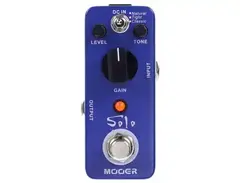
The Blue pedal aspiring to be a purple one
The Mooer solo is quite the unapologetic clone of the revered Suhr Riot, a boutique-grade distortion box known to be the go-to pedal of many professionals (including the incredible Mr. Guthrie Govan!). However, I, unfortunately, do not own a Suhr Riot in my arsenal and therefore cannot make a comparison between the clone and the original. This review shall discuss the Mooer Solo based only on the Mooer Solo.
The pedal has a very typical setting as seen on countless other distortion and overdrive units: Gain, Volume, Tone. It should be noted that this pedal is of a high-gain nature and should not be treated as one that sings the blues or does the crunchy punk tone. Although the Gain knob retains tonal integrity throughout its rotation (Low gain setting can also be nicely utilized), what fun is there if a high gain pedal's gain is not turned up? At above 12 o'clock, the pedal truly shines (particularly if given a boost in front) and delivers not only what its name "solo" suggests, but also beefy, thick rhythm tone that goes great with humbucking guitars. The sound is very organic and punchy, having just the right amount of growl and wildness for hard rock and metal rhythms.
The distortion of this pedal is rather "dark". It comes with a certain quality that heavier genres would appreciate.
As a solo tone, as its name suggests, this pedal offers generous amounts of gain (as previously noted) and consequently great sustain. String definition and clarity is maintained - the pedal hardly gets too muddy or muffled. Even distorted let-ring passages are not a challenge for this pedal.
A feature that distinguishes this pedal from other dirt boxes in the market is its three-way toggle switch which conveniently switches between three clipping modes, or simply "modes". These are normal, tight, and classic. While the "normal" setting, as its name suggests, doesn't strike remarkably, the other two are noticeably more dynamic and interesting to the ears. The "classic" mode is similar to the "normal" mode, which has a rather flat EQ and bland character, the "classic" mode offers more bite and crunch than its counterpart. It has an "open" character that is reminiscent to amp distortions of Randall and Peavey heads alike, a very promising sound to use. The "tight" mode, when engaged, is noticeably louder in volume (changing the mode withing a song would mess the balance up) and has slightly less gain. But the sacrifice of gain brings about a worthwhile twist in the pedal's tone. This mode covers very modern distortion sounds, even approaching (but not reaching) the much coveted "djent" sound used by many these days. The tone is, well, nicely captured by the name of the mode. There isn't much to describe, really.
All in all, this is a great pedal if you want a formidable heavy rhythm tone featured in heavier genres. This pedal also works if you wish to have a soaring solo tone with lots of sustain and gain.

41034
just a heads up, I've tried a Riot, its nothing to write home about at the price Suhr charges. At half that its a pretty cool marshallesque distortion, but its a real one trick pony. Great for 80s type british sounds.
171
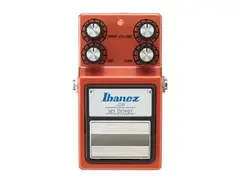
One worthy of the Ibanez overdrive lineage
If Ibanez excelled in overdrive with the tube screamer, they have perfected it with the Jet Driver. I am hard-pressed to find anything the tube screamer has on this orange descendant. It isn't even an over statement that given the high quality of this pedal, I suspect that the tube screamer would pass as an "affordable version" of this pedal. It's THAT good.
Perhaps the most immediate difference between this pedal and its classic green uncle would be the extra "mid" knob. Tube screamers are notorious (not necessarily a bad thing) for their characteristic mids that give the tone a little more beef. The JD-9, while being capable of that, allows both mid scoop AND mid boost (depends on where you consider the middle ground is, really), so mids are optional on this drive. With a little experiment, the jet driver could sound like a tube screamer.
The Jet Driver has noticeably more gain than a tube screamer (which never had been a keen competitor in the first place) but not so much that would classify it as a distortion. On lower gain settings, notes remain clear and well-defined while the higher gain produces a fat round tone with a lot of sustain, typical high gain tone. On high gain, the pedal is a bit too muffed for my tastes. Chords sound too full and fat, which could be, to some degree, remedied with a scoop in the mid knob.
This pedal, in terms of volume, is VERY loud, sometimes unnecessarily. That isn't a problem, though. More volume = more boost.
The pedal serves effectively as a boost as it allows a lot of low through. The transparency is also notably better than the Tube screamer, which always adds the notorious "Mid-hump" to the guitar's signal.
The construction of this pedal is sturdy and hefty. It carries a lot of weight and is encased in a very tough box (the same box encasing the TS9). My only complain would be the switch - besides not having a very definite "click" (which I do not really have a problem with), the pedal seems to be hard to turn on. The switch has to be depressed to the max in order for the pedal to be switched on/off. The struggle is real.
41034
the 9 series switches are notorious, but they're better than the original TS808 switch, that earlier series was a real pain in that it wated to be stomped hard but was prone to mechanical failure when yous tomped it, kinda like 80s and 90s DOD tac switches.... 9 series pedals aren't true bypass and the buffers are notoriously mediocre, just slap it in a programmable looper gadget and make some complex, one-stomp patches with your other doohickies

171
For the metal rhythmers
This is the first Joyo pedal I've bought and I'm glad that I didn't let it deter me from getting my hands on other products. By no means this is a sub-par distortion pedal, but it does not stick out particularly well as one of Joyo's proud presentations either.
A note to be taken is that this is, unlike the majority of Joyo pedals, NOT a true bypass pedal, as eloquently written on its case the word "bypass". Some players would refrain from these, but I do not find it affecting my tone remarkably.
Notably, the pedal has mid-high adjustment knobs instead of a single tone knob, and such a feature sets it from the conventional drive pedal. With the mid knob, the pedal can turn from a crunchy, full sound to the hollow mid-scoop as perfectly demonstrated on Metallica's "Riding the Lightning". This pedal is definitely capable of recreating that classic metal sound, which is not entirely to my taste but some may prefer. With the high turned up, the pedal gets very "screechy" and icy.
While very saturated and full with a boost in front (a la tube screamer), the pedal could sound a little weak without one. The touching is not entirely sensitive to the touch and there is a certain "metallic" and inorganic quality to the sound. Perhaps players of early metal may find it preferable, but the
This pedal can be used to play earlier metal like Sabbath, Metallica, Death and even AC/DC with the gain dialed back. It has a certain amp distortion quality to it that some may like.
All in all this pedal is for the classic metal rhythm players who want that "oomph" in their rhythm tone.

171
Best drive I own at any price point
Easily the best overdrive/distortion pedal you could get at this price. Unbelievably versatile and crunchy (just as the name suggests), this pedal could be used for most rock applications as well as some metal. From meaty thick rhythm sections to wailing leads, this pedal could handle it all.
In build quality, the pedal could strike you as one with a somewhat light case and a flimsy switch. I have not had any problems with mine, but better switches are definitely preferred. The pedal is very light by any standards and reasonably sized. The power socket however is located at the side, close to the jack input, and could occasionally be troublesome.
The volume of the pedal does appear to be lower than most other drive pedals. To get a desirable volume level (especially one matching the volume of the rig when this pedal is bypassed), not very uncommonly do you find yourself turning the volume knob past 12 o'clock. Moreover, the pre(sence) knob significantly affects the pedal volume, so adjustment is required. The "pre" knob affects the tone quite drastically. When turned down, the mids are slightly cut, while the pick attacks soften yet the gain is retained. This gives a smooth, fluid overdriven tone most lead players can appreciate. The other direction implies the contrary. As previously mentioned, turning this knob affects the volume a lot. Rock or metal lead players may find the pre knob useful when turn up higher. The gracious mid offered ensures that a guitar stands out in a mix. Loudly.
Tonally, this pedal is on the bright side, no matter how you turn the tone knob. The highs and lows of the pedal appear to be flatter than some others, meaning that it might not achieve as much low end as a djent chugger would prefer. For rock rhythms, this pedal is unparalleled.
The touching on this pedal is superb. When engaged, the strings are very responsive to a player's touch (even at a lower gain setting) and adjustments with the volume knob yields different results to each's own preference.
This pedal is NOT transparent at all and offers a lot of its character to the tone. It doesn't quite serve the purpose of being a boost (experimenting with it in that direction hasn't turned out to the most satisfactory results).
I usually play with a boost pedal in front of drive pedals to achieve tone saturation and better touching, but this pedal requires no boost to sound superb and feel comfortable to play. For this reason, this pedal could serve as the only pedal in one's drive unit and comes in especially handy when you cannot afford too much space or ports for more pedals.
Would highly recommend for any rock guitarist. Can't beat the price and tone.

171
Versatile for aspiring rock and metal players. Highly recommended for beginners.
Ergonomically saying, this guitar is mid-weight with a very comfortable neck to play on. It is still thicker than Ibanez wizard necks and Musicman JPs but nonetheless a very flat and wide fretboard thin enough to play fast music (particularly metal leads given that it is made by ESP). Note that it is sufficiently different than a strat neck. "Fast" players might appreciate such a neck. The body is the average superstrat body, comfortably thin and contoured to fit on your lap.
The finish is Satin, but surprisingly durable. Mine lasted for 4 years until the slightest hint of barewood showed in a scratch. Dents are uncommon as well, as long as no heavy bumps are made.
Tonally speaking, this guitar has a very flat character (I suppose it's the basswood? Or maybe it's just a lower model). Very little will you get to experience the "screaming" bends at the post-22 frets, but heavier string gauges could give it a boost in bass resonance. On a clean channel, the guitar has a dark warm tone, not entirely designed for the "popping" tone.
With higher gain pickups, this guitar can have a superb rock/metal rhythm sound on the bridge position and a great consistent fluid sound with the neck pickup (think sweep picking). The highs are underwhelming, as previously mentioned, so high register emotional soloing would not be its greatest strength. Rapid metal runs are however satisfactory.
For rock and punk, this should be a go-to guitar for beginners due to its low price and great playability. For Metal, this guitar might lack the thickness present in mahogany bodies, but will suffice where modern metal music demands. This guitar's thin neck allows ease in fast lead playing. Bending is not a problem. For mellower genres, get another one.