
sofamusician's Reviews
27 reviews Back to sofamusician's Equipboard

855
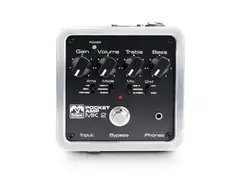
Perfect portable pedal platform on a budget
The Palmer Pocket Amp has been quite useful as a portable pedal platform for my practice pedalboard. It is affordable, takes pedals well, and provides multiple connection options (headphones, xlr, jack out, and aux in) to support multiple uses.
I use the Pocket Amp at the end of a battery-powered pedalboard, making it a truly portable solution. I can connect my headphones for silent practice, or a battery-powered speaker for others to hear. In this way, I can play anywhere without looking for power sockets, or the need to carry an amp.
With three types of amp simulations, the Pocket Amp may not be as versatile as other digital solutions. You'll find more options in modern amp simulators, modellers, or profilers. However, I find the simplicity of this all-analog pedal to be quite appealing in order to focus just on playing without distractions.
Most of the time I use the clean "Vintage" (Fender-style) option for a clean sound, with different pedals in front. Normally I just tweak my main overdrive to approach a tone that suits the song, and keep the rest of the pedals (higher gain, EQ, delay and reverb) at their usual sweet spot
Occasionally I used the British (Marshall style) setting too, and found it quite convincing on its own or pairing with the EHX Hot Tubes.
Preferred Settings + Usage:
"Vintage" option in "clean" setting with gain at 10:00.
855
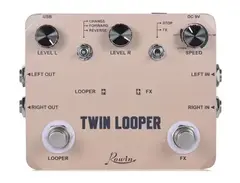
Simple affordable looper for practice with questionable built quality
I had this looper in a portable pedalboard for practicing with my guitar. It has been useful to create a base track to play over, recording what I played to listen/compare after, and experiment creating multiple sound layers. Unfortunately, after a couple years of moderate use at home, overdubbing results in harsh noises.
It has been unfortunate since it is not easy to find an affordable looper with these features:
- Having two buttons for the simplicity of operation. With two buttons the options are clear in every moment. No extra effort required to think how many times I need to tap a single multi-function button (while my brain is already busy playing).
- Long recording time. 10min of looping time seems more than enough. I never had to worry about exceeding this time.
- Analog dry-through. Being from a more affordable brand, I can accept the recorder quality not being excellent, but I didn't want interferences in my signal when the looper is not used. The Twin looper keeps the dry signal unaffected when it passes through.
Sound quality was good, with minimal but noticeable degradation from the digital conversion. I was not expecting it to last forever, but it broke much sooner than expected.
855
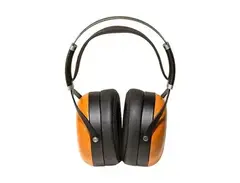
Affordable planar headphones with quality sound
I'm not an audiophile, and I lack experience with high-end headphones. My point of reference are the Bose Quiet Comfort headphones with noise cancelation, which I use for work meetings and listening to music.
I was looking for some headphones for silent guitar practice (which I could use for listening to music too).
I did not need Bluetooth or noise cancellation. Actually, I preferred to be able to hear the environment (in case someone talks to me) while not disturbing others. I was attracted to the idea of trying some headphones using planar technology, and most of the options were quite expensive.
The Sumdara Closedback have been a clear improvement in sound quality over my previous headphones.
Currently the Sumdara Closedback are available at less than one third of their original price. After launch, the Sumdara Closedback got bad reviews due to the comparisons with the open back version. However for someone who has not tried the open back version, I find the Sumdara Closed backs to be very good headphones at an affordable price.
They are easy to drive. I have been able to use them on all kinds of devices from mobile phones to amps and headphone amp pedals.
The only drawbacks are minor:
- Weight. The use of nice materials such as metal and wood make them more heavy than the previous headphones I had, which were made mostly out of plastic. Wearing them feels comfortable, but after a long practice session, I have a slight feel of relief when taking them out.
- Cable connection. A Y-shaped cable is used to connect each side of the headphones. This makes it a little harder to get the cable out of the way when playing guitar compared to other headphones where the connection is only done to one side of the headphones.
855
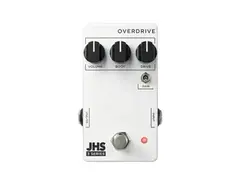
Great overdrive to get many tones
The 3 Series Overdrive is a versatile low-to-mid gain soft-clipping overdrive, and it is the main dirt pedal of my practice pedalboard.
I'm quite new to guitar but I have already tried a bunch of overdrive pedals. What I found special about the 3 Series Overdrive is how its sound does not get muddy. It is possible to play chords and still get good definition when using significant gain.
In addition, it is very versatile, enabling for a wide range of usable sounds. Its simplicity makes it easy for me to know which knob to adjust in order to get closer to a particular sound. I use the pedal to get an overdrive tone that fits the type of song I'm practicing, and also to stack it with an EHX Hot Tubes when fuzz is needed.
This pedal replicates the discontinued Japanese HAO Rumble Mod boutique pedal, which was inspired by the tones of Dumble amps, which were inspired by the tone of Robben Ford using a Fender Bassman amp pushed by a Tube Screamer. So it has a connection with the Tube Screamer while being different, as JHS describes in a surrealistic way.
Other reviews indicate that the pedal sound is too bright. I'm using a Gretsch guitar with blacktop Broad'Tron humbuckers, and the brightness level of the pedal works really well for me, finding usable sounds in most of the "body" knob range. For brighter pickups, the story may be different.
The "gain" toggle provides another level of versatility: a cleaner sound with the gain toggle up (led clipping) and more compressed with the toggle down (silicon clipping).
The only minor negative considerations for me are related to volume discrepancies:
- The last 15% of the "body" knob becomes noisy, requiring to reduce the volume to fix it.
- The gain toggle has a significant difference in volume. I have adjusted my EQ pedal to compensate for the volume difference quickly.
855
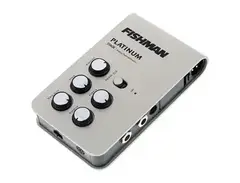
Great for taming the piezo quack
I use it with an electric ukulele with carbon strings. The ukulele uses a "piezo" system and the sound was not ideal when connected directly to amps or effect pedals.
After researching, the issue seems related to impedance imbalance. My ukulele had an output impedance of 3M Ohms, and it needed to be connected to a device with a much higher input impedance (which was not the case of most amps and pedals). The Fishman Platinum Stage has an input impedance of 10M Ohms, improving the resulting sound.
In addition, the available EQ helps to attenuate the spike of piezos when attacking the string. The other piece that helped with the piezo differences of volume was a compressor. If you don't have one, you may consider the pro version of the Fishman Platinum.
Some of the drawbacks: - Knobs are not very solid with little friction settings can get changed by accident. - Physical format is not very pedalboard friendly. I ended adding Velcro on top of it's flat surface to attach a tuner on top and save space. - There is no button to turn it off, which was not a problem for my "always on" use
855
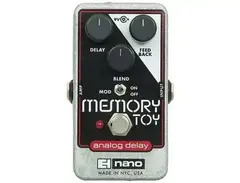
Great simple analog delay part of a classic family
I needed a simple slapback delay for my practice pedalboard, and the Memory Toy does the job well.
I didn't need extra features, but the pedal comes with a modulation option which I have been using it more often than I expected.
Although it is the smallest member of the Memory Man family, it seems to be using the bucket brigade chips that provide the classic analog delay sound of the bigger relatives
Something to consider: the pedal seems sensitive to power supply characteristics, in my case it was affecting the point of the feedback knob at which self-oscilation starts.
Initially, I tried the pedal with an EHX power adapter (that came with another pedal), and the Memory Toy was self-oscilating quite early (around 40% on the feedback knob). That EHX adapter have been working well with many other pedals, but I noticed that the adapter was actually providing 9.6V instead of just 9V. So maybe that was causing the issue.
For a moment I considered adjusting the internal trim pots, but I was concerned about messing it up. Finally, I didn't had to since the issue was fixed when I added the pedal to the pedalboard.
I connected the pedal to a 9V power bank with isolated outputs in the pedalboard. The issue was fixed. The self-oscilation now takes place much later (about 70% of the feedback knob). This gives a much broader range to adjust the settings.
855
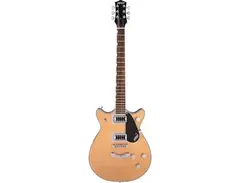
Great electric guitar, with everything a beginner can ask for.
As a beginner I wanted a guitar that facilitates my learning journey, and makes me excited to play with it. This guitar plays good, sounds good, is versatile, is attractive, and is quite affordable.
When looking for my first guitar, in this price range it is hard to find something that is not a direct copy of models from another brand (as it is the case with Squire or most of the Epiphone models). This "double jet" is part of the Gretsch history, and a relative to the higher-end models that can be seen in the hands of inspiring musicians such as Malcolm Young, Jack White or Jordan Cook.
Pros:
Good build quality makes it easy to play. Has a comfortable neck, low action, and a double cutaway that facilitates access to all frets. It also stays in tune well. Some reviews report the jack connector to be a bit loose, but that was not an issue with mine (maybe it was fixed in recent models, or I was lucky).
Good sound. Blacktop Broad'Tron pickups fall in-between P90s and PAFs, which provide good versatility for different genres. These pickups respond to picking dynamics quite well . The characteristic Gretsch configuration of a master volume and one volume control for each pickup allows to blend the bridge and neck pickups to taste, and use the master volume to clean-up your overdrive while keeping the balance between pickups.
Nice details. The natural wood Finnish, thumbnail fret markers, V-stoptail and screwed strap buttons are distinctive features which I like (although this is subjective).
Affordable. For under 500 $/€/£ you avoid the worrying that come with more expensive options. Being new to the guitar world I cannot compare to too many guitars, but trying a couple of guitars 2-3 times the price at the shop, I can say I was not missing anything significant.
Cons:
Neck dive. When standing, the strap button position is not balanced and there is some neck dive. For playing seated (what I’m doing most of the time) it is not a problem at all. Using the right strap is enough to prevent the neck dive when standing up. For me, a wide leather strap, a Y-shaped strap (with one strap for each shoulder), using an anti-slip pad on a regular strap or an acoustic-style lace to the headstock have been useful options to avoid the neck dive.
Pickup selector and electronics. At some point the pickup selector stopped working properly. Selecting the neck pickup was muting it. A bit of Deposit F5 fader lubricant was enough to fix it. I just had to unscrew the pickup selector and apply the spray there.
Affordable bag/case is hard to find. There are not many options for a guitar case or bag. The official from Gretsch is expensive (about half the price of the guitar). Fortunately I found a used case at a good price. The only affordable alternative I found was the RockCase RC 10604, which seem to fit based on the internet comments and pictures but I have not checked it myself.
Preferred Settings + Usage:
Pickup selector: Middle position. Master volume: 100% (reducing up to 25% when needed). Neck pickup: 80% Bridge pickup: 100%. Tone: 100%