
Sofa Musician
Sofa musician getting ready for the streets
Role
Every rig tells a story. Start yours.
Catalog your gear, wishlist what's next, and share the setups behind your sound — free.
Create your EquipboardInstruments 11

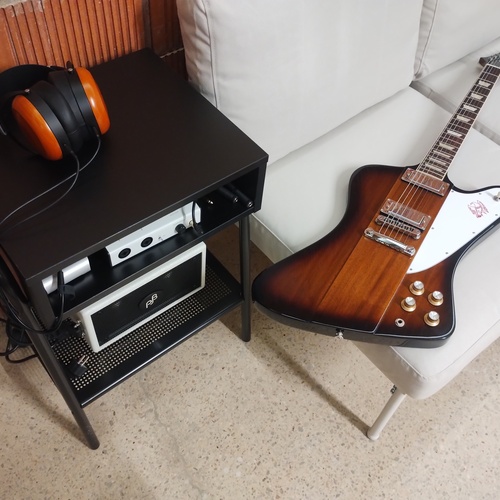
The Platypus is a special incarnation of the Firebird, combining some aspects from the classic "reverse" model (body shape, and pickups) and other aspects from the later "non-reverse" model ( set-neck construction, flat six-on-top headstock design, and lack of banjo tuners).
The result is a modernized version of the Firebird that keeps the great classic looks and sound, while improving some aspects contributing to the neck playability, avoiding neck-dive, keep pickups parallel to strings, and improving tunning stability. I'd have appreciated the new model to still be nechk-through, but it was not a deal breaker for me since this has not much practical impact.
The pickups are true Alnico 5 Firebird pickups, and they sound great. Dynamic and great note clarity. The volume and tone knobs allow to get a wide range of usable tones, which makes the guitar really versatile.
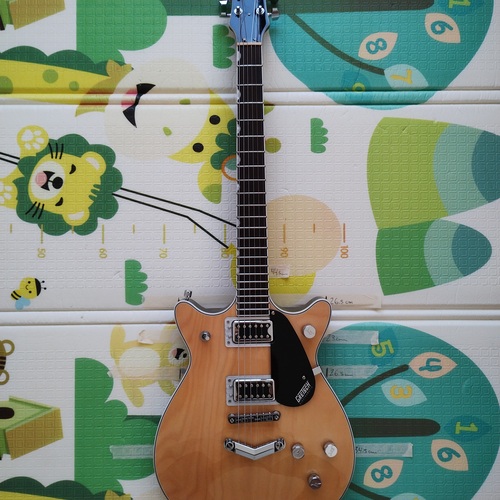
Versatility was important in my case, since I want to keep my guitar collection quite minimal with just two guitars: an affordable Gretsch electrònic double jet (my first guitar, which being affordable I've been comfortable taking anywhere) and, the Firebird Platypus (to play at home).
I play mainly seated, and found the Firebird quite comfortable. The ergonomics of Firebirds have always been a mystery to me.
The Firebird horn on the treble side helps to keep the neck higher (less horizontal to the floor) which makes it comfortable and facilitates fret access when playing seated. On more conventional guitars you may need to shift to "classic" position to achieve this. However, comments and reviews often describe Firebirds, as huge and "shifted to the left".
Interestingly, when I was finally able to try a Firebird in a store, it didn't feel that different from my Gretsch G5222 (for which you won't read such comments). So I guess it depends on which types of guitars you are used to play, in which position, and how it fits your body.
Being a less common model, it is priced a bit high. However, with some research you may find good opportunities for a discount (I got mine at a 24% discount of the official price).

As a beginner I wanted a guitar that facilitates my learning journey, and makes me excited to play with it. This guitar plays good, sounds good, is versatile, is attractive, and is quite affordable.
When looking for my first guitar, in this price range it is hard to find something that is not a direct copy of models from another brand (as it is the case with Squire or most of the Epiphone models).
This "double jet" is part of the Gretsch history, and a relative to the higher-end models that can be seen in the hands of inspiring musicians such as [Malcolm Young](https://youtu.be/n_GFN3a0yj0?si=PLwx2QcwgJTBedrZ), [Jack White](https://youtu.be/iLRPTvlDqNc?si=itdQ49NGfADopeq4) or [Jordan Cook](https://youtu.be/_5i6JcRontc?si=ivJEoT6K2EwokCes).
**Pros:**
- **Good build quality** makes it easy to play. Has a comfortable neck, low action, and a double cutaway that facilitates access to all frets. It also stays in tune well. Some reviews report the jack connector to be a bit loose, but that was not an issue with mine (maybe it was fixed in recent models, or I was lucky).
- **Good sound.** Blacktop Broad'Tron pickups fall in-between P90s and PAFs, which provide good versatility for different genres. These pickups [respond to picking dynamics quite well](https://youtu.be/c-Efq8nf_-I?si=w-5iRm5S3RVXEnv8) . The characteristic Gretsch configuration of a master volume and one volume control for each pickup allows to blend the bridge and neck pickups to taste, and use the master volume to clean-up your overdrive while keeping the balance between pickups.
- **Nice details.** The natural wood Finnish, thumbnail fret markers, V-stoptail and screwed strap buttons are distinctive features which I like (although this is subjective).
- **Affordable.** For under 500 $/€/£ you avoid the worrying that come with more expensive options. Being new to the guitar world I cannot compare to too many guitars, but trying a couple of guitars 2-3 times the price at the shop, I can say I was not missing anything significant.
**Cons:**
- **Neck dive.** When standing, the strap button position is not balanced and there is some neck dive. For playing seated (what I’m doing most of the time) it is not a problem at all. Using the right strap is enough to prevent the neck dive when standing up. For me, [a wide leather strap](https://equipboard.com/items/levy-s-basic-leather-strap-m1), a [Y-shaped strap](https://equipboard.com/items/d-addario-daddario-50dare000-guitar-strap) (with one strap for each shoulder), using an anti-slip pad on a regular strap or an acoustic-style lace to the headstock have been useful options to avoid the neck dive.
- **Pickup selector and electronics.** At some point the pickup selector stopped working properly. Selecting the neck pickup was muting it. A bit of Deposit F5 fader lubricant was enough to fix it. I just had to unscrew the pickup selector and apply the spray there.
- **Affordable bag/case is hard to find.** There are not many options for a guitar case or bag. The official from Gretsch is expensive (about half the price of the guitar). Fortunately I found a used case at a good price. The only affordable alternative I found was the RockCase RC 10604, which seem to fit based on the internet comments and pictures but I have not checked it myself.
-m.webp?v=1756456302)


Pedalboard 54


The 3 Series Overdrive is a versatile low-to-mid gain soft-clipping overdrive, and it is the main dirt pedal of my practice pedalboard.
I'm quite new to guitar but I have already tried a bunch of overdrive pedals. What I found special about the 3 Series Overdrive is how its sound does not get muddy. It is possible to play chords and still get good definition when using significant gain.
In addition, it is very versatile, enabling for a wide range of usable sounds. Its simplicity makes it easy for me to know which knob to adjust in order to get closer to a particular sound. I use the pedal to get an overdrive tone that fits the type of song I'm practicing, and also to stack it with an EHX Hot Tubes when fuzz is needed.
This pedal replicates the discontinued Japanese HAO Rumble Mod boutique pedal, which was inspired by the tones of Dumble amps, which were [inspired by the tone of Robben Ford](https://youtu.be/JlWrkqChSVk?si=s-FWOxV1SP3T316w) using a Fender Bassman amp pushed by a Tube Screamer. So it has a connection with the Tube Screamer [while being different](https://youtu.be/82uuxCyHXt0?si=-ysQJsl5cyQTWBNG), as JHS describes [in a surrealistic way](https://m.youtube.com/shorts/TskKYb9n2jY).
Other reviews indicate that the pedal sound is too bright. I'm using a Gretsch guitar with blacktop Broad'Tron humbuckers, and the brightness level of the pedal works really well for me, finding usable sounds in most of the "body" knob range. For brighter pickups, the story may be different.
The "gain" toggle provides another level of versatility: a cleaner sound with the gain toggle up (led clipping) and more compressed with the toggle down (silicon clipping).
The only minor negative considerations for me are related to volume discrepancies:
- The last 15% of the "body" knob becomes noisy, requiring to reduce the volume to fix it.
- The gain toggle has a significant difference in volume. I have adjusted my EQ pedal to compensate for the volume difference quickly.

-m.webp?v=1784200864)

I needed a simple slapback delay for my practice pedalboard, and the Memory Toy does the job well.
I didn't need extra features, but the pedal comes with a modulation option which I have been using it more often than I expected.
Although it is the smallest member of the Memory Man family, [it seems to be using the bucket brigade chips that provide the classic analog delay sound of the bigger relatives](https://youtu.be/zcfg-Blhepo?t=387&si=wNE8c6TPmq5bDFUH)
Something to consider: the pedal seems sensitive to power supply characteristics, in my case it was affecting the point of the feedback knob at which self-oscilation starts.
Initially, I tried the pedal with an EHX power adapter (that came with another pedal), and the Memory Toy was self-oscilating quite early (around 40% on the feedback knob). That EHX adapter have been working well with many other pedals, but I noticed that the adapter was actually providing 9.6V instead of just 9V. So maybe that was causing the issue.
For a moment I considered adjusting the internal trim pots, but I was concerned about messing it up. Finally, I didn't had to since the issue was fixed when I added the pedal to the pedalboard.
I connected the pedal to a 9V power bank with isolated outputs in the pedalboard. The issue was fixed. The self-oscilation now takes place much later (about 70% of the feedback knob). This gives a much broader range to adjust the settings.


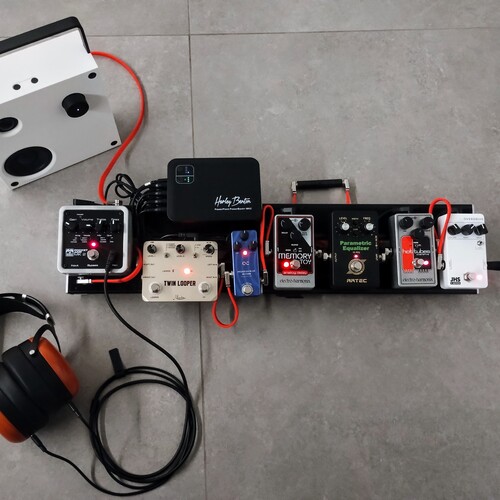
The Palmer Pocket Amp has been quite useful as a portable pedal platform for my practice pedalboard. It is affordable, takes pedals well, and provides multiple connection options (headphones, xlr, jack out, and aux in) to support multiple uses.
I use the Pocket Amp at the end of a battery-powered pedalboard, making it a truly portable solution. I can connect my headphones for silent practice, or a battery-powered speaker for others to hear. In this way, I can play anywhere without looking for power sockets, or the need to carry an amp.
With three types of amp simulations, the Pocket Amp may not be as versatile as other digital solutions. You'll find more options in modern amp simulators, modellers, or profilers. However, I find the simplicity of this all-analog pedal to be quite appealing in order to focus just on playing without distractions.
Most of the time I use the clean "Vintage" (Fender-style) option for a clean sound, with different pedals in front. Normally I just tweak my main overdrive to approach a tone that suits the song, and keep the rest of the pedals (higher gain, EQ, delay and reverb) at their usual sweet spot
Occasionally I used the British (Marshall style) setting too, and found it quite convincing on its own or pairing with the EHX Hot Tubes.


I have used this PowerBank on two pedalboards already, with overall positive results.
I wanted these pedalboards to be very portable: using them without an amp, and having no need to plug them into a socket. Just plug the guitar to the pedalboard, and either some headphones or a battery-powered speaker.
By using an amp simulator and a headphone amp pedal at the end of each pedalboard, I just needed a battery to power the pedals.
The PowerBank+ has been powering my pedals and keeping them quiet. Connecting the pedals to the bank has solved some issues in terms of noise and unexpected behaviours (EHX Memory toy was self-oscilating too early). The capacity is enough for weeks of playing without having to charge.
I only experienced a particular case where pedals got noisy, but it was possible to fix it. A chain of seven true-bypass pedals was producing some electric noise, even when they were bypassed. But the issue only happened when pedals were connected to a particular combination of the battery outputs. I'm not sure if it may be an issue of the pedals, or a problem with the specific unit. But I didn't had such issue with another unit which is powering my larger pedalboard (using all the outputs).
Fortunately, for my practice board I just needed 7 of the 9 outputs available, so I could connect the pedals to different outputs and avoid the issue.
Another minor issue I experienced was trying to make the Power Bank fit in the pedalboard. I was planning to attach the battery to the back of the pedalboard in order to keep more space in the surface for the pedals. However, the PowerBANK+ is thicker than other non-battery power plants. While I could fit the battery at the back of my larger pedalboard, I had to keep it in the surface (partially overflowing) in my smaller pedalboard.
-m.webp?v=1783936871)

Great tuner with big and clear display despite being compact. You can connect your instrument directly (for better results), or just place it nearby to use the incorporated microphone (supporting acoustic instruments). More precise than most apps, clip-on, and pedal tuners.
This is not in the pedal format, so it is not possible to silence the signal while tuning. If you really need that, Korg has a pedal tuner with a similar display, for twice the price.


The EHX Bass9 provides excellent tracking and a realistic bass sound. I have used it successfully with both a guitar and a ukulele.
This pedal has been useful to both record bass backing tracks to use with a looper, and to use the bass as an additional layer doubling the main instrument to achieve a thicker sound. The later has been useful to get a much richer sound with a fuzz pedal (the Deluxe Bass Big Muff, in my case). With the ukulele, in some situations, removing the dry signal completely.
The pedal has two outputs. One keeps the original signal and the other provides the effect signal (where the bass and the original can be blended to taste). Having these two signal paths has been useful in combination with an ABY pedal. The original signal can go through some gain stages to be combined in the ABY pedal with the bass signal as an optional layer that can be enabled with a tap.
I have been mainly used the P-bass option, but there are a good number of options to experiment further.

The Lead foot ABY is a simple ABY pedal. Feels solid and the foot switches placement and style make it usable. I use footswitch toppers for extra surface and color coding.
I use the ABY pedal to combine together two signal paths that were split with the [EHX Bass9](https://equipboard.com/items/electro-harmonix-bass9-bass-machine). In this way, I can optionally add the pitched-down bass sound to the main overdriven guitar sound. It has worked quite well for my purpose, without noises or glitches.
This ABY pedal is mechanical, which makes it basically equivalent to switching patch cables on the fly. Depending on the application a more advanced solution (buffered line switchers) may be preferred.
The size is ok, taking less vertical space than other pedals. The access to the battery is not the easiest but fortunately the battery lasts long since it is only used for the LED lights.
In my experience, the main inconvenient is that the lights only turn off when there are no jacks connected to the A and B inputs. This makes it a bit inconvenient to use on a fixed set-up on a pedal board since you have to remember to connect and disconnect those jacks every time if you don't want the battery to drain when the pedal board is stored. An on/off switch or 9V connection would have been preferred.


Amplification 14


The Spark Go is one of the most portable and affordable ways to enter the Spark ecosystem.
A compact amp that provides many tone options and covers many of the practicing needs with a single device: good quality amp and pedal simulations, easy access to backing tracks (from YouTube or AI generated), chord detection, recording option, use as audio interface, and access to a myriad of community-created presets in Tone Cloud to quickly find a particular tone.
The amp speaker is obviously limited by the size of the device when playing loud, but it sounds great for practicing at low volumes or using headphones.
The only drawbacks are related to some unpolished aspects about the app:
- Connecting to the device is not always working at the first attempt. Especially on Android. On an iPad the connection was more reliable and stable.
- Exporting your local presets across devices is not straightforward. The only option seems to be based on Dropbox.
- Recording feature is limited. It does not work on Android due to a bug. On iOs It is possible to record, but the sound is recorded from the device microphone which is not ideal.
- The audio interface functionality is not working on mobile devices.


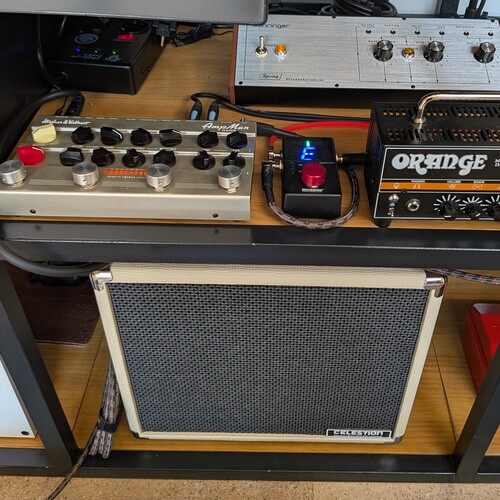
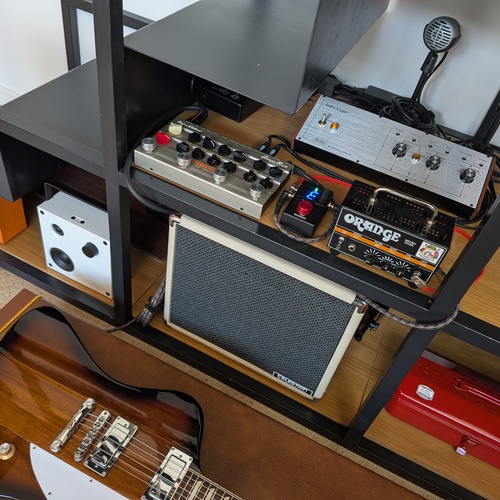
The EHX 5mm is a simple and affordable power amp pedal. It has been useful to connect my practice pedalboard into a 10" cab ([Harley Benton G110](https://equipboard.com/items/harley-benton-g110-celestion)) to get a fuller sound compared to headphone practice or smaller combos.
The 5mm pedal provides more than enough volume in this context, and can work connected to the pedalboard battery ([Harley Benton PowerPlant PowerBank+ mk2](https://equipboard.com/items/harley-benton-powerplant-powerbank-mk2)), which makes it a portable solution (with lighter cabs).
This pedal was also quite affordable. I was lucky to get it right before it was discontinued in 2025.
The only drawback is the lack of an on/off button, which requires to use the power connection as such.

The looks of this orange amp in miniature are really cool, but don't think this is a toy or pure decoration. This little box provides many possibilities for very little price.
I'm using the Crush Mini with a portable pedalboard, powered by the same Harley Benton battery power bank I use for the pedals.
The direct sound is limited by the speaker size, and too much distortion becomes unpleasing. However, the clean sound is good, and usable as a pedal platform. The cab output makes it go to another level. Connecting to a cab you can get a good loud sound with a totally portable solution. In comparison, the sound through the cab is not as full as with the Orange Micro Dark, but still sounds good with the Crush Mini.
The headphone output for the Crush Mini is quite usable (much better than the Micro Dark, which was a bit noisy).

After playing with practice amp combos (with small speakers) for a while, I wanted to try a larger cab. Due to space constraints, a 1x10 was the largest I could get, and the Harley Benton G110 was a very affordable option.
This cab sounds full and provides enough volume for jamming. I don't have extended experience with other cabs, but I was happy to hear a smoother sound without the roughness I was getting at times with smaller speakers and headphones.
I tried this cab connected to different devices: the [Orange Micro dark](https://equipboard.com/items/orange-micro-dark) hybrid amp head (20W), the [Orange Crush Mini](https://equipboard.com/items/orange-crush-mini-2018) combo through its 8 Ohm out (3W), and the [EHX 5mm](https://equipboard.com/items/electro-harmonix-5mm) power amp pedal (2.5W).
The cab sounds best with the more powerful Micro dark, but the other options (combined with [a battery-powered power bank](https://equipboard.com/items/harley-benton-powerplant-powerbank-mk2)) allow for a more portable set-up.
The cream tolex and the grill cloth look nice. To simplify the look I unscrewed the Harley Benton logo from the top, leaving only the Celestion logo at the bottom corner.
The build quality seems good, and it is quite lightweight. It is equipped with a [10" Celestion Tube10 (G10E-30) speaker](
https://equipboard.com/items/celestion-tube-10-g10e-30) in a closed-back set-up. This speaker is used in amp combos such as the [Fender '68 Custom Princeton Reverb](https://equipboard.com/items/fender-68-custom-princeton-reverb-12w-1x10-tube-guitar-combo-amp). For the average price of a pedal, you cannot ask more from a cab. This cab provides excellent value for the money.

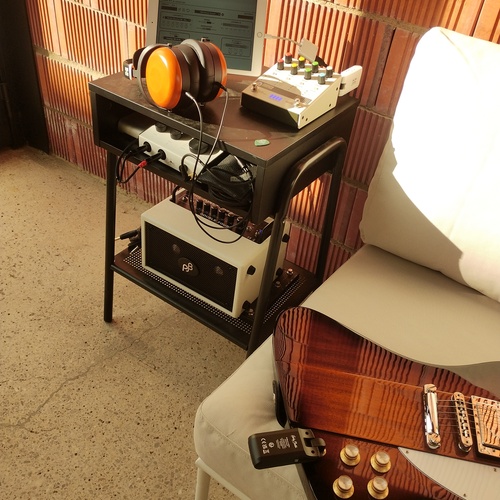
The Vappeby (formerly Eneby) speaker is mainly intended as a portable Bluetooth speaker. However, it has an aux input without any latency. In combination with a battery-powered amp-like pedal (amp simulator, headphone amp, etc.), it enables a very portable setup.
Sound is good for home uses, and [the internal design seems solid](https://youtu.be/1t5E-9tRq-8?si=yt9F4zB03xmOHpzz).
Being an Ikea product, it provides a nice design at an affordable price. Visually, it has its roots in a previous collaboration between Ikea and Teenage Engineering (whose products are often priced much more higher).

I'm not an audiophile, and I lack experience with high-end headphones. My point of reference are the Bose Quiet Comfort headphones with noise cancelation, which I use for work meetings and listening to music.
I was looking for some headphones for silent guitar practice (which I could use for listening to music too).
I did not need Bluetooth or noise cancellation. Actually, I preferred to be able to hear the environment (in case someone talks to me) while not disturbing others. I was attracted to the idea of trying some headphones using planar technology, and most of the options were quite expensive.
The Sumdara Closedback have been a clear improvement in sound quality over my previous headphones.
Currently the Sumdara Closedback are available at less than one third of their original price. After launch, the Sumdara Closedback got bad reviews due to the comparisons with the open back version. However for someone who has not tried the open back version, I find the Sumdara Closed backs to be very good headphones at an affordable price.
They are easy to drive. I have been able to use them on all kinds of devices from mobile phones to amps and headphone amp pedals.
The only drawbacks are minor:
- Weight. The use of nice materials such as metal and wood make them more heavy than the previous headphones I had, which were made mostly out of plastic. Wearing them feels comfortable, but after a long practice session, I have a slight feel of relief when taking them out.
- Cable connection. A Y-shaped cable is used to connect each side of the headphones. This makes it a little harder to get the cable out of the way when playing guitar compared to other headphones where the connection is only done to one side of the headphones.

The Marshall Monitor headphones (version 3) are excellent.
They are light, comfortable and provide great audio quality.
I found noise cancellation to be better than my old Bose Quiet Comfort. Also, when connected to multiple devices, the headphones handle very well the device switch based on where audio is being played (which was a common issue with previous Bluetooth headphones)
The only drawbacks are minor:
- Lacks a jack connector. An USB C to jack cable (included) is needed, which seems less standard than the common jack cable to connect I to the headphone out of an amp.
- Construction materials include a good amount of plastic. So it is unclear how it will wear over time


Recording 10

Great interface to capture audio with good quality. Compact, solid and simple to use. I use it with an iPad to capture the audio of an electric guitar for different purposes: record the audio, record videos using the interface input as their audio, and using virtual amps and effects. I used it successfully when both, connecting the guitar directly, and also using a pedalboard.
The "enhance" feature provides a subtle but nice improvement. So I keep it on. Despite some added amp qualities with the "enhance" option, the clipping is still something to avoid. In any case, the level indicators make it easy to adjust the right amount of input gain to avoid clipping easily.
For my setup, using it with an old iPad (5th gen), it is great to see that it just works when connecting it (using the camera adapter since older iPads lack USB ports). The only drawbacks in my case is that the control app is not available for mobile devices. So it is not possible to change the default settings (which is not an issue for my uses). For advanced adjustments I'd need to connect a laptop. For example, activate direct monitoring or separate the inputs to different outputs require the use of the control app. Fortunately, the changes made, are preserved in the interface until it is turned off, even when connecting it back to the iPad. So this can be used as a workaround if needed.
I mention that the interface is very silent. However, that will depend on the quality of the power supply you use with it. Using a regular USB phone charger, or connecting the unit directly to my old laptop resulted in the interface to capture audio with a lot of electric noise.
I had a similar experience with the another audio interface (Universal Audio Volt 2) and I returned it because it was noisy. Then, I found the Polar 2 with the promise of the silent FET-based preamps, and I was disappointed to get the same noise initially. So this may be a common issue with USB powered interface.
The noise issues were completely solved when I used a spare USB hub by elgato that has a power supply with ground connection and I no longer needed for my computer. This is a bit overkill, since the hub provides many ports for connecting a computer (USB, USBC, network, HDMI) and I'm using just one to power the audio interface. However, the result is exceptional. Total silence, unless the input gain is turned really high (over 80%).
I also tried a Harley Benton battery that works well for pedals and has a USB connection too. Although the noise was reduced to usable levels, the hub from elgato worked much better.
I think that manufacturers should provide a good power supply for users to experience their products at their best, or, at least, provide some recommendations for power supplies that work well with their device.

I was looking for a good and affordable condenser mic. After researching all the usual suspects in the under $100 range (AT2020, Behringer B1, MXL 990...), I found the Kingbee II.
The Kingbee II was originally released at $170, and was compared favorably to even more expensive mics. I was quite surprised to find that it was available for just a fraction of the original price (got mine for about $70). At this price point it provides huge value for the money.
The mic provides ultra low self-noise, resulting in excellent audio quality without artifacts. The sound is a bit on the dark/warm side, which I find great for me but it may or may not suit your voice.
The design is quite original, with a very unique shape. It feels like a modern version of one of those vintage mics with a sphere on top. The reference to bees is much more subtle than with version 1.
The mic is quite heavy, but it works well with a solid desk stand. I've been using [Elgato wave desk stand](https://equipboard.com/items/elgato-wave-desk-stand) and it seems quite stable.
During my research I learnt that some units may have an issue with the paint that caused a grounding issue, resulting in the mic producing hum noise. My unit was not affected, but if you can get the mic from a seller with a good return policy, it seems totally worth the risk.

I'm using this stand with the Neat Kingbee II, which is a heavy microphone. I needed a solid desk stand, preferably one that looks good and is not more expensive than the mic itself.
Elgato Wave desk has been a great solution. The stand holds the mic safely and provides flexibility adjusting the position. It provides the right amount of friction to be easy to adjust but avoid accidental moves. In addition, it has a nice minimalistic design that pairs well with the mic.
According to the specs, the max load for the stand is 1.0 kg (2.2 lbs), but is perfectly capable of holding the mic safely despite the mic weight, over 1.1Kg (2.47 lbs), exceeding slightly the stand theoretical capacity.
It is a bit pricy, but I could not find a more affordable alternative that meet the requirements. In fact, it is available at a lower price point than similar solutions such as the [Rode DS2](https://equipboard.com/items/rode-ds2).
The construction uses metal with a few plastic exceptions (such as the top part of the base). The plastic quality seems good, but at this price point, I'd expect a full-metal body.


The iRig HD is a practical solution to connect an XLR mic to a computer or mobile device. In this way, you can get a higher quality audio than with the average USB mic, without much extra hassle.
The compact size makes it apt to work almost as an adapter. I have the iRig Pre HD attached to my computer to connect a phantom-powered condenser mic for streaming purposes. In this way, I can avoid moving the audio interface from my main recording set-up, and reconnecting it back again.
The audio quality is good for my use case, with no issues or glitches. My mic requires phantom power, and it works well with the iRig Pre using just the power coming through the USB connection (not using the batteries).
The device compatibility seems quite good. I tried multiple devices and all recognized the iRig with no issues (where it was not the case of my other interface).
One important consideration is that the iRig Pre HD needs to be connected to a device in order for the mic audio to reach the headphone out. For example, it cannot be used to connect a mic into the aux in of an amp through the headphone out, even when batteries are used. For that use case, you can use the iRig Pre 2 instead.
The rubber-like plastic and the very light weight makes the construction and finish not to feel very solid. Only time will tell how long it lasts.in good condition.

I needed a portable solution to integrate an XLR mic into a battery-powered pedalboard. The iRig Pre 2 is an affordable solution for this case.
The iRig Pre 2 works with two batteries and can be used even with mics requiring phantom power.
The iRig allows me to connect the XLR mic into the aux in input of an amp sim pedal at the end of the pedalboard. In fact, both the main jack output and the headphone out of the iRig Pre 2 can be used to direct the mic audio to other devices, with independent volume controls.
The device is very compact, and audio quality seems good. However, the rubber-like plastic and the very light weight makes the construction and finish not to feel very solid.


Digital 5


I use the Dolby On app on an iPad to record videos of myself playing. These are helpful to keep track of my progress over time, and sporadically sharing with family and friends.
I found this app as I was looking for alternatives to the limited recording capabilities of the Spark app, which cannot be used with an audio interface.
The Dolby On app takes the audio from external sources, when those are available. Thus, it is possible to record the audio from an audio interface. While other apps are limited to recording only from the device microphone, Dolby On picks up the audio automatically with no issues.
I use the app with the Blackstar Polar 2 audio interface, and the audio quality of the resulting videos is great with no noises.
One consideration is that the app does not allow to select specific audio input channels for recording. Instead, when detecting an audio source, the app uses channels 1 and 2 for recording in stereo. The signal from input one goes to the left channel and the signal from input 2 goes to the right channel. To simplify the process, I use a Y cable to split the guitar signal to connect it with both inputs.
The app is simple and easy to use.
Sound enhancing features (EQ, noise reduction), and basic editing (trimming) provide good control. With all these features based on Dolby's audio expertise, it is amazing that this app is free.
The only feature I miss is the ability to "retake" a video in the middle of the recording.


Accessories 25


The case fits perfectly my Gretch G5222, for which there seems not to be many alternatives (either gig bags or hard cases).
This is not a very affordable case. Given the few alternatives, I’m glad I got a used one at half the price of a new one. This felt a much reasonable price point for a case of an affordable guitar.
The only viable alternative I found was the Rockcase RC 10604, which based on research, pictures and specs, could fit the guitar tightly, invading the padded areas in some parts. The Rockcase was available at a similar price point as the used Gretsch so I prefer to take the risk on the used condition than the guitar fitting.
The case is solid and not too heavy given it is a wood-based hard case. I’ve only been carrying during a 5min walk distance once a week. With a non-padded plastic handle and the total weight, it may be tedious to carry for much longer distances.
The guitar feels safe in the case, and the extra storage space is quite useful. The main storage box allows for keeping common accessories with me (cable, clip-on tuner, picks, polishing cloth, and notebook). I had even used the main storage to carry the Spark Go amp, keeping all the basic practice gear in a single case.


The best strap I've used so far. This is an excellent strap. The leather has a soft texture on both sides and the strap is overall very flexible. So it adapts very comfortably to the body (standing and seated), and has a good quality feel.
The locking mechanism works really well. It is quick to attach and detach. In addition, the mechanism at the strap ends is installed inside the leather ends, which avoids plastic parts to be in contact with the guitar body.
Since the leather strap comes in two parts with soft leather on both sides, it is possible to reverse one part to better attach to guitars with strap buttons located at the neck heel.
I was looking for a strap for my Firebird and wanted it to be quick to use without modifications, and safe for the guitar (integrity and finnish). I'm very satisfied with this strap.


Wishlist 26
Gear Photos 10




Top artists 3
The artists Sofa Musician has added the most gear to.


