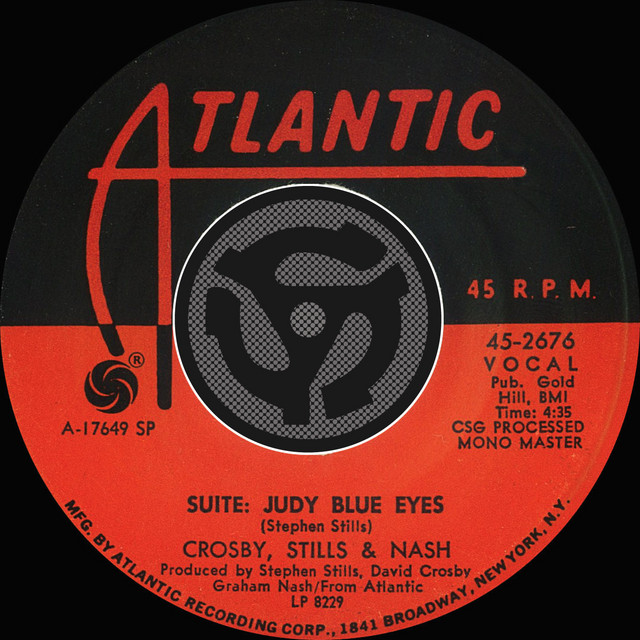
Crosby, Stills & Nash – Suite: Judy Blue Eyes / Long Time Gone
The music gear and equipment used by the artists, producers, engineers, and more involved in the making of the 1969 single Suite: Judy Blue Eyes / Long Time Gone.
Music from Suite: Judy Blue Eyes / Long Time Gone
Artists on Suite: Judy Blue Eyes / Long Time Gone

Gear Used On Suite: Judy Blue Eyes / Long Time Gone
Explore the instruments, equipment, software, and production tools used in the making of Crosby, Stills & Nash – Suite: Judy Blue Eyes / Long Time Gone (1969). Click more on each item to see exactly how it was used.
Microphones used by Stephen Stills on Suite: Judy Blue Eyes / Long Time Gone

Avg price: $7,193.09
Used to record the guitar and vocals on "Suite: Judy Blue Eyes", as stated by engineer Bill Halverson in this August 2010 Sound on Sound interview.
"I went and got a really nice acoustic guitar mic, a tube Neumann U67, and I set it up, got Stephen some headphones so he could hear what he was doing, and after I'd turned the lights out according to his request, he started playing. At this point, having watched Wally Heider record Wes Montgomery and other jazz musicians, and even though I'd done rock & roll with some electric stuff, I was pretty much a purist. So, when the old Martin D28 that Stephen played sounded really dull to me, I started adding top end and using those equalisers that we'd got for Bones Howe, while also putting a limiter on it and taking all the bottom‑end off. I just kept trying to brighten it up and get it a little more present, and once I had it sounding pretty good I thought I'd record a little, let him take a listen, and then see if he liked it and how we could change it. I was really trying to please.
"So, with David and Graham sitting next to me, I started to roll tape on the 16‑track and David signalled this to Stephen by making a circular motion with his hand above his head. Until then, Stephen had just been goofing around on his guitar, but suddenly he zeroed in on the microphone and started flailing away, and the sound was so bright that the compressor was way over‑compressed — instead of bouncing around like compressors do, it just laid down and sat there. There was also no bottom end. However, from my training with Heider I knew that I couldn't stop the take; I had to just let it go and then explain the problem and try to fix it later.
"Sitting there, I was already thinking about the things I could do to fix it, because I had totally overdone the sound, but Stephen was totally into what he was playing, and just when it looked like he was going to stop, he started another section and played some more. By now, my whole life was flashing in front of me, and certain that my career was over, I began to sweat. Meanwhile, Crosby and Nash were standing next to me, dancing — they were having a good time — and it wasn't until seven and a half minutes into the recording that the whole thing ended. Stephen had just played the basic track to 'Suite: Judy Blue Eyes'...
"It still gives me goose bumps when I listen to that recording, aware that he blew through seven‑and‑a‑half minutes with all the time changes, all the pauses, all the everything in just one take,” Halverson says. "No edits, no nothing. Anyway, when Stephen was done and I could hear him taking off his headphones, I figured he was going to come in and just blast me for the horrible recording, so I was ready with my excuses. David and Graham met him at the double doors, and while they were all high‑fiving each other Stephen turned to me and said something to the effect of, 'Oh, that's the sound I've been looking for! I love it!' and I went, 'Thanks.' I was just dumbfounded. For the next 20 years, I didn't tell him it was an incredibly happy accident, and that if I had known what I was doing he wouldn't have got what he wanted.”
"After Stephen had recorded his acoustic guitar part, he, David and Graham were ready to sing, and for that I was ready. We had done all kinds of jingles in the little room at Heider's, from the Anita Kerr singers to Jan and Dean, and so I just took the Neuman U67, opened it all the way around [ie. put it into omni mode], gave them three sets of headphones and went, 'Sing!' Singing into the one mic, they moved around a bit. They didn't need any music; they were rehearsed, they knew the lyrics, and while harmonising with each other they were also in the process of amazing each other."


