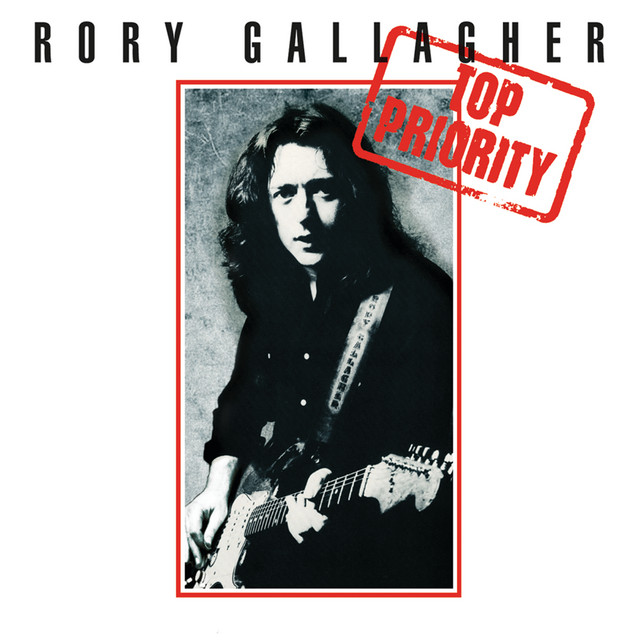
Rory Gallagher – Top Priority (Remastered 2017)
The music gear and equipment used by the artists, producers, engineers, and more involved in the making of the 1979 album Top Priority (Remastered 2017).
Music from Top Priority (Remastered 2017)
Artists on Top Priority (Remastered 2017)

Gear Used On Top Priority (Remastered 2017)
Explore the instruments, equipment, software, and production tools used in the making of Rory Gallagher – Top Priority (Remastered 2017) (1979). Click more on each item to see exactly how it was used.
Guitars used by Rory Gallagher on Top Priority (Remastered 2017)

Fender Stratocaster Electric Guitar
Avg price: $622.79
"Featuring an unusual three-tone sunburst finish, Rory used his 1958 Strat on some US tours around 1972. According to Rory’s brother, there’s a slim possibility it once belonged to Buddy Holly" - via Music Radar


Effects Pedals used by Rory Gallagher on Top Priority (Remastered 2017)

S. Hawk Ltd. Hawk II Tonal Expander
Pictured on Gallagher's official website and mentioned by Gallagher himself in the following interviews:
Then I got into a tweed Fender Bassman, and recently I got a Fender Concert, which is an old brown one, from around 1959, with four 10” speakers. I use a Hawk booster through that just to roughen it up a bit, or if it's a quiet number I plug straight in and keep the guitar clean sounding.
Guitarist, February 1985, "Rory Gallagher" by Bob Hewitt
I don’t like stacks much, except the Marshall 4x12s and 50 watt heads. I like combos miked through the PA - the Vox AC30 is my favourite. Sometimes I’ll link that up with a 50 watt Marshall twin combo. I’m fortunate enough to have a couple of the old Fender tweed covered amps - a Bassman and a Concert. I use them with a Hawk Booster, which was made by Di Marzio before he got into the pick-up business. It’s really difficult to find the perfect amp, especially if you play a Stratocaster, because there are limitations in terms of ‘dirtiness’ you can get. You sometimes have to use pre-amp, whereas if you use humbuckers, you’ve all the dirt but little clarity.
What about effects?
I use them off and on! I go through phases when I just use the Hawk Booster. At the moment I’m using some Boss units - a vibrato, flanger, octave divider and occasionally a distortion pack. I also have a little DOD analogue delay between the two amps. I don’t like rack units, I prefer the battery power - it makes less noise.
I don’t like the idea of radio transmitters on the guitar either. I much prefer that sort of umbilical cord between me and the amplifier - it makes you feel as if you’re in touch with something!
One thing I do insist on is a studio quality noise gate, but as regards effects I try to get as much from the guitar and amp as possible.
Guitar for the Practicing Musician, August 1991, "The Wearing of the Blues" by Vivian Campbell
I used to use these boosters made by DiMarzio. They were treble boosters with kind of a graphic on them.
Gallagher's personal unit was replicated by Flynn Amps for the Rory Gallagher Hawk Booster; its manual (uploaded online in November 2015) describes Gallagher's use of the Hawk II in depth, while its official product page includes two images of the interior (here and here).
Flynn Amps Rory Gallagher Hawk Booster Manual, 2010
In march [sic] 2008 we flew down to London on a mission to try and recreate Rory Gallagher’s favourite booster, the ‘Hawk®’. With help from Rory’s brother (and band tour manager) Donal Gallagher, Tom O’Driscoll (band roadie) and Daniel Gallagher (Donal’s musician son) we took Rory’s Hawk apart, meticulously photographed and carefully measured every component. It was from these sketches and photographs that the Rory Gallagher signature Hawk booster was born.
Designed as a multi-purpose device, the Hawk was intended to be used with guitars, keyboards, vocals and mixing desks. The 18V power supply meant that the Hawk was capable of massive output levels and Rory discovered that it could overdrive the input of any valve amp he used it with. Rich harmonics, wide dynamics, smooth sustain and a biting edge are all controlled from the guitar volume control. Rory used his primarily with his Tweed Fender amps but it can drive most valve amps into classic Rory tones. The Hawk was a ‘set and forget’ device that would normally be left on all the time and for guitar use it would be used last in the effect chain driving the amp hard.
From around 1973 onwards you can hear Rory use the Hawk almost exclusively, both live and in the studio. It’s a clear yet highly driven guitar tone that is precise, natural and completely unique to Rory’s music.

