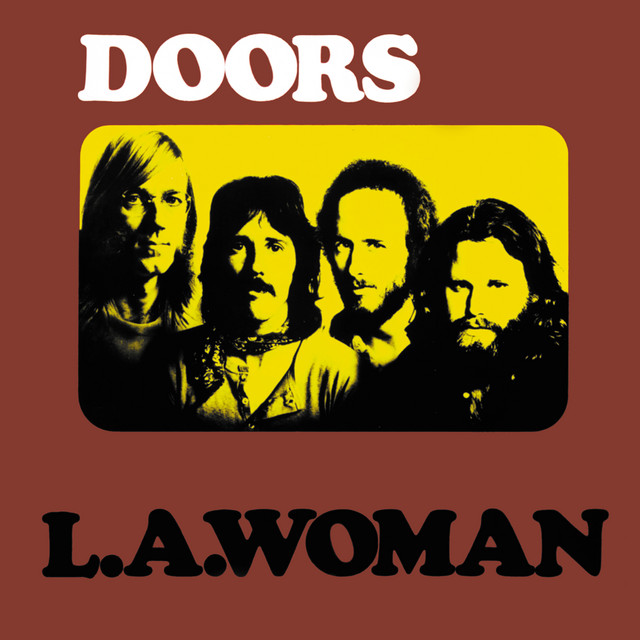
The Doors – L.A. Woman
The music gear and equipment used by the artists, producers, engineers, and more involved in the making of the 1971 album L.A. Woman.
Music from L.A. Woman
Artists on L.A. Woman

Gear Used On L.A. Woman
Explore the instruments, equipment, software, and production tools used in the making of The Doors – L.A. Woman (1971). Click more on each item to see exactly how it was used.

Ray Manzarek
Roles:
Keyboards and Synthesizers used by Ray Manzarek on L.A. Woman

Fender Rhodes Mark I Stage 73 (1969-1975)
In this photo from December 11, 1970, Ray Manzarek can be seen playing a Fender Rhodes Mark I Stage Piano at the State Fair Music Hall in Dallas, Texas. This concert was Jim Morrison's penultimate performance with the Doors before leaving for Paris. Manzarek usually toured with only his Gibson G-101 and Rhodes Piano Bass, but he also brought along a Fender Rhodes piano for the band's final two performances in Dallas and New Orleans.
A Fender Rhodes Stage 73 can also be seen in the Doors workshop during the recording sessions for L.A. Woman. The instrument would be featured on the song "Riders on the Storm."


Avg price: $1,850.00
In this photo, Manzarek can be seen playing a Wurlitzer electric piano during the Doors' L.A. Woman sessions in late 1970. The Wurlitzer is either a model 140B or its tube-amplified twin, the 145B. You can hear it on the songs "Crawling King Snake" and "L.A. Woman" from the 1971 album of the same name.


Ray Manzarek playing a Gibson G-101 organ during The Doors' legendary concert at the Hollywood Bowl in 1968. This was Ray's primary touring organ during the band's prime, as he can be seen playing it at nearly every Doors concert from late 1967 and on.
Ray described his switch from a Vox Continental to the Gibson in an interview with Modern Keyboard:
I played a Vox Continental for the first half of the Doors’ career. Until Columbia sold Vox to an Italian company. Vox was an English firm originally. And the Italian Vox Continentals just didn’t hold up. They started falling apart. Even the old ones I used to have to replace every six months. I would break them just by playing too hard. The keys would start to stick and I would fuse everything. So I’d have to throw it out, get a new one. Once every six months wasn’t bad. But once Vox was sold to the Italians, it was like once a month, once every other week.
I said, “Well that’s it. I can’t use these anymore. I’ve got to get something else. What else is there?” There was the Farfisa and there was the Gibson Kalamazoo. Now I would have gotten the Farfisa, except the top was rounded and I couldn’t put the Fender Rhodes bass on it. I needed something with a flat top. And the Gibson Kalamazoo was the only one that had a flat top. So that’s what I used—a Kalamazoo—for the rest of the time. They don’t make those anymore. They were rare and very interesting.
It was the first keyboard to have pitchbender on it—a pedal. So you could actually bend down a half step. And I use that to great effect—if I do say so myself—on “Not to Touch the Earth.” Paul Rothchild played the pedal. I couldn’t move my foot sideways on it to get the right rhythm. So Paul was kneeling down on the floor next to me as I was playing, bending this little thing that stuck up off the volume pedal. Also on “The Unknown Soldier,” I had the sustain and the pitch-bend. I had a piano stop with a sustain on it and then bent the pitch.
