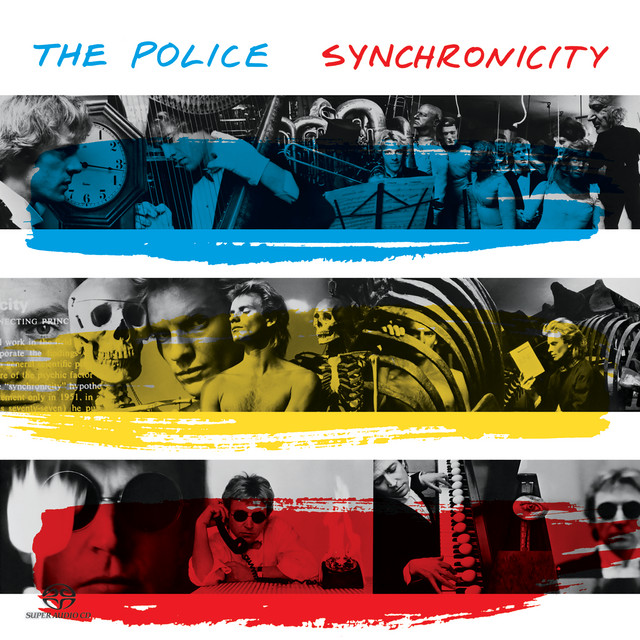
The Police – Synchronicity (Remastered 2003)
The music gear and equipment used by the artists, producers, engineers, and more involved in the making of the 1983 album Synchronicity (Remastered 2003).
Music from Synchronicity (Remastered 2003)
Artists on Synchronicity (Remastered 2003)


Gear Used On Synchronicity (Remastered 2003)
Explore the instruments, equipment, software, and production tools used in the making of The Police – Synchronicity (Remastered 2003) (1983). Click more on each item to see exactly how it was used.
Studio Equipment used by Stewart Copeland on Synchronicity (Remastered 2003)

Avg price: $2,649.08
Stewart Copeland has used an Oberheim DMX drum machine (available at the time at Tres Virgos studio facility) to record the Rumble Fish soundtrack in March 1983. He later used the DMX to program drum rhythms for the sequences Sting wrote in Los Angeles for the Synchronicity tour in order to keep in time with them, and clocked the DMX to Sting's DSX sequencer live on "Synchronicity I", "Walking In Your Footsteps", "King Of Pain" and "Wrapped Around Your Finger". He referred to it as "Mr. Oberheim". Source: The PoliceWiki, Down Beat May 1984, Jeff Seitz
Stewart had this to say about the DMX in Home Studio Recording magazine:
I've been using the Oberheim DMX up till now, and that in my opinion has the best sound, the best bass drum and the best snare sound. The cymbals on all of them are crap, you need to overdub live cymbals for that. But the triggering and so on, where you put down a trigger track on channel 1 and then you can overdub anything you want just by syncing it back in, are great. In the old days you would have to record your drum box first, then put everything else on top of it. Now you record just 4 beats in a bar and a sync pulse track.


Fostex X-15 Multitrack Recorder
Visible in this photo of Stewart Copeland's "hotel rig" (or "suitcase studio") from around the Synchronicity tour, featured in the Police Vintage gallery section of his website. Also visible in a photo of his "Rhythmatist" writing setup (though it looks reversed) here
From Down Beat magazine May 1984 issue:
On the road Copeland figures out his new charts on his "suitcase studio" - a Yamaha HandySound HS-5O1 polyphonic mini-synth, a Casio PT2O monophonic mini-synth (that also plays chords), a BOSS Dr Rhythm, the Scholz Rockman (for studio effects), a Fostex X-15 Multi-tracker cassette recorder, Sanyo C mini-monitor speakers, and Sony headphones, plus a Fender Stratocaster for that dose of heavy metal.

Avg price: $400.00
Visible in this photo of Stewart Copeland's "hotel rig" (or "suitcase studio") from around the Synchronicity tour, featured in the Police Vintage gallery section of his website.
From Down Beat magazine May 1984 issue:
On the road Copeland figures out his new charts on his "suitcase studio" - a Yamaha HandySound HS-5O1 polyphonic mini-synth, a Casio PT2O monophonic mini-synth (that also plays chords), a BOSS Dr Rhythm, the Scholz Rockman (for studio effects), a Fostex X-15 Multi-tracker cassette recorder, Sanyo C mini-monitor speakers, and Sony headphones, plus a Fender Stratocaster for that dose of heavy metal.
Keyboards and Synthesizers used by Stewart Copeland on Synchronicity (Remastered 2003)

Visible in this photo of Stewart Copeland's "hotel rig" (or "suitcase studio") from around the Synchronicity tour, featured in the Police Vintage gallery section of his website. Also visible in a photo of his "Rhythmatist" writing setup (though it looks reversed) here
From Down Beat magazine May 1984 issue:
On the road Copeland figures out his new charts on his "suitcase studio" - a Yamaha HandySound HS-5O1 polyphonic mini-synth, a Casio PT2O monophonic mini-synth (that also plays chords), a BOSS Dr Rhythm, the Scholz Rockman (for studio effects), a Fostex X-15 Multi-tracker cassette recorder, Sanyo C mini-monitor speakers, and Sony headphones, plus a Fender Stratocaster for that dose of heavy metal.

Avg price: $100.00
Visible in this photo of Stewart Copeland's "hotel rig" (or "suitcase studio") from around the Synchronicity tour, featured in the Police Vintage gallery section of his website.
From Down Beat magazine May 1984 issue:
On the road Copeland figures out his new charts on his "suitcase studio" - a Yamaha HandySound HS-5O1 polyphonic mini-synth, a Casio PT2O monophonic mini-synth (that also plays chords), a BOSS Dr Rhythm, the Scholz Rockman (for studio effects), a Fostex X-15 Multi-tracker cassette recorder, Sanyo C mini-monitor speakers, and Sony headphones, plus a Fender Stratocaster for that dose of heavy metal.
Amplifiers used by Stewart Copeland on Synchronicity (Remastered 2003)
-m.webp?v=1777705588)
Scholz Research & Development Rockman X100 Headphone Amp
Visible in this photo of Stewart Copeland's "hotel rig" (or "suitcase studio") from around the Synchronicity tour, featured in the Police Vintage gallery section of his website. Also visible in a photo of his "Rhythmatist" writing setup (though it looks reversed) here
From Down Beat magazine May 1984 issue:
On the road Copeland figures out his new charts on his "suitcase studio" - a Yamaha HandySound HS-5O1 polyphonic mini-synth, a Casio PT2O monophonic mini-synth (that also plays chords), a BOSS Dr Rhythm, the Scholz Rockman (for studio effects), a Fostex X-15 Multi-tracker cassette recorder, Sanyo C mini-monitor speakers, and Sony headphones, plus a Fender Stratocaster for that dose of heavy metal.
Studio Monitors used by Stewart Copeland on Synchronicity (Remastered 2003)

Sanyo Super-Compact Booster Speaker System MSP-5
Visible in this photo of Stewart Copeland's "hotel rig" (or "suitcase studio") from around the Synchronicity tour, featured in the Police Vintage gallery section of his website. Also visible in a photo of his "Rhythmatist" writing setup (though it looks reversed) here
From Down Beat magazine May 1984 issue:
On the road Copeland figures out his new charts on his "suitcase studio" - a Yamaha HandySound HS-5O1 polyphonic mini-synth, a Casio PT2O monophonic mini-synth (that also plays chords), a BOSS Dr Rhythm, the Scholz Rockman (for studio effects), a Fostex X-15 Multi-tracker cassette recorder, Sanyo [MSP-5] mini-monitor speakers, and Sony headphones, plus a Fender Stratocaster for that dose of heavy metal.
Keyboards and Synthesizers used by Sting on Synchronicity (Remastered 2003)

Avg price: $5,849.00
Sting regularly performed "Invisible Sun" on an Oberheim OB-Xa synthesizer live with The Police during the early 80s, for instance in this video of the Gateshead concert on 31 July 1982 at around the 59:30 mark. The Oberheim was Sting's main synthesizer both on tour and in the studio for both the Ghost In The Machine and Synchronicity albums, before it was replaced with the Synclavier.
According to Hugh Padgham in an interview featured in the March 1984 issue of Studio Sound magazine, Sting never liked spending ages programming a synth (the Oberheim OB-Xa in this case) to get particular sounds he wanted. Instead he'd say he wants roughly such-and-such and runs through the different presets available on the synth until he found something. "Walking In Your Footsteps" is an example of this.
Studio Equipment used by Sting on Synchronicity (Remastered 2003)

Avg price: $546.99
In this interview with Sting about the Synchronicity album published in Musician magazine in June 1983, reproduced on his website, he discusses his use of the Oberheim DSX sequencer:
“[Walking In Your Footsteps] was the first thing I ever did on the [DSX] sequencer. I was learning to work it and just played a couple of riffs [sequencer lines] which fit together contrapuntally, then played them through a couple of different sounds. It's wonderfully mechanical and rhythmic. Then I used the same sequence with the drum sound over it based on a classic rock'n'roll riff (laughs). I'm pushing the DSX to its limits. The other day I used up its memory entirely, about sixty-four bars of stuff. and it just said. "Stop! I have no more memory" I tried to stick some more in and it got really angry! It started to buzz and lights began to flash, and I had to turn it off (laughs). I had this bizarre relationship with this machine. I pushed it too far. but now I believe I'm on good terms with it. It's a little like HAL in 2001. Weird, but such a pleasure.”
In Spring 1983, Sting wrote sequences for the then-forthcoming Synchronicity tour in Los Angeles using the DSX sequencer and OB-Xa synthesizer, according to The PoliceWiki website. Stewart Copeland eventually wrote complementary drum patterns on his DMX drum machine, which he then clocked to the DSX sequencer live so he could keep in time with the sequences. Effectively a complete Oberheim system was formed - DMX, DSX, OB-Xa.
Effects Pedals used by Sting on Synchronicity (Remastered 2003)

Avg price: $161.87
In this photo from 1982, Sting can be seen with a Boss Chorus CE-2 effects pedal.
According to this Sound On Sound article, Sting would use the chorus pedal to thicken the bass sound on the Synchronicity record.

Andy Summers
Roles:
Guitars used by Andy Summers on Synchronicity (Remastered 2003)
Classical & Nylon-String Guitars

Avg price: $1,499.00
This guitar can be seen in "Wrapped Around Your Finger" music video. (0:43 minute mark).