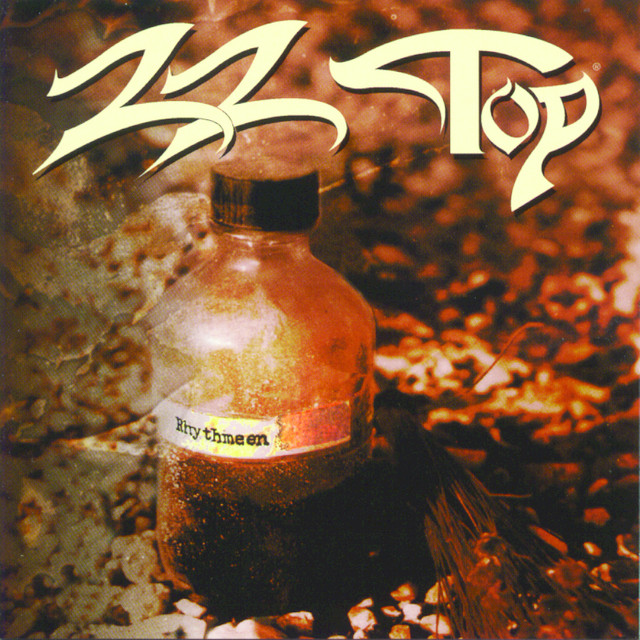
ZZ Top – Rhythmeen
The music gear and equipment used by the artists, producers, engineers, and more involved in the making of the 1996 album Rhythmeen.
Music from Rhythmeen
Artists on Rhythmeen


Gear Used On Rhythmeen
Explore the instruments, equipment, software, and production tools used in the making of ZZ Top – Rhythmeen (1996). Click more on each item to see exactly how it was used.

Billy Gibbons
Roles:
Effects Pedals used by Billy Gibbons on Rhythmeen

Avg price: $600.00
Featured in this September 2012 Vintage Guitar article covering the history of the Tremolo Control. One is on prominent display throughout Gibbons' segments in Fuzz: The Sound That Revolutionized the World, starting at 3:41.
Even now – four decades on – Billy F Gibbons remembers the first time he heard a DeArmond Tremolo Control work its peculiar magic.
“We first heard the effect not knowing what it was,” he says, speaking in the royal plural and summoning up recordings including Muddy Waters’ 1953 Chess cut “Flood” and other early blues and rock-and-roll sides where that tremolo sound shimmered. “It was not until we took a gig in 1972 with Bo Diddley, who told me about it. We were speaking about what his sound was, and I said, ‘DeArmond Tremolo Control – I don’t think I know what that is?’ Bo Diddley planted the seed.”
It’s little wonder that even Gibbons, a renowned purveyor of rare and weird sounds, didn’t know of the effect; in the ’70s, the Tremolo Control was already “vintage” when other now-classic gear was just “used.”
(...) After Bo Diddley enlightened Gibbons to the Tremolo Control, he sought one. Plugging in, however, he was unimpressed. Little did he know, but his Tremolo Control was suffering from a common ailment of the unit after so many years.
“Many users discarded them or left them behind because they claimed they didn’t work,” Gibbon relates. “But in reality it was just the simple fact that the electrolytic liquid had evaporated. We fooled around and fooled around [with ours] and said, ‘Gee whiz, this thing doesn’t seem to be doing anything,’ and that’s when we took it apart and poked around, and an electronics specialist who worked at the recording studio smiled and said, ‘Oh, you fellows don’t know about that: this unit is missing the fluid.’ I said, ‘What went in there?’ And he said, ‘Well, I’ll tell you what will work, and that’s Windex.
“So we thought, how are we going to get it in there? The little canister has a soldered, sealed top; you don’t unscrew it – it was soldered shut. But it does have a rubber gasket. So you need to find a syringe, load it with Windex, stab it in there, and fill it a little less than two-thirds up.
“So this is where the fun begins. We went down to the nearest drug store with a bottle of Windex and threw this contraption on the counter, and we said to the pharmacist, ‘We need some syringes.’ He saw us with that bottle of Windex in our hands and this thing and he said, ‘Either explain yourselves or you’re going to jail.’ But sure enough, we slated a good story and he scratched his head and smiled and said, ‘This is a first for me, but I don’t think we’re breaking any laws. Open her up!’ So we gave it an injection, and all of the sudden, back at the studio we had tremolo, brother!”
Gibbons first used the Tremolo Control on “What’s Up With That” from ZZ Top’s 1994 album Rhythmeen. From there, he never looked back. “We’ve used it on so many delightful excursions from the recording studio into the outer limits of the ether… We gained some measure of notoriety for using this thing exclusively. The mystique is quite entertaining.”
He told his fond tale of discovering the effect while recording a new album, featuring a “stereo” Tremolo Control setup. “We have two of them mounted in a convenient pull-out drawer and we’ve wired them so the guitar signal plugs into the drawer that feeds DeArmond Tremolo No. 1, which is the left signal, and DeArmond Tremolo No. 2, which is the right. The driving spindle is not notched; there are no presets. So if you’re trying to get them to jiggle at the same rate, good luck! It ain’t going to happen. But when you get two Tremolos operating at two different speeds, it really gets wild.”


