
andrescalamar's Reviews
13 reviews Back to andrescalamar's Equipboard

261
A curio
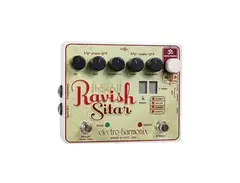
Through a convoluted web of trades and exchanges, the EHX Ravish Sitar briefly came into my life. I never had the proper theoretical grounding to tackle the nuances of its scale-based modes; I just wanted the hypnotic buzz that is so often associated with the sitar. Curiously, I don't think I ever even used this pedal on a guitar. Instead, I applied onto a bass once and onto a synth numerous times. Using both of the unit's outputs, I I rarely even used the Main sitar voice. It was usually kinda dopey. Instead, I milked every juicy, resonant drone out of the Sympathetic output. I then layered effects on top of that one (Mel9, reverb, delay) for some out-of-this-world ambience. Misusing equipment is always a fun way of getting unique sounds.
Despite the textures I could coax out of this pedal, I felt like I wasn't really getting too much from it. After a few months, I said goodbye to this fella as I sank the profits into a slush funds that yielded a Moog. The verdict? Unless you're a muso steeped in theory, this curiosity won't intuitively lead to particularly desirable tones. As such, you'll have to be extra clever as you forge your own unforeseen sounds.
261
A punchy little beastie
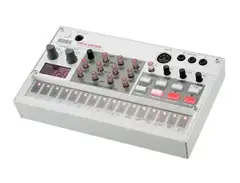
After messing around with rhythms on software and phone apps, I decided to finally spring for a piece of hardware that could supply my pieces with a necessary 4/4 snap. This little guy appealed to me due to its tiny size and minuscule price tag. As with all the Volcas, you typically get quite a bit of bang for your buck. Nonetheless, there are always limitations and caveats to keep in mind.
As far as the Volca Sample goes, there are lots of appealing factors. It's loaded with 99 presets, and a great many of them are actually quite useful. Unlike a DAW or a modern sampler, this one has a few quirks that really give the rhythms a punch. The relatively low bit rate ensures some grit, and the two analog filters on the left side will guarantee that some warmth will color the tone. Also, the step sequencer is very intuitive and quite responsive. Your finger can glide smoothly as patterns play out, as you go into step mode, or when recording live. It certainly doesn't have cumbersome buttons or complex menus. In addition, notice all those knobs in the center? They can be really helpful in tweaking a sound's pitch, speed, start point, end point, and more. You can even save your real-time twiddles. Next, you can save quite a few patterns and string them up to create "songs." Also, since it comes with a set of batteries and has built-in speakers, you can make beats on the go in seconds flat. That immediacy is certainly more conducive to pattern construction than just staring at a laptop.
Nevertheless, its not perfect. First and foremost, its the Volca Sample and not the Volca Sampler. That's a critical point! If you want to add sounds, you'll need to use your phone or computer. Then you'll need a weird app that will send the sample into the Volca via the headphone jack. Resampling, a feature of basically every other sampler out there, is also non-existent. It's not you like you can actually add effects beyond reverb anyway. It's worth adding that, while a lot of the samples are pretty good, many seem oriented towards genres that I'm personally not really into. I'd venture as far to say that some are just cheesy. Aside from the sample issues, there are other minor gripes to consider (and these are applicable to all Volcas). First, it only has MIDI IN. All the other Ins and Outs are 1/8 jacks. You'll also have to buy a power supply. In addition, while there's not extensive menu diving, you will have to deal with the several less-than-intuitive alternate features generated by pressing the Function button. Nearly every button and most of the steps in the sequencer will do a different thing when you hold down the Function key, and the barrage of options can throw you off if you're making a live rhythm. Finally, there's the issue of all the darn central knobs. It's very easy (almost too easy) to render a sample unusable by twiddling in the wrong direction. This can kill the vibe almost instantly.
In the end, I went on to say goodbye to this little fella. It was a great introduction to tactile rhythm creation, and I'll always love it for that. The sounds one can get from it are massive and have character. However, its limitations became plain enough after a while. I soon replaced it with an old Korg Electribe ES-1. Despite its own flaws, that one is more intuitive, has a multitude of effects, can do MIDI IN and OUT, is able to sample, can resample, and has 1/4 inch outputs. I'm satisfied.
Should YOU get it? Whether you're a beginner or a veteran, you'll find some great things about the Volca Sample. Your recordings will gain quite a lot from its mighty tones. The low-end rumble can be tremendous! You'll have way more fun on this than on a DAW, and your wallet won't be too upset about your choices. Just be warned that you'll end up running into frustrations as you bump into its the limits imposed by its construction.
261
A wacky reverb from a wacky set of wildcats
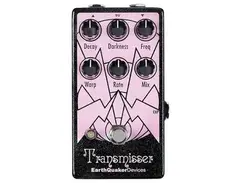
If you're here, you probably already know that Earthquaker Devices has a reputation for zany pedals. They tend to take a basic concept and then transmogrify it into some unrecognizable permutation that seems to defy preexisting categories. On this device, they subvert the notion of reverb by mixing it with bizarre filtering choices.Let it be known, right from the get-go, that the Transmisser is no ordinary reverb. This doesn't seek to emulate some realistic studio space or some cavernous churchspace. Instead, you get a weird trail of sound that woozily envelops your tone in some creamy haze. There are a lot of spacey superlatives in the official literature, and they're not far off the mark.
From a practical standpoint, though, the layer of sonic gloop which the Transmisser adds to your sound can be problematic. If you're the kind of person that likes to stack a load of pedals atop one another, you might find that it smothers your tone unsympathetically. There's little nuance once this is engaged. The length of the reverberation tends to last a good while, even on short settings. The mix knob will dominate if you go past 11 'o clock and will be nearly useless when you go past 3 'o clock.
With those caveats in mind, let's get to the fun part. If you stack simply -like, say, just two pedals- between your instrument and the Transmisser, you might have a chance of nailing something utterly unique. The best part about using this pedal, however, isn't the effect it creates when you leave it alone. "Set it and forget it" types won't get much mileage of out this. I hope you're the sort of player who loves to twiddle while holding a sustained note on your synth or guitar. The Darkness knob allows clarity to shine through or can help mute the highs on the overall sound. It's subtle, but its capable of redefining tonality. Truly lovely and trippy things can immediately happen as soon as you tweak the Frequency and Warp knobs. The former messes with the frequency of the filter while the latter sounds like you're messing with a record player's speed. When you mess with them in tandem, physically impossible ambient domains will collapse and explode before your very ears. Of course, this is tough to do while playing live. An expression pedal can help you tweak the Frequency parameter, but, well, not all of us use those add-ons.
So, is this for you? Maybe not. It's not the best pedal for absolutely everything and it won't complement most rigs. Like many Earthquaker creations, it fills a niche you never knew existed. Chances are you won't always need to fill that void. Luckily, the Transmisser will always be there if and when you do need creamy, freaky reverb trails that warble like the final echo of a dying universe.

41016
this is like the short version of the official review I wrote for Equipboard over the summer.... gloop is RIGHT. Although I find it infinitely useful as a studio tool, mainly for synthsizers though.
261
You're right about the synths. The things it did as part of the Minibrute>EchoBrain>Transmisser chain were phenomenal. Twisting knobs while arpeggios did their thing was nothing short of miraculous.
The day after I wrote this review, I ended up trading it for a Ravish Sitar. Was it a wise move? Time will tell. I probably just traded one semi-useless pedal for a more complex semi-useless pedal.
41016
I'm going to be honest, I loaned it to a bandmate for his circuit bent sampley setup and he enjoys it so much more than I do that I haven't asked for it back in almost a year.

261
A bit too much bass
I needed some headphones for some reason, and these were the only ones available at my price point at the local big box store. Sonically, they're not marvelous. I was a bit annoyed by the bass boost; this trend has been fashionable since the Beats by Dre phenomenon, and I'm not a fan. I should've just bought some headphones with a flat frequency response. Oh well. Luckily these aren't terribly uncomfortable. They have a detachable cable, too. I initially saw this is a disadvantage, but now I can see how this allows me to switch from 1/8-1/8 cables to 1/8-1.4 cables. This comes in handy when monitoring music from my Tascam or sampler.
Overall, these are nothing serious.
261
Pretty gnarly at its price point
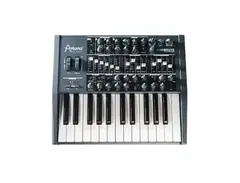
Analog for the masses? For a miserly sum, this bad boy offers users a hands-on approach to analog synthesis. There's a throwback factor in the fact that there are no presets. Forget about hidden menus and little screens. What you see on is what you get, functionally speaking.
Tonally, this synth definitely feels analog. It also feels like its got a unique voice all its own. It's not a Moog, it's not an old Korg, and its not some Oberheim. It is its own thing. Luckily, within the scope of its parameters, you've got enough leeway to craft lots of different sounds. At any point you can bring up a sub, a square wave, a saw, a triangle, white noise, and an external input. No sine wave, but you can get one by being subtle with the sub. Moreover, each one of those parameters can be mixed in with a dedicated fader and most can be tweaked with individual knobs. Some provide cool phaser and chorus effects as you play with the rates. Again, tactile faders also come into play when sculpting the envelope of your wave. I prefer immediate attack, mid level decay and sustain, a just a tiny bit of release. Your ideal sound may vary, and thankfully you've got the possibility of also crafting lengthy pads or tiny bleeping bursts of color.
Personally, most of my tweaking happens on the filter banks. This beastie is a monster when it comes to doing frequency sweeps. At times you can enter the realm of unusable high pitched squeals if you overdo it on the resonance, but generally the filters are all good fun. You can also go wild with the much-vaunted Brute Factor knob. That one can introduce a degree of distortion that can really give the sound an extra boost.
There's way more, too. You can shape each wave with a subset of faders, and you can play with a whole mess of LFO parameters (all of which can be blended in via a dedicated wheel). Also, you can arpeggiate at your heart's delight. There are enough variations on board to keep it interesting. In addition, you can simply use it as a MIDI controller thanks to its very sensitive keys. Finally, since it has Audio In, you could potentially just use this thing as a wacky effects unit. It's done pretty interesting tremolo and sweep filtering to my guitar, and I bet it could do far more if you do real time knob twisting as you insert prerecorded music.
So far there's been praise, but what about the cons? Well, the keyboard is a bit annoying. The keys are the right size, but its only about two octaves. If you want to shift, you'll have to press buttons for that. Moreover, when I got mine, one key was already finicky and it only works if I press at the center rather than the edge. Also, many of the LFOs aren't that useful, so that's a drag. I also dislike how the arpeggio doesn't respond to the order you play the keys that constitute a chord. Want to use it as a sequencer? You'll have to do some hacking. Lastly, there will be a steep learning curve at first; expect to end up getting very useless sounds very quickly. It will take a while to truly grasp what each knob does. Since you can't save any presets, you'll eventually have to intuitively grasp what works best for your sound design.
Regardless of these gripes, I'm pleased with this monophonic synth. I've used it for pads, leads, and bass lines. It's got character by itself, and it has interacted very well with my effects units. It has also been study enough to survive international travel intact. It's not grossly oversized, after all. Any fledgling synthesist ought to consider starting off with this unit. It might not be a Minimoog, but it's still a powerful device that can inspire with its simple old school approach.
41016
great review, you should write for the site, right now I'm the only one doing official gear reviews, everyone else is just doing those 'round up' type artcile
261
It'd be cool to give that a go. I'll admit I'm not too loaded with equipment, though. What I've listed is all I've got.
41016
nah, you get loaner units from the manufacturers to do reviws, in the process you get to test out a lot of stuff... but you need to forge relationships for yourself, right now the admins pretty much just get offers for reviews from string companies. I had to go out and make friends with effect and synth manufacturers on my own via facebook and stuff.
261
@jimmarchi1 that might require a bit more chutzpah than I can muster!
261
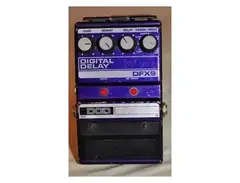
Pedestrian delay with a cool trick up its sleeve
I bought this one from some middle aged guy who'd still kept the original box, manual, and battery cover. What prompted me to get a standalone digital delay, though? Perhaps I had some nostalgia from the days when I'd messed with a friend's DD-7. Maybe I liked the idea of creating short but infinite repeats. Whatever it was, I went ahead and paid about fifty bucks for this toy from the waning days of the eighties.
It's not the best delay you'll ever hear. The shortest delay options on the Range/Mode know are, it should be said, utterly useless. You have to crank it to the 63ms option to get anything remotely audible. From there, the delay times become good enough for practical playing. It's 12-bit digital, so you're operating below CD quality; nevertheless, its a clean sound overall.
The real draw here, however, isn't the delays themselves. It's the weird little repeat mode. It's worlds away from your modern loopers or freeze functions, but its got its own little charm. You can only capture about a second's worth of music, but that's where your imagination can take hold. Want to repeat a single note or keep a chord that will chop in over and over again? Here's your machine. Think of what Zappa did live in 1988. A better use for it, however, is to nab some kind of sustained ambiance and hold it. Then, by tweaking the Delay parameter, you get to shift the pitch of the sampled pad. Turn a rumble into a hiss, or reshape a dreamy pad into an ominous drone. Instant ambient! The low bit depth ensures you'll get a sound brimming with character.
If you're into more out-there genres, try to score one of these. If you're more straight-ahead, need a super basic digital delay, and happen to see one of these for cheap, I guess you might enjoy it too. Just know that there are better options these days.
261
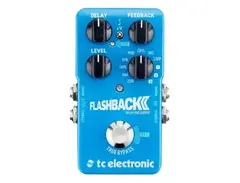
It was great but not for me
In the eternal search for great pedals, I often find myself tripping up. There have been some that sound amazing in isolation yet never seem to click in tandem with the rest of the rig. This is one of them.
When demoing the item, I was blown away by the wacky MASH feature. When coupled with the analog and tape options, it did some wild self-oscillations that reminded me of a pal's digital Space Echo (except way more gnarly). The reverse option was also pretty sweet; when coupled with the MASH button, it instantly killed the dry signal and gave you an instant backwards Jimi option. Moreover, the Crystal setting did some dreamy octave stuff that always sounded beautifully melodic. And those three TonePrint slots? Oh, TC Electronic, bless your generous little Danish hearts!
Sadly, the euphoria quickly faded as I tried to integrate this beautiful machine with the rest of the board. As I got to know the pedal, I became aware of its limitations. The tape and analog function, despite their much-vaunted new algorithms, still sounded too precise at times. Sure, there was occasional warble, but it didn't have much character or grime. The 2290 setting was pristine and digital, but too clean for my taste. The dynamic feature was initially tougher to master, and though I could see it being used to add definition to a section of a song, it just didn't seem overly useful. The two bright features, mod and crystal, were the quite wonderful. In fact, if I hadn't bought the Hall of Fame 2, I may have kept the Flashback 2. You see, both pedals share similar chorus-ish and shimmer-ish abilities. It was overkill to have both, honestly. I still believe those two are among the more magical of the pedal's presets. I've already mentioned the awesome reverse; still, I began to dislike how clean it was. Again, compared to another one of my pedals, the signal doesn't experience any radical warbles or decays over time. Finally, the looper is just a looper. Cool at times, but I already have other unit with that function.
So, what about the unique TonePrints and the MASH function? Yes, I downloaded the editor. Yes, I messed with patches. While they were indeed quite fun, none were utterly radical. As much as I appreciated the flexibility, they didn't totally convince me. And the MASH button? One thing that really ticked me off was how the tape and analog settings went right into self-oscillation as soon as you engage the MASH. I would've loved something more subtle like on the Space Echo. While a bit of nuance was eventually tame the MASH, you're never spared from the full-on mess early on.
Overall, if you don't have any kind of wacky multifacted delay, this might be a great investment. I really liked about 65% of its abilities. For me, though, it just didn't strike me as essential since I already own an Echo Park delay and the Hall of Fame 2 reverb pedal.
261
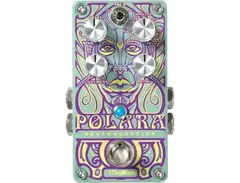
Eh.
I briefly owned this one for a while. It's one of those pedals that sounds great by itself when testing it out, yet it manages to lose its pizzazz when incorporated into the main rig at home. See, I was in the market for a reverb pedal that could go beyond the usual spring/hall/whatever yawnfests. This one seemed like a likely candidate. The reverse option was cool, as was the Halo function. That one was basically a shimmer. The modulated function seemed neat, too.
Sadly, once integrated into the pedalboard, the Polara's limitations became apparent. First, the reverse reverb is totally wet. Any nuance or blending is lost since all you can control is the predelay and intensity of the effect. Next, the Halo didn't really extend itself in any kind of magical way across the signal. It was too subtle for my taste. The modulated effect was okay, but nothing revolutionary. The other effects were rather pedestrian, too, despite their Lexicon lineage.
As such, despite its cool graphic design, this little guy went back to the store. I replaced it with the Hall of Fame 2 pedal and I regret nothing.
261
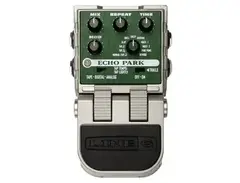
My favorite delay pedal
I bought this one used; actually, scratch that. I got it for free after I bought a Tascam multitrack tape recorder from some dude who was about to move. He included a power supply, too.
Well, after having owned a multi-fx unit with delays that simply stopped after moving one knob, the Echo Park was like a revelation from the heavens. The knob-twiddling burbling and its bouts of self-oscillation are the bees knees! The different modes (Analog, Digital, and Tape) coupled with the Mod feature all add different tonal possibilities to bend the sound even further. The textures you get from these choice ensure a certain undeniable grime to the sound. I love it. There pedal offers an array of possible delay types are well; most are vanilla, but a few others are remarkable. I'm a fan of the Swell effect for slow fade-ins on your dry signal, the Sweep effect's phaser, the Ping Pong's stereo madness, and the wild Reverse. That reverse can be amazing if you max out most of the settings. Play a few notes on the guitar then let the regeneration and decay slow take hold on the effected signal. Instant ambient piece! It mutates slowly but surely, particularly if you've messed with the Mod section. I've been known to let the Reverse just roll on for an hour after plucking two chords' worth of notes. It's incredible, it's got character, and it never ceases to amaze me.
... well, then again, this is Line 6. I had a little period between 2013 and 2017 when this little bastard failed to give me any sound from the output jack. The lights were on, but the sound was gone. Then, without doing anything other than plugging it into a daisy chain rather than its own power supply, the Echo Park began to work again. Insane, illogical, and weird; I'm just glad this little dude is back on the team. No other delay has charmed me as much as this one.
Useless fact: If you throw in stereo signals and only use one output, it folds to mono.
If you see it, but it. Immediately. If I ever get spot another one in the wild, I will absolutely nab it.
-s.webp?v=1784300277)
261
Kill yr bass
Do you hate low end frequencies? So does this pedal. When I bought this used from a dude at a postal shop, he told me it wasn't so much a 60s fuzz as it was a distortion similar to what industrial bands used in the 90s. Interesting. Well, when I plugged it in, I could sort of see his point. While it's indeed possible to nail some Keef riffs with this, there's more you can do. I myself use it to tame the booming bottom end of my Big Muff. It sharpens things quite well while maintaining a big bite. At lower volumes, it can also sound sweet right before going into some chorus and reverb.
Given its low price point and malleable snarl, I can't see you not getting at least three tricks from this particular pony.
41016
the original maestro FZ1 I sued to have was like a lazer beam of just upper mid. No bottom, no ACTUAL treble. Just some midrange and tons of boosted, buzzy, spitty upper mid. I loved it. Sometimes. Traded it for a an 80s Marshall tube amp. Made out like a bandit. Sold the amp for a grand, got the FZ1 as a birthday present back before the fuzz craze drove values up high. Bet my friend got it for peanuts.
261
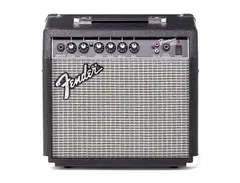
My first amp
I got it on the same day I was given my first guitar. Is this a great amp? No. Does it occasionally have an annoying buzz? Yes. Is the distortion rather dumb? Yeah. Does it get the job done when I just want to plug in and play? It sure does. It's just an amp. Nothing more, nothing less.
41016
it makes a great fuzz unit run DI and padded down though. Fucking hysterical.
261
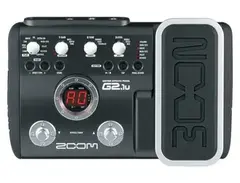
Effects Galore
I bought this one used around 2009 or so. It was like a dream come true. Suddenly I could summon several simultaneous delays or try out a bunch of shimmery modulations all at once. Post-punk, anyone? Decent distortions and realistic reverbs made it all more fun. Coupled with some decent noise reduction and adequate compression, I was all set. Later on, I discovered the fun world of slow fades and I was soon in Frippertronics land (kinda sorta, but close enough).
The unit's limitation, as with most multi-fx boxes, was that I was locked into a particular pattern every single time (Comp/wah/NR/Distortion/EQ/Amp/Modulation/Delay/Reverb). Eventually this grew frustrating. Another thing that began to rankle me is that after years of abuse some of the knobs require persistent turning and some of the buttons can now only be accessed by tapping at weird angles.
Still, I love this little guy. It's one of those cases where I got to know the unit inside and out, so I can eek out some very personal tones out of it. If I found another one for really cheap, I might consider it to replace my current dinged-up warhorse.
261
Very digital and occasionally useful rack unit
I bought this one on sale from some middle aged surfer dude. When I took it home, I figured that at least some of the presets would be useful. Well, only a few truly were. This unit was primarily directed to hair metal guys, hence the abundant number of patches prepared by axemen from Judas Priest, Dokken, and more. Want trebly distorted guitar with a hint of cheese? You got it. Lots of it. Still, that particular sound (like the genre) becomes kind of a dead end after a few minutes.
At the other end of the spectrum, my inner dream popper rejoiced at what I could get out of this unit. The rack offered some neat little Leslie simulators. Of course, they were nowhere close to the real thing, but that wasn't the point. The best way to exploit them was to max out the parameters and maybe nab some swirling Cocteau Twins tones. Lush reverbs are definitely possible when tweaking this rack unit. On other settings, you can get very long sustained cathedral sounds that are just gritty enough to stand apart from today's outstanding algorithms. Remember, this is fairly early consumer-grade digital. Oh, I should also add that it has a pretty neat Reverse Reverb setting in there somewhere. Stack a Big Muff after it and you'll get something approximating an MBV tone.
Anything else? Well, the signal chains are predetermined on your patches, so forget about customizing and tweaking. Also, the noise gate is generally always on. Not all patches allow for FX Loops, but some do. The unit also offers "Speaker Simulators" which are honestly just goofy EQ settings.
I rarely use this one since the internal battery is dead and it reverts to factory settings every single time I switch it on. It should be a simple fix; I'll get around to it at some point.
So, should you get it? Only if you're a shoegazer or a hair metal guy. Or both.