

Pricing and availability
We compare 600+ stores and found this item at 1 store. Prices updated .
Store
Reviews
Price




Average Price: $279
Budget/Beginner
$500
$1501+
Price Tier
Budget
Standard
High-end
* Product prices and availability are updated by Equipboard every 24hrs and are subject to change. Equipboard may receive compensation for purchases made at participating retailers linked on this site. This compensation does not affect what products or prices are displayed, or the order of prices listed. For more information, please refer to our affiliate disclosure.
Description
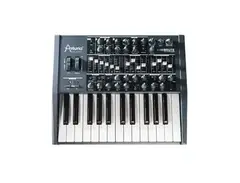
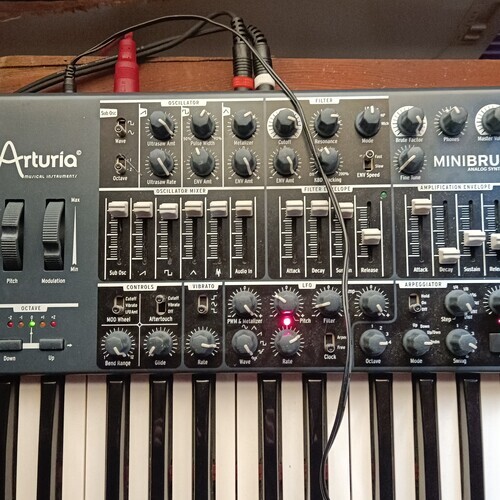
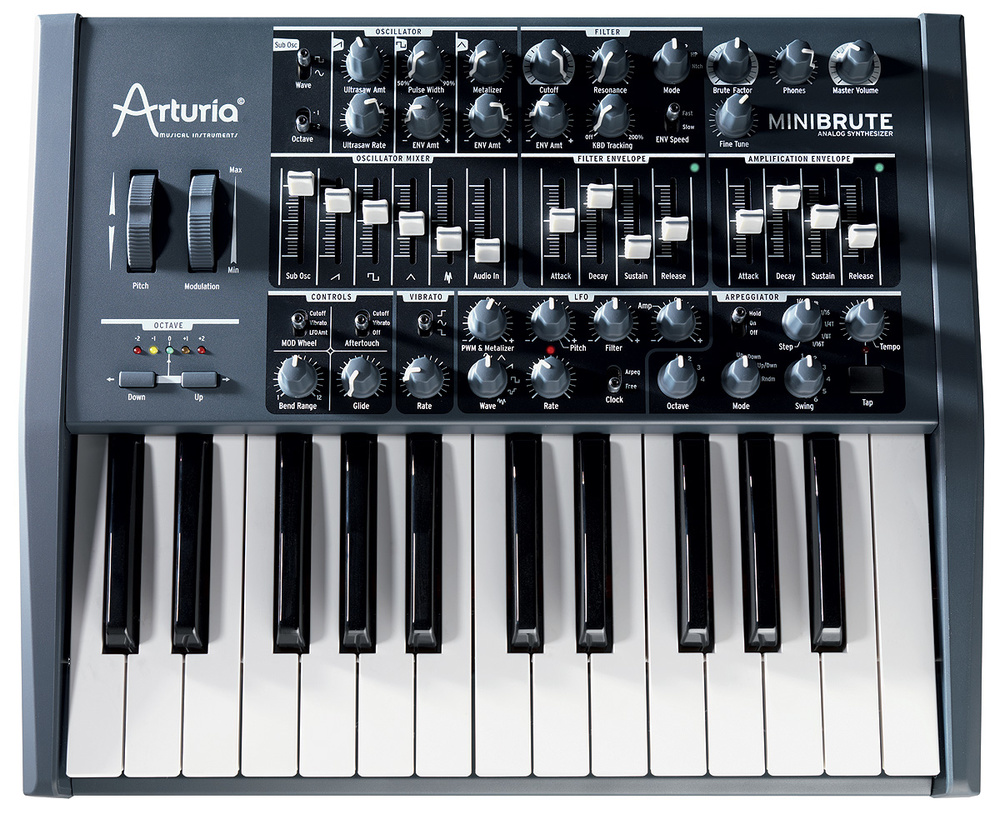
Meet the Arturia MiniBrute Analog Synthesizer, a compact yet robust monosynth that's all about versatility and sound exploration. This little powerhouse boasts 3 distinct oscillator types, each offering its own adjustable processing form, giving you a rich palette of sounds to paint your sonic masterpieces. Its standout Ultrasaw circuit amplifies the saw wave, while the Pulse Width Modulation enhances the square wave. For the triangle wave, there's the unique Metallizer circuit. But that's not all; with its 25-key semi-weighted keyboard, MIDI and CV I/O, and audio and USB connections, it doesn't just produce amazing sounds, it also bridges the gap between vintage/modular synths and computers, making it a flexible tool for any modern musician.
Key Features:
- Compact, full-featured analog monosynth
- 3 oscillator types with adjustable processing: saw wave (Ultrasaw circuit), square wave (Pulse Width Modulation), triangle wave (Metallizer circuit)
- 25-key semi-weighted keyboard
- MIDI and CV I/O, audio and USB connections
- Functions as an interface between computers and vintage or modular synths
Product specs
| Brand | Arturia |
| Model | MiniBrute 25-Key Synthesizer, MiniBrute Red 25-Key Synthesizer |
| Finish | Black, Red |
| Year | 2012 - 2018 |
| Categories | Analog Synths |
| Analog / Digital | Analog |
| Key Size | Full Size |
| Keyboard Action | Synth Action |
| MIDI I/O | MIDI Input, MIDI Output, USB MIDI |
| Number of Keys | 25 Keys |
| Polyphony | 1 Voice |
FAQs
-
Is the Arturia MiniBrute Analog Synthesizer monophonic or polyphonic?
-
The Arturia MiniBrute is a monophonic synthesizer, meaning it can play one note at a time. This design is ideal for lead lines and bass sequences.
-
What kind of sound can I expect from the Arturia MiniBrute's oscillator?
-
The MiniBrute features a multi-waveform oscillator with a unique "Brute Factor" control, providing a rich, aggressive analog sound suitable for a wide range of genres.
-
Does the Arturia MiniBrute have MIDI connectivity?
-
Yes, the MiniBrute offers both traditional MIDI In/Out and USB MIDI connectivity, allowing it to integrate seamlessly with modern DAWs and other MIDI-compatible gear.
-
How many keys does the Arturia MiniBrute have and what is their size?
-
The Arturia MiniBrute features a 25-key keyboard with full-size keys, making it comfortable for both studio and live performance use.
-
What is the keyboard action type on the Arturia MiniBrute?
-
The MiniBrute has a synth-action keyboard, providing a fast and responsive feel ideal for expressive playing and quick note repetition.
Videos

Arturia
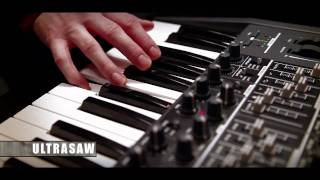
Introducing Arturia MiniBrute Analog Synthesizer
Introducing Arturia MiniBrute Analog Synthesizer
Arturia
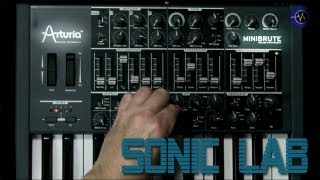
Arturia MiniBrute Synthesizer - SonicLAB Review

sonicstate
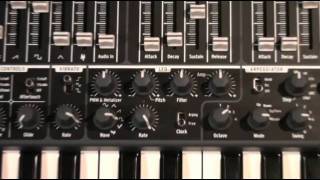
Arturia MiniBrute Tour
Arturia
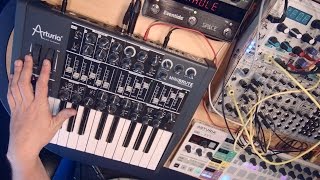
Arturia MiniBrute Analog Synth Demo

SourceDistributionTV

Bad Gear - Arturia Minibrute - The Tutorial Synth???

AudioPilz

FIVE MINUTES WITH Arturia MINIBRUTE
sonicstate
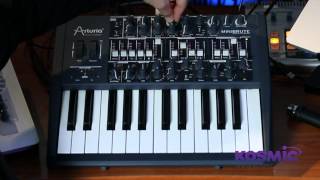
Arturia Minibrute Analogue Synthesizer

Kosmic Sound
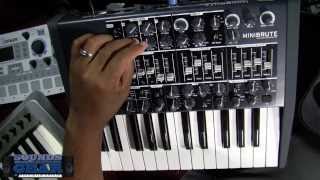
Review: Arturia MiniBrute analog synthesizer

SoundsAndGear
Arturia Minibrute Analog Synthesizer Demonstration

Sounds Like Soma
Reviews
PROS
-
Sub oscillator adds thick sound
-
Aftertouch feature surpasses competitors
-
Superior key quality for its class
-
Steiner Parker filter provides unique sonic experience
-
Versatile oscillator tone mixing capabilities
-
Built sturdy, durable for travel
-
Offers a hands-on approach to analog synthesis
-
Can sound fat and multi-oscillatory with built-in tricks
-
Arpeggiator and LFO offer extensive sound shaping
-
No presets encourage sound design exploration
CONS
-
Noticeable bad noise floor
-
Metallic sound quality can be off-putting
-
Limited to two octaves, shifting requires button pressing
-
Some LFO settings not useful
-
Steep learning curve for beginners
-
Cannot save patches on the device
-
Build quality can be hit or miss
-
Keyboard design prone to cracking
-
Rubber side panels can become sticky
-
Keys could be improved
Owner Insights
We analyzed real musician discussions from forums and Reddit to find what players love, question, and tweak about Arturia MiniBrute Analog Synthesizer.
Features and functionality
-
The MiniBrute 2S excels in producing "dirty" and aggressive sounds, ideal for those seeking unstable, analog-style volt noises.
Source -
The sequencer on the MiniBrute 2S is highly praised and considered one of the best integrated sequencers in a non-Elektron synth by experienced users.
Source -
The MiniBrute 2's patchbay and sliders are highly praised, offering versatility for modular enthusiasts to integrate additional oscillators and effects seamlessly.
Source -
The Steiner-Parker filter, often criticized, is valued by some for producing distinct bass and bright leads, showcasing the synth's tonal range.
Source
Software and compatibility
-
MIDI controllers can be connected to the MiniBrute 2S, but compatibility depends on having the correct MIDI connections or involving a computer for USB MIDI.
Source
User experience
-
Users with piano backgrounds may find the lack of keys on the MiniBrute 2S limiting if they prefer playing over programming.
Source -
The pads on the MiniBrute 2S offer velocity and pressure sensitivity, providing an expressive alternative to traditional keybeds.
Source -
Several long-term users report no tuning issues, highlighting stability compared to the problematic MicroBrute.
Source -
Some owners express nostalgia and regret selling their MiniBrute, indicating its lasting appeal despite newer models.
Source
Value and pricing
-
Buying second-hand is suggested to retain resale value, especially if desk space is a constraint and future re-purchase is considered.
Source
Build quality
-
The original MiniBrute's knobs can yellow over time, though this doesn't affect functionality.
Source -
The original MiniBrute's keybed could be improved but matches or exceeds some newer, pricier models in durability.
Source -
The MiniBrute 2 is appreciated for its robust construction and full-size keys with aftertouch, enhancing playability for users.
Source
Use cases and applications
Critic Reviews
4.5 out of 5
Based on 20 Reviews and 107 Ratings

325
The New Old School
Arturia made a statement to the world that they were not F'ing around! https://youtu.be/sUNNwibffTw With its Steiner Parker filter it provides the visceral sonic experience enjoyed by my fellow syntheisists such as Vincent Clark, and Italian DJ and producer Sasha Carass. This is my goto synth. I used it as the main fixture and synth on my 12 minute monster drum drone "Someone Forgot The Drummer" It is my workhorse. UPDATE
I love the principles of a company, as that is usually what makes them great. Arturia is one of my "crew", (even though they don't know me) due to the fact that I use at a minimum 2 of their synths on every song. Why? Because their unique. Just like a MiniMoog, the MiniBrute is all, ALLL, analogue. Through-hole, and SMD analogue... is what makes the sound of the Arturia unique. At this point in time, only the very abused "Brutes" will exhibit any sort of uniqueness...sort of. Aging plays a role in the sounds we love. Arturia like many others, have made synths just like everyone else. Some are hitting their 10 and 15 year old age, and while we have a while to get to 50 year old synths those that treasure their classics hold on to them, as I will with my Arturia Minibrute.
Not having a patch system is one of the best experiences I can recommend. Not that it isnt welcome, but sometimes its limiting in its own nature. Turning on a minibrute is a lot like turning on any old old synth ie (60's-70's-80's) You have to let it warm up and the older it gets the longer it takes to get to an even operating temp.... and you can tell! But I can say not knowing anything and turning one on and just trying to make ANY sound is what creates a synthesist....usually (it worked for me) *** BUILD QUALITY***
Excellent.... but. They don't make the miniBRUTE anymore... it's been discontinued but it lives on in shops and collectors now.. It weighs in at 8.8lbs. all steel and rubberised plastic sides that I have seen become sticky. But there are many 3rd-party wooden upgrades for the BRUTEs so don't let that dissuade you. It works great without the sides too just don't stick your finger inside ...lol ZAP!
I saw some comments below that questioned the quality of the Arturia. Arturia makes both high-end and affordable synths. If you so choose you can get one for around $200. I too own a Moog Sub Phatty. It weighs in at a respectable 20lbs, while the original miniMoog weighs 32lbs, Mind you the Sub Phatty and the miniMoog declare in their manual you need a strong table :) IT'S TRUE! While the 8.8lbs is much lighter, I dropped mine the first week I got it, and it fell flat. Normally that would shake or rip a standoff or 2 maybe at least 1 screw.. nope. Nothing... (literally thank the maker) so for me in my experience with their products it's been WOW. The miniBrute 2S is built the same and comes in at 7.7lbs. It's not a Volca.
BUT
The keys... The keys are real keys with aftertouch and velocity. For all the love I pour over this synth. A review below reminded me of what I do not like about it, and it's so minuscule for me.., but might be very off putting to others. They keys have a tendency to crack underneath due to the design (lip) that hangs underneath the underside of the white keys. Once they crack they all the other touch points to give way and crack some more until your playing a "flappy" key and while it still works .... so does the spring action. I don't have to show you a picture of a flappy key bouncing off the spring when slapped... you get the idea. Yes, while that is one thing I wish would have been "beta" tested thoroughly, I know you can't be all things. And with that said... this is one of the finest monosynths for the money.
Preferred Settings + Usage:
OOOOOoooooooooowww thats a secret about my patches.... but I have 4 and I reuse and abuse from those 4 starting points. I will tell you about this one, "SNÖ Monster" and my favorite orange cards are. My favorite patch is the one i used on a song that I have not released yet because 1. I'm nervous no one will like it..(I know) 2. It's different.. and finally 3. I'm nervous no one will like it.. SNÖ Monster was an accident and like all good synth accidents I was aware of myself and wrote down the settings, and even took pictures of the settings. (it was that good) What I created or (sic) recreated was the "talking monster" or "vocant growler" to be more specific. You can hear this tone usually from an FM synth due to the need for a 3rd modulator. I was able to do this with just the limited patchbay on the back, and utilizing the input and outputs and even the headphone port as a sound source back into the Minibrute. As many know about the BRUTE-alizer and its heritage you will understand when I say... I jammed the sound back into the synth for reprocessing but from.... and to....? Again go play with your miniBrute and you might hear it. Much easier to accomplish on the MB 2 and 2S. Idiot UPDATE* I forgot... The ORANGE CARDS. I use one and its sitting on the synth right now... CLAV. its the best starting point because it provides a built-in avenue to other lead sounds and sounds like..: Glass, Air, Trains, Whistles, Chugging, Metal pots, Jets, Lasers, Popcorn, Incredibly accurate Cat noises (no seriously... check out track on Catastrophe (its hilarious)

261
Pretty gnarly at its price point
Analog for the masses? For a miserly sum, this bad boy offers users a hands-on approach to analog synthesis. There's a throwback factor in the fact that there are no presets. Forget about hidden menus and little screens. What you see on is what you get, functionally speaking.
Tonally, this synth definitely feels analog. It also feels like its got a unique voice all its own. It's not a Moog, it's not an old Korg, and its not some Oberheim. It is its own thing. Luckily, within the scope of its parameters, you've got enough leeway to craft lots of different sounds. At any point you can bring up a sub, a square wave, a saw, a triangle, white noise, and an external input. No sine wave, but you can get one by being subtle with the sub. Moreover, each one of those parameters can be mixed in with a dedicated fader and most can be tweaked with individual knobs. Some provide cool phaser and chorus effects as you play with the rates. Again, tactile faders also come into play when sculpting the envelope of your wave. I prefer immediate attack, mid level decay and sustain, a just a tiny bit of release. Your ideal sound may vary, and thankfully you've got the possibility of also crafting lengthy pads or tiny bleeping bursts of color.
Personally, most of my tweaking happens on the filter banks. This beastie is a monster when it comes to doing frequency sweeps. At times you can enter the realm of unusable high pitched squeals if you overdo it on the resonance, but generally the filters are all good fun. You can also go wild with the much-vaunted Brute Factor knob. That one can introduce a degree of distortion that can really give the sound an extra boost.
There's way more, too. You can shape each wave with a subset of faders, and you can play with a whole mess of LFO parameters (all of which can be blended in via a dedicated wheel). Also, you can arpeggiate at your heart's delight. There are enough variations on board to keep it interesting. In addition, you can simply use it as a MIDI controller thanks to its very sensitive keys. Finally, since it has Audio In, you could potentially just use this thing as a wacky effects unit. It's done pretty interesting tremolo and sweep filtering to my guitar, and I bet it could do far more if you do real time knob twisting as you insert prerecorded music.
So far there's been praise, but what about the cons? Well, the keyboard is a bit annoying. The keys are the right size, but its only about two octaves. If you want to shift, you'll have to press buttons for that. Moreover, when I got mine, one key was already finicky and it only works if I press at the center rather than the edge. Also, many of the LFOs aren't that useful, so that's a drag. I also dislike how the arpeggio doesn't respond to the order you play the keys that constitute a chord. Want to use it as a sequencer? You'll have to do some hacking. Lastly, there will be a steep learning curve at first; expect to end up getting very useless sounds very quickly. It will take a while to truly grasp what each knob does. Since you can't save any presets, you'll eventually have to intuitively grasp what works best for your sound design.
Regardless of these gripes, I'm pleased with this monophonic synth. I've used it for pads, leads, and bass lines. It's got character by itself, and it has interacted very well with my effects units. It has also been study enough to survive international travel intact. It's not grossly oversized, after all. Any fledgling synthesist ought to consider starting off with this unit. It might not be a Minimoog, but it's still a powerful device that can inspire with its simple old school approach.

41031
great review, you should write for the site, right now I'm the only one doing official gear reviews, everyone else is just doing those 'round up' type artcile
261
It'd be cool to give that a go. I'll admit I'm not too loaded with equipment, though. What I've listed is all I've got.
41031
nah, you get loaner units from the manufacturers to do reviws, in the process you get to test out a lot of stuff... but you need to forge relationships for yourself, right now the admins pretty much just get offers for reviews from string companies. I had to go out and make friends with effect and synth manufacturers on my own via facebook and stuff.
261
@jimmarchi1 that might require a bit more chutzpah than I can muster!

362
synthetic metal
This is one of the "affordable two-octave analog monosynths" that have been having a renaissance over the past seven or eight years. It was among the first of that crop, and while it has some interesting features like the ability to combine all waveshapes using just the one oscillator; and the option to modulate every shape with the LFO, I find there to be an inherent metallic nature to the sound of this machine which is inescapable. Even a warm PWM bass sound has a sort of nasal bite to it that I find extremely off-putting. I can't fall in love with it because of that.
325
Yeah, I know what you mean. I find it a bit crunchy too. I have attempted to tame the sound through the patchboard and it can soften it up a lot, but you need to amp it up on the output because you really place a lot of filter/attenuation points inline with the osc. I also tried manually taking the headphone jack out with a Stereo to 4OutMONO adapter then play around patching that into the inputs on the patchbay while using the BRUTE factor . It tames it a bit and makes it scream as well lol, but nothing warm like a 24db filter lol. Thanks for the input

117
The new SH-101
It is a monosynth, which has built-in tricks to make it sound like a fat multi-oscillator modular. The name "brute" comes from an option which returns the audio signal back to the synth, making it sound very rough and metallic, however if you do not set the waveforms higher than 50%, it can sound soft and beautiful. The variety of sounds is great. Minibrute is affordable yet not easy to use after all. It is very understimated, because many artists do not really understand the mechanics and push the knobs and sliders to the max most of the time. Moreover it can be officialy "hacked" and with one short line of hex you can switch from arpeggiator to sequencer, making the Minibrute a very powerfull tool.
325
ditto!

115
A bit of an analogue monsoter
While build quality can sometimes be hit and miss, my early issue MiniBrute has been going on strong and is great for complex basslines and leads. Occassionally I think about selling it, but after playing with the aftertouch, the enhanced ultrasaw and additional noise generator, I am reminded why I kept it. Only downside is the size - it's a bit large!
41031
dwarfed by my sub-phatty and MIDI Moog SE1 rack... wanna talk unnescasarily big monosynths? huge, heavy

73
Brutally amazing!
I love the fact that you can´t access to presets nor save your own, because the heart of this instrument is the ability to design each time you turn it on. The soul of the instrument is in his powerful sound.
Preferred Settings + Usage:
On this instrument, the thrill is not to have presets. Make your own!

163
Great analog monosynth for the bucks!
Well made, really fat and gritty filter and really good feature when it came out. Little bit ''outdated'' with all the analog synth that come out lately, but this one really start the ''budget'' analog synth recent era. Use it for bass/lead/Fx in my live sets.

You have one? Keep it.
I had to change the side panels recently. The rubber started to get sticky. Arturia replaced it without any costs. The sound of the minibrute is very unique. Compared to Minimoog and Arp Odyssey it is a third kind of solo- sound. Very good keyboard action and an arpeggiator on board that can be synced to your song.

102
What a nice synthesizer!
The owner of the Arturia Mini Brute is one of my bandmembers, but from time to time I'm allowed to use it in my set-up. I sai "allowed" on purpose, because we both enjoy it soo much to play with the Minibrute. In very short time you have created a very specific sound and you don't need to know much about oscillators and synthesizers in order to do so. Very great instrument!
325
Yep It's so like that! lol Great Review!

369
My go to lead machine.
It can be very gritty and ready for thrash but the real secret is to not turn the wave form volumes past 50%. Then you get those nice warm analog sounds.
Artist usage
Add artist

Sold on Reverb.com in 2019 for charity.
This Arturia Mini Brute is from the private collection of Martin Gore, founding member of Depeche Mode
The Arturia Minibrute is a full featured analog monosynth in a compact package, featuring 3 oscillator types which can be mixed for a huge variety of sounds. Each type includes an additional form of adjustable processing as well.
The saw wave gets a widening Ultrasaw circuit, the square wave can utilize Pulse Width Modulation, and the triangle wave can be run through the unique Metallizer circuit. Featuring MIDI and CV I/O in addition to it's 25 key semi-weighted keyboard, audio and USB connections, the Minibrute also excels as an interface between computers and vintage or modular synths.
SN: 1312196000968. Clean mini brute. With power supply. Signed by Martin Gore.
All items in The Official Martin Gore of Depeche Mode Reverb Shop ship fully insured with delivery confirmation and include a signed and embossed Certificate of Authenticity from Martin Gore.


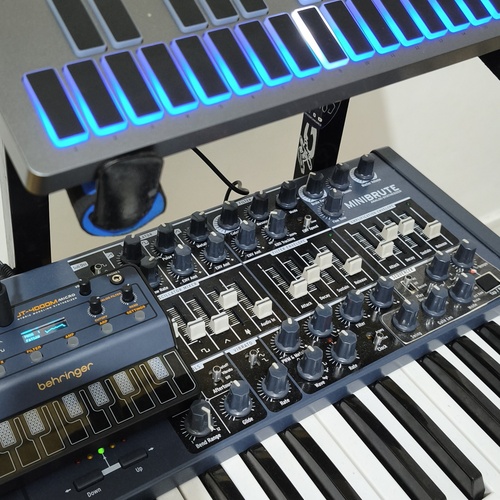
In this photo from Thijs' Tumblr, an Arturia MiniBrute rests above an NI Maschine in his studio.


can be seen at 1:33 in the video


In a Facebook photo, Jordan Rudess can be seen with an Arturia MiniBrute Analog Synthesizer placed on the table.


At 0:24, he says that he likes this synthesizer and that it's very efficient.


"There's my little modular system and I stole Szary's Arturia MiniBrute, which I'm using for a few songs. I re-programmed some sounds we used the modular for in the studio. It's nice because you have much more modulation moments. We have one part in Reminder, which we call the 'Chemical Brothers part' as it's full of modulation."


In this interview/video of Vince Clarke he discusses how he uses the Arturia MiniBrute.


This video features Utley using the MiniBrute to create many sounds.

‘Arturia mini brute’ is used on ‘Timebomb zone’ from the album ‘No Tourists’ by The Prodigy . Intro bass sound and throughout the tune.


In the video by Produce Like A Pro, Tom Holkenborg, also known as Junkie XL, features the Arturia MiniBrute Analog Synthesizer, visible on the left side of his studio setup.


Album Usage
The Arturia MiniBrute Analog Synthesizer has been featured on the following albums:

Soothing Rain Sounds
Thunderstorm (2022)

LA CANZONE NOSTRA ⟁ (con BLANCO & Salmo)
Mace & Salmo (2021)

MOMENTUM
Calibro 35 (2020)

No Tourists
The Prodigy & The Prodigy (2018)
Hamburg
Third Son (2017)

Reminder
Moderat & Moderat (2016)
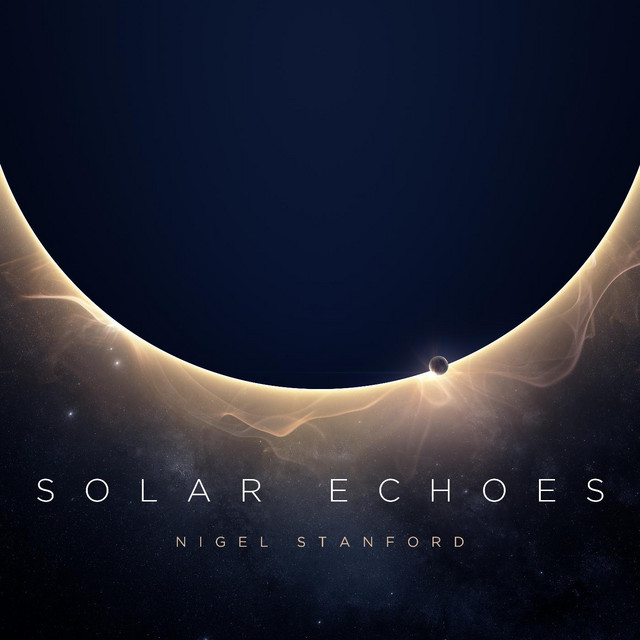
Solar Echoes
Nigel Stanford (2014)
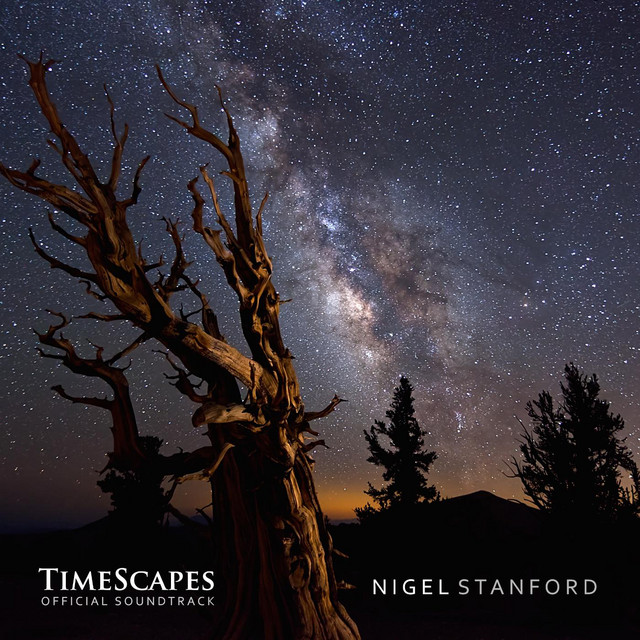
TimeScapes
Nigel Stanford (2013)

Bedouin’s Vigil / Assyrian Blood
OM & Six Organs of Admittance (2006)
Genre Usage
Based on how artists on Equipboard use this gear, it is most commonly found in the following genres.
Used With
Based on how musicians on Equipboard use Arturia MiniBrute Analog Synthesizer, it is most commonly used with the following gear.




-s.webp?v=1784933177)


Community setups
Show yours


.jpg?v=1762528348)
Similar
Add recommendation1 alternative for Arturia MiniBrute Analog Synthesizer, curated by the Equipboard community.

The filter in the MiniBrute is based on that of the Synthacon, with oversight from Nyle Steiner himself. This is explained in The Synthesizer by Mark Vail: https://pdfcoffee.com/mark-vail-the-synthesizer-pdf-free.html
The Synthacon’s filter isn’t unique; Arturia successfully implemented—under Steiner’s guidance—this type of filter in the MiniBrute analog monosynth (2012). You can also duplicate this positive feedback response with any synth that allows you to route the filter’s output back into its input.
(...) Among the many notable features of Arturia’s affordable MiniBrute monosynth is a new version of the positive-feedback self-oscillating resonant filter Nyle Steiner created for the Steiner-Parker Synthacon. To assure they did it right, Arturia engaged Nyle himself to approve the MiniBrute’s multimode filter. Yves Usson designed its analog circuitry, and Axel Hartmann arranged the layout of its controllers.
More Arturia Synthesizers

$277.00 - $349.00
in Synthesizers Rank


$298.61 - $652.00
in Synthesizers Rank


$1,853.58 - $1,999.00
in Synthesizers Rank


$277.00 - $349.00


$311.00 - $379.00


$1,250.00


$1,444.00 - $1,999.00


$3,276.47 - $3,499.99
in Synthesizers Rank


$469.00 - $699.99
in Synthesizers Rank


$20,282.71
in Synthesizers Rank


$439.00 - $545.00
in Synthesizers Rank
.jpeg?v=1784917540)
.jpg?v=1784893209)

$3,333.00 - $3,499.99
in Synthesizers Rank


$999.00 - $1,084.00
in Synthesizers Rank

-m.webp?v=1784905194)
$1,100.00
in Synthesizers Rank
-m.webp?v=1784933057)
$379.00 - $499.99
in Synthesizers Rank


Accessories & Related Items


Gear Guides






.webp)

Most Popular Synthesizers
Most Popular Brands
-
Added to Equipboard on by
 musique
GearIQ 95
-


