


Pricing and availability
We compare 600+ stores and found this item at 1 store. Prices updated .
Store
Reviews
Price




Average Price: $94
Budget/Beginner
$100
$251+
Price Tier
Budget
Standard
High-end
* Product prices and availability are updated by Equipboard every 24hrs and are subject to change. Equipboard may receive compensation for purchases made at participating retailers linked on this site. This compensation does not affect what products or prices are displayed, or the order of prices listed. For more information, please refer to our affiliate disclosure.
Description
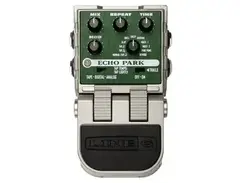
Elevate your guitar sound with the Line 6 Tonecore Echo Park, a compact and robust delay pedal inspired by the acclaimed DL4 Delay Modeler. With its diverse range of delay modes and settings, you can create ethereal echoes or vintage tape-style repeats, all controlled by an intuitive tap tempo. Whether you're seeking classic analog warmth or crystal-clear digital precision, the Echo Park is your tool to craft the perfect ambience for your musical expression.
Key Features:
- Circuitry based on Line 6's much-loved DL4 Delay Modeler
- Onboard tap tempo for real-time delay control
- Three delay modes to choose from: analog, tape, and digital
- Eleven distinct delay settings for ultimate sound customization.
Product specs
| Brand | Line 6 |
| Model | ToneCore Echo Park Delay |
| Finish | Black |
| Year | 2006 - 2010 |
| Made In | China |
| Categories | Delay Pedals |
| Pedal Format | Standard |
FAQs
-
What types of delay modes are available on the Line 6 ToneCore Echo Park?
-
The Line 6 ToneCore Echo Park offers three delay modes: Tape, Digital, and Analog, each emulating different classic delay sounds to suit various musical styles.
-
Does the Line 6 ToneCore Echo Park have tap tempo functionality?
-
Yes, the Echo Park includes a tap tempo feature, allowing you to easily sync the delay time with the tempo of your music during live performances or recordings.
-
Can the Line 6 ToneCore Echo Park be used with a bass guitar?
-
Yes, the Echo Park is compatible with bass guitars and can add depth and texture to bass lines with its versatile delay effects.
-
What power supply does the Line 6 ToneCore Echo Park require?
-
The Echo Park requires a 9V DC power supply, which is standard for many guitar pedals, ensuring easy integration into most pedalboards.
-
How does the Line 6 ToneCore Echo Park handle modulation effects?
-
The Echo Park includes a modulation control, allowing you to add a subtle or pronounced modulation to your delay, enhancing the overall sound texture.
Videos

Robert Jackson
Line 6 ToneCore Series Echo Park Delay
Line 6 ToneCore Series Echo Park Delay
Robert Jackson
Reviews
PROS
-
Smooth knobs and sound, allowing for a wide range of effects without noise
-
Versatile delay types including Normal Tap, Ping Pong, and Reverse for creative outputs
-
Features tap tempo with extensive delay range up to 2500 msec for varied music styles
-
Offers both battery operation and low power consumption for ease of use
-
Built like a tank, durable and reliable for long-term use
-
Compact design doesn’t take much space on pedalboards
-
Buffered bypass helps compensate for signal loss in large pedal setups
-
Unique modulation types (tape, digital, analog) add depth to the sound
-
Can double as chorus, vibrato, or lo-fi effect pedal, adding value
CONS
-
Lacks memory presets for quick sound recall
-
Some found it bulky compared to other pedals
-
Small knobs and varying pot resistance can make precise adjustments tricky
-
Requires proprietary power supply to avoid noise issues in studio settings
-
Noticeable volume boost when engaged might not suit all playing environments
-
Activation switch can be hard to engage, potentially hindering live performance use
Owner Insights
We analyzed real musician discussions from forums and Reddit to find what players love, question, and tweak about Line 6 Tonecore Echo Park.
Features and functionality
-
The Echo Park's modulation options vary by delay type: digital delay offers chorus, analog gives vibrato, and tape provides wow and flutter, all with fixed rates controlled by the "Mod" knob.
Source -
The Echo Park includes a highly praised auto swell setting, comparable to the DL4 series, which is favored by users for its smooth, gradual volume increase.
Source -
The Boss DD-200's ability to rebind footswitches and add up to two more offers a highly customizable and versatile setup, enhancing its utility for complex performances.
Source -
The Boss DD-200 includes a Tera Echo mode praised for its tape delay simulation, although some modes are perceived as overly digital unless carefully adjusted.
Source
User experience
-
Some owners find the footswitch challenging to engage accurately, which can be problematic in live settings; it tends to require precise pressure to toggle.
Source -
Some users find the Electro Harmonix Canyon's looper feature challenging to use effectively in live performances, suggesting it's not as intuitive as other options.
Source
Comparisons
-
The Echo Park offers unique ambient sound oscillations with dynamic feedback and speed changes, which some users prefer over generic endless delays from other pedals.
Source -
The Digitech Obscura, priced around $150, is noted for its impressive delay capabilities but lacks preset functionality, making it less ideal for live settings compared to the DD-200.
Source
Build quality
Use cases and applications
-
It's favored in studio settings for creating background noise and distinctive ambient sounds, especially in noise and ambient music contexts.
Source
Value and pricing
-
Owners note that the value of the Echo Park is increasing, making it a potentially good investment despite some usability issues.
Source
Other
-
This pedal line was designed by the founder of Meris, tying its innovative features to a respected heritage in pedal design.
Source -
The Echo Park shares a historical connection with Red Panda, as the blank module concept influenced their development, showcasing its impact on modern pedal innovation.
Source
4.5 out of 5
Based on 12 Reviews and 56 Ratings

983
Best compact digital delay
This unit dethrones any competition in the compact stereo stompbox format. Everything I missed in the Boss DD7 (my first ever effects pedal) the Echo Park has, namely trails, modulation knob, and separate voicings/modes. It looses looping function, but the sounds and added flexibility make up for the absent looper.
I was very lucky to find a brand new unit on an old local music shop (2022), and for 140€ with full warranty this 2003 built pedal is still very much up to date.
Very well thought out pedal, built like a freakin' tank, only negative thing I can point out is the mix and mod knobs are kind of fiddly, offering different degrees of resistance/drag, which makes fine tuning kind of tricky.
Positive points:
- Compact stereo delay;
- Dedicated 3 position voicing/mode switch;
- Each mode has its own specific modulation type, tape (wow and flutter), digital (chorus), analog (vibrato);
- Digital mode with maxed repetition provide infinite and steady repeats;
- Analog and tape mode with maxed repetition provide stable runway oscillation without need to bring mix down;
- Mix knob offers 100% wet at full clockwise position;
- Great functionality via Function knob, with filter sweep, volume swell, ducking, reverse, etc;
- 2 great multi tap settings and ping pong for rhythmical stereo delay taps;
- 9V battery ready, low power consumption, 40 to 60 mA current draw;
- Can also be used as chorus/vibrato/filter pedal, as well as a auto volume swell;
- Super silent operation using internal 9V battery;
- No discernible colouring of signal.
Negative:
- Small knobs and irregular pot drag/resistance;
- Requires a pretty hard press to engage bypass;
- Can't find info on I/O impedance.

15320
A Great and Highly Versatile Digital Delay Pedal
In terms of solo applications, the Echo Park never fails to sound great. In fact, it makes practice a lot of fun because it opens up a world of experimentation via the various models, settings and delay patterns that are available. I was reminded of a quote from The Edge of U2, who described how he incorporated echo into his composition process when writing guitar parts once he really started to find out what he could do with the effect. I found myself delving deeply into the Echo Park's features just because it was so easy to do, and the result was a plethora of new ideas as well as a refinement of older ones.
In a recording scenario, I initially had some problems with the Echo Park because I was unaware that using a Line 6 power supply would resolve noise issues. Unfortunately, prior to obtaining the DC-1G cable, the Echo Park was unusable in the studio because of the buzzing it created even when the pedal was turned off. However, once I obtained the Line 6 proprietary power supply, the signal cleared up instantly and the sound was just beautiful. (Update: Voodoo Labs' Pedal Power 2 Plus is an ideal unit if you're looking to run juice to several pedals simultaneously, as it includes a port that is set up specifically for Line 6 pedals.)
This is a good place to mention a quirk of the Echo Park: when it's turned on, there is a small but noticeable volume boost. There will be a certain percentage of the guitar-playing population who will strongly dislike this, but I'm not one of them. In fact, I love the little hint of extra gain it adds to the signal--and since I rarely turn my Echo Park off, I don't notice the discrepancy between the dry sound and the effected one.
The reason I mention the volume boost when discussing recording with the Echo Park is because it's the one situation where I had to account for it. Playing alone, it's a non-issue; playing in a band, it's kind of an advantage. In a studio, however, where microphones are carefully placed and settings are adjusted specific to a certain sound, I didn't think to compensate by having the engineer work with the pedal on first--which would have been a good idea, because if the mics are picking up a hot signal well, a slight volume dip will generally not be a problem. However, a sudden boost in signal can result in unanticipated, unwanted distortion. So, note to anyone who will use the Echo Park for recording... Read More

41031
I am debating whether I think that level boost when engaged is good or bad. I can see where that would be handy if you only use the echo park for solos or just use a tasteful slap all the time, but I hate when effects tamper with my gain structure as I am a volume-knob type of player and tend to run my amps super-loud and control things from the guitar. Echo is a classy effect, but every echo unit from the first tape delays to all the modern digital stuff is a pain in the balls in one way or another.
15320
Honestly, it's really pleasing (to my ear) in this context. It's a super-slight bump and since I almost never play with a pristine signal anyway, I actually really like it. It's consistent and entirely predictable, so it's relatively easy to work with/around. But if you're looking for a perfectly clean echo pedal, this is not it.

80
Hard to Beat, but Also Hard to Step On
This is probably the only one of my Line 6 pedals that I won't replace at some point. It's easy to use, has a wide variety of nice-sounding delays, and works well with both electric and acoustic guitars. I'm still not a fan of the "gas pedal" activation switches, which you really have to stomp on to get them to switch, and sometimes, even then, they still don't, but when I'm using delay I'm usually not also doing a lot of fast switching on and off during a song, so for this pedal, it flies.

338
Great All-Around Delay
I needed a stereo delay pedal for my particular pedal setup. While I wasn't looking for anything particularly special, I'm glad I found this pedal! Kind of a Sleeper hit in my opinion. It has three different delay voicings (Tape, Analog, and Digital) that give you a wide range of tones, and additionally has modes that are super useful in stereo rigs. Another plus is that it is buffered bypass, so it makes up for signal loss if you have a lot of true bypass pedals on your board.

261
My favorite delay pedal
I bought this one used; actually, scratch that. I got it for free after I bought a Tascam multitrack tape recorder from some dude who was about to move. He included a power supply, too.
Well, after having owned a multi-fx unit with delays that simply stopped after moving one knob, the Echo Park was like a revelation from the heavens. The knob-twiddling burbling and its bouts of self-oscillation are the bees knees! The different modes (Analog, Digital, and Tape) coupled with the Mod feature all add different tonal possibilities to bend the sound even further. The textures you get from these choice ensure a certain undeniable grime to the sound. I love it. There pedal offers an array of possible delay types are well; most are vanilla, but a few others are remarkable. I'm a fan of the Swell effect for slow fade-ins on your dry signal, the Sweep effect's phaser, the Ping Pong's stereo madness, and the wild Reverse. That reverse can be amazing if you max out most of the settings. Play a few notes on the guitar then let the regeneration and decay slow take hold on the effected signal. Instant ambient piece! It mutates slowly but surely, particularly if you've messed with the Mod section. I've been known to let the Reverse just roll on for an hour after plucking two chords' worth of notes. It's incredible, it's got character, and it never ceases to amaze me.
... well, then again, this is Line 6. I had a little period between 2013 and 2017 when this little bastard failed to give me any sound from the output jack. The lights were on, but the sound was gone. Then, without doing anything other than plugging it into a daisy chain rather than its own power supply, the Echo Park began to work again. Insane, illogical, and weird; I'm just glad this little dude is back on the team. No other delay has charmed me as much as this one.
Useless fact: If you throw in stereo signals and only use one output, it folds to mono.
If you see it, but it. Immediately. If I ever get spot another one in the wild, I will absolutely nab it.

174
Maybe there are better delays out there but I cant't imagine one wich fits more to my needs than this.
It has everything I need from a delay pedal, and even more... Beside the obvious with some tweaking I can use it as a swell, a chorus, a vibrato and a lo-fi effect...
Preferred Settings + Usage:
I use it for a subtle reverbish effeckt with tape sound, dotted eight mode, the time around 300 ms, and low repeat, low mix, 0 mod. Igen I need a rythmic delay I just turn up the mix and start tapping the tempo.


Great alternative to DL4 delay.
I was interested in this pedal for 2 reasons. 1. I liked the Line 6 DL4, but didn't need the loop function, and 2. I needed board space. This thing is a beast. It's a DL4 in a boss style stompbox. Does everything the DL4 does barring the loop, and it's built like an absolute tank. Super heavy, and incredibly sturdy, no regrets with this purchase.

a mini DL4
stereo in and out, tap tempo, modulation, trails... it does all the things you could possibly need in a small footprint and budget price

320
Best delay within it's price range
It's digital, has warm dark repeats and has modulation. It will do anything from swells to reverse delays to ducking. It's really solidly built and is a pedal everyone that is looking for delays on a budget should consider.


136
You wouldn't think so
but this thing is awesome. Seriously some of the best delay sounds I've ever heard. Tape, analog, and digital are all pure gold. I can't imagine not using it. Get one
Artist usage
Add artist
When touring Attack & Release in 2008 and 2009, Dan Auerbach used a Line 6 Echo Park.


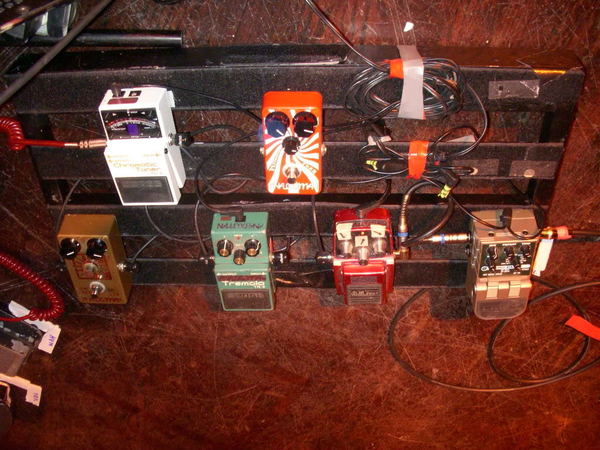
The official Dot Hacker Twitter released these pictures. In the second picture, a Line 6 Echo Park Delay pedal can be seen on Josh Klinghoffer's pedalboard.


According to this interview she uses a Line 6 Echo Park

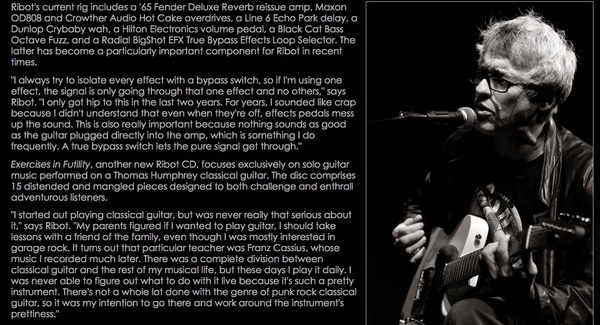
"I only got hip to this in the last two years. For years, I sounded like crap because I didn't understand that even when they're off, effects pedals mess up the sound. This is also really important because nothing sounds as good as the guitar plugged directly into the amp, which is something I do frequently. A true bypass switch lets the pure signal get through." - Marc Ribot.

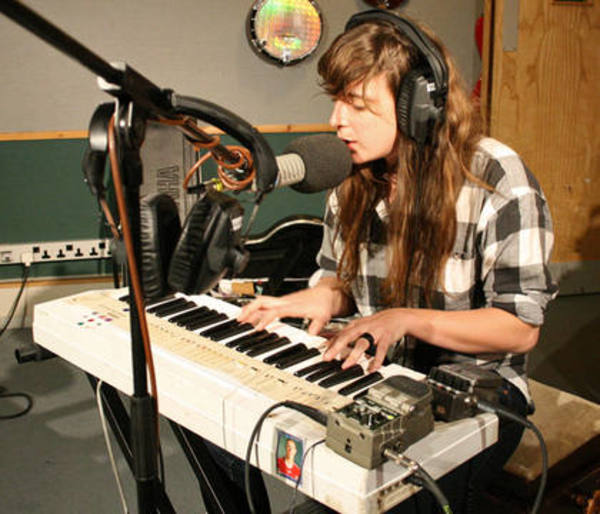
Victoria Legrand uses a Line 6 Tonecore Echo Park pedal, as seen in a photo from the BBC, alongside a Boss RV-6 for her keyboard setup.


In the Effects Bay article titled "FUGAZI: A guitar gear summary," it is noted that Guy Picciotto uses the Line 6 Tonecore Echo Park delay pedal as part of his effects setup.


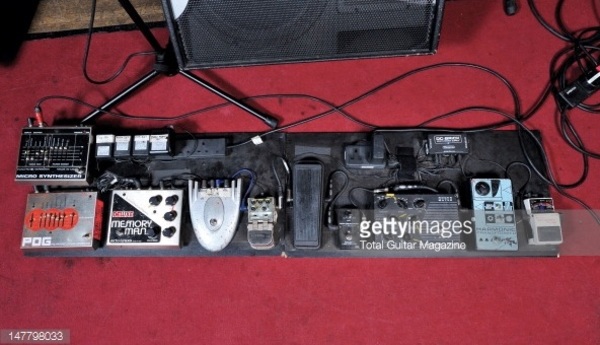
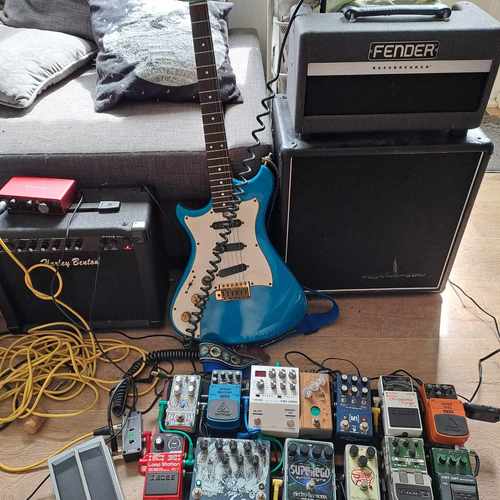
In this user-uploaded photo on Imgur, Sergio Pizzorno's collection of guitar pedals includes the Line 6 ToneCore Echo Park, demonstrating his use of this delay effects pedal.


"I did a tour last year with David Baker from Mercury Rev, borrowed his Echo Park, and had to buy one. They’re ugly pedals, but great ones, and you can stomp them like a boss. It doesn’t have any fiddly buttons."


Tim Pierce: ''It's kind off one of my favorites, George Tripps designed this. The Way Huge Guy. It's just a really analog and warm sounding.


In an interview with Premier Guitar, Elliot Easton mentions using the Line 6 Tonecore Echo Park delay pedal, as noted in the Gearbox section.


In the description of this video, Andy lists the pedals that he uses for this song:
Matchless Clubman
Matchless Chieftain
Marshall JMP
Hohner Pianet T
Strymon Bigsky
Strymon Timeline
Eventide Space
El Capistan
Naunaber Slate Stereo Wet
Electro Harmonix EHX POG2
Earthquaker Devices Afterneath
Echo Park
Telecaster
Album Usage
The Line 6 Tonecore Echo Park has been featured on the following albums:

Genre Usage
Based on how artists on Equipboard use this gear, it is most commonly found in the following genres.
Used With
Based on how musicians on Equipboard use Line 6 Tonecore Echo Park, it is most commonly used with the following gear.


-s.webp?v=1784991509)
-s.webp?v=1784991518)
-s.webp?v=1784991509)

Community setups
Show yours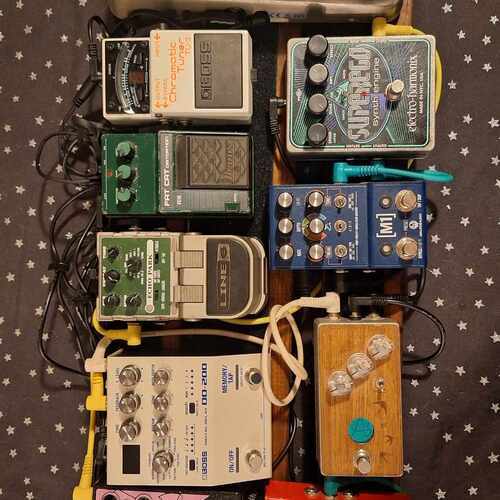

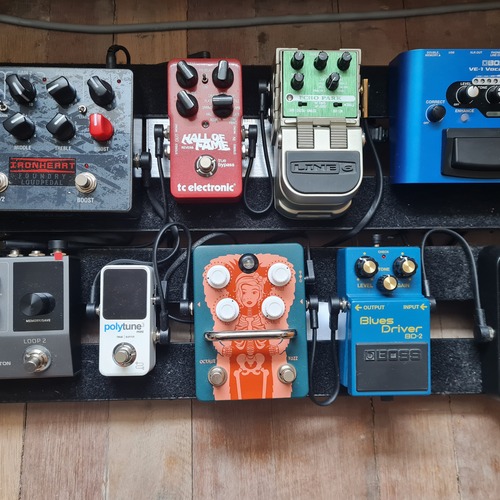


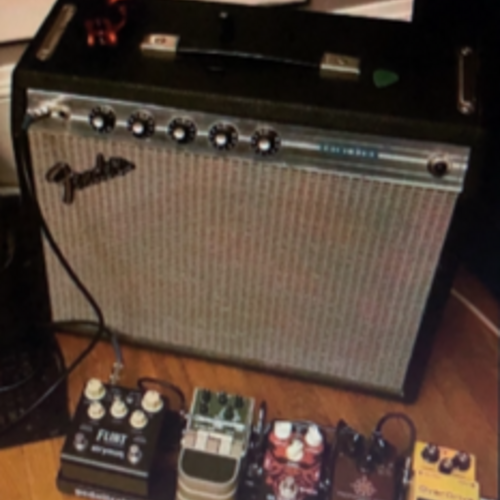
More Line 6 Delay Effects Pedals

$208.00 - $259.22
in Delay Effects Pedals Rank


-m.webp?v=1784992357)
$209.00 - $249.99
in Delay Effects Pedals Rank


-m.webp?v=1784991509)
$12.95
in Delay Effects Pedals Rank


$249.00 - $379.99
in Delay Effects Pedals Rank


$196.00
in Delay Effects Pedals Rank


$150.00 - $179.00
in Delay Effects Pedals Rank


$399.00 - $449.00
in Delay Effects Pedals Rank

$399.00 - $449.00
in Delay Effects Pedals Rank


$128.00 - $153.99
in Delay Effects Pedals Rank


$90.00
in Delay Effects Pedals Rank


$85.00
in Delay Effects Pedals Rank


$70.00
in Delay Effects Pedals Rank


$154.50 - $197.99
in Delay Effects Pedals Rank


$382.00 - $499.00
in Delay Effects Pedals Rank
.jpeg?v=1784984769)


$356.31 - $389.69
in Delay Effects Pedals Rank


$323.87 - $552.28
in Delay Effects Pedals Rank


$80.00 - $158.00
in Delay Effects Pedals Rank


$125.00 - $176.00
in Delay Effects Pedals Rank


$85.18
in Delay Effects Pedals Rank


$86.55
in Delay Effects Pedals Rank


$123.99 - $170.34
in Delay Effects Pedals Rank


$135.00 - $166.00
in Delay Effects Pedals Rank

$64.00
in Delay Effects Pedals Rank


$163.56
in Delay Effects Pedals Rank


$229.99 - $250.00
in Delay Effects Pedals Rank


$329.99 - $406.99
in Delay Effects Pedals Rank
.jpeg?v=1784994498)


$207.02 - $235.00
in Delay Effects Pedals Rank

$99.00 - $129.00
in Delay Effects Pedals Rank


-m.webp?v=1784991542)
$119.99
in Delay Effects Pedals Rank


$184.00 - $250.90
in Delay Effects Pedals Rank


$150.00
in Delay Effects Pedals Rank


$389.00 - $429.00
in Delay Effects Pedals Rank


$199.00
in Delay Effects Pedals Rank


$154.79 - $194.10
in Delay Effects Pedals Rank


$225.00 - $252.20
in Delay Effects Pedals Rank


$120.00
in Delay Effects Pedals Rank

Accessories & Related Items


Similar


Gear Guides






Most Popular Delay Effects Pedals
Most Popular Brands
-
Added to Equipboard on by
 equipboard
GearIQ 4934
-


