
lazarus's Reviews
6 reviews Back to lazarus's Equipboard

2595
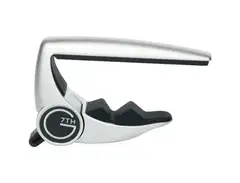
The best capo I didn’t know I needed
The first capo I ever owned 25 years ago was a Kyser. At the time that’s really all you could find in local shops. I used it on both my electric and acoustic guitars.
Fast forward to present day when I needed to replace it. I determined from photos that Johnny Marr was using a G7th Performance on his signatures Fender Jaguars during live performances which intrigued me because he’s almost always using one on the 2nd, 4th or 5th frets. If it worked for him, I thought it might do the trick for me.
I can’t speak to the science behind their Adaptive Radius Technology but can attest to the fact that it does what G7th says it does: “mechanically adapts to the true curvature over your strings and fretboard, exerting completely even pressure across all the strings - setting a new standard of in-tune, buzz-free use.”
Also the string pads are fully replaceable and available to order so there’s no reason they can’t last a lifetime (unless you lose it; don’t lose it).
2595
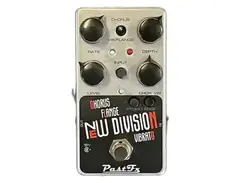
Miles ahead of the current EHX Clone Theory and as good or better than the original
There are certain vintage pedals that I am likely just never going to be able to justify the spend on and an original 1970’s / 80’s EHX Clone Theory is one of those. The modern EHX version is sadly just not comparable in sound.
But in this case, not only is the PastFX pedal more affordable than an original EHX box, it may actually be a better pedal given the modern, updated design.
First of all, as unique as the old big box EHX pedals are, they’re not practical for a pedalboard. Second, they are noisy and there are often volume drops which presents another practical challenge for live settings.
Enter the PastFX New Division. It’s kind of a best of both worlds version of the old EXH versions because it has the bright switch (“edge”) from the original sad1024 chip version as well as the vibrato/flange control for the later mn3007 version. There are both input and output level controls to address any volume issues, and the noise floor is a huge improvement over the old EHX units (note: it operates on 18v so you need to consider your power needs accordingly; rather than running at 9v with an internal voltage doubler, running at 18v helps keep it quiet).
If you’re a fan of chorus, this one is worth checking out. I have a JC-40 and regularly use a Boss CE-2W as well but this one adds something else that those doesn’t cover.
Preferred Settings + Usage:
One of my favorite settings is rate 10 o’clock, depth 1 o’clock, level according to your needs and chorus/vibe at 2 o’clock. Mess with the studio and or edge buttons to add or remove brightness to taste.
2595
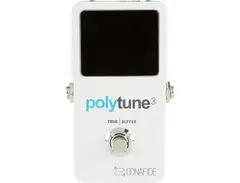
My preferred tuner over the Boss TU-3
I know there are other accurate alternatives out there (eg Peterson) but between the big two — Boss TU-3 and Polytune 3 — I prefer the latter.
For one, the display is just easier to read, particularly on a darkened stage. I don’t use the strobe tuning feature but even that is more visible than the Boss. Where it’s really at for me are the big letters for the string/note you’re tuning to. And it auto detects, so for someone like me that uses a capo a lot, you don’t need to pick a different mode (although you can program tuning up/down or alternate tunings).
Oh and it has a good buffer to start your board with.
Preferred Settings + Usage:
I use the single string tuning. I’ve never tested/compared to the multi string tuner, I just find it easier and quicker as a personal preference.
2595
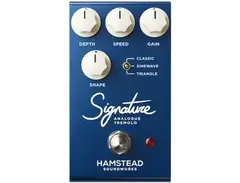
The best tremolo no one’s heard of
This pedal has been featured on That Pedal Show and reviewed in all the usual places but I rarely if ever see it on anyone’s board (not here in the US anyway).
I have a Victory V40 Duchess Deluxe head that has a great tremolo unit but the speed options are limited. And while it does what it does well (classic tremolo), it doesn’t do more than that. Enter the Hamstead Soundworks.
I’ve never played a Hamstead amp but the pedal circuit is taken from the analog tremolo they use in their amps. There are three wave forms (classic, sine wave and triangle) and you can use a shape dial to tilt them left or right. So you have old school, vintage tremolo with a bunch of added versatility. It’s all analog, no digital waveform circuitry, so they all sound great.
There are a few videos on the product page, check them out.
2595
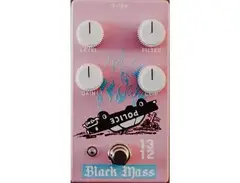
Great RAT pedal with more versatility
This knocked the JAM Pedals Rattler off my board. It does what a RAT does but more options because of the 8 different clipping options. Because there’s an internal pump that takes the 9v input and bumps it up to 18, there’s more clarity and headroom than your typical ProCo RAT. (You can also flip a dip switch inside to turn the charge pump off if you want to just run it at 18v right from your power supply).
I would be remiss if I didn’t mention that I would be happy buying this pedal on principle alone (1312 being the numeric equivalent of ACAB). I bought mine in the trans rights colorway.
Preferred Settings + Usage:
My two favorite clipping options are right at 3 o’clock (silicon) and down at 6 o’clock (germanium/silicon), but they’re all great.
2595
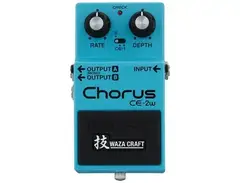
Hey, it’s that chorus pedal
There are plenty of comprehensive reviews out there along with demos to give you an idea of whether this chorus is for you or not. I use both the CE-1 and CE-2 modes, and I like to pair it with the VB-2W with just a very subtle hint of Vibrato. Previously, I had a Red Witch Empress chorus on my board, but you have to choose between chorus and vibrato. A great sounding pedal but have preferred the CE-2W since I got it