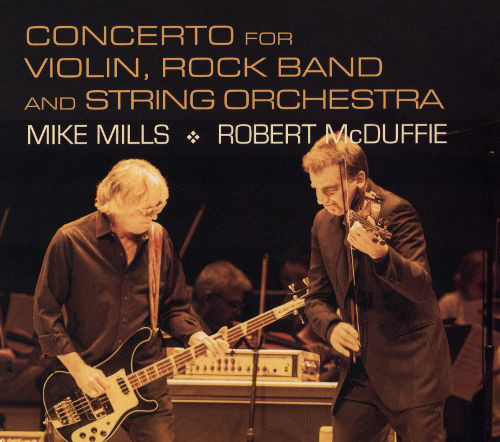
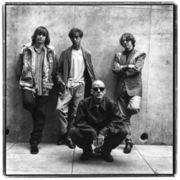
Mike Mills
R.E.M. bass player
Role
Role
Mike Mills' Amplifiers


Used on Murmur, according to these two sources.
R.E.M.'s Murmur by J. Niimi (2005)
Mike Mills had been using a Dan Armstrong bass up to the time of Chronic Town, but Easter lent him his Rickenbacker 4001 bass on an early garage session, and by the time of the Murmur sessions Mills had bought his own. Mills played through the studio's trusty Ampeg B-15, which was set up in the hallway outside the live room.
This time around, while Bill Berry's drum kit was conventionally miked in the booth — "I'm sure we had an [ElectroVoice] RE20 on the bass drum, because that's what you did in the United States at that time” — Mike Mills played his Rickenbacker bass through the studio's Ampeg B15 amp which was recorded with a distant mic in a small corridor. "I had probably just read that Geoff Emerick miked Paul McCartney from about eight feet away,” Easter says. "We would try stuff like that, and sure enough it worked.”
Find it on:


Used in the "mid-70s", as stated in this July 13, 2017 Music Radar interview.
His mid-70s bass setup was modelled after that of a local hero, Allman Brothers Band bassist Berry Oakley. “I had two Fender Dual Showman reverb amps: one cabinet with two 12s and one cabinet with four tens,” he remembers. Although Mills is most often associated with the Rickenbacker 4001, he went through a series of basses before finding the Rick.
“I played a beat-up Hofner for a while,” he says. “Then I played an Ampeg Dan Armstrong clear acrylic bass, followed by a Fender Musicmaster, and then I found that ’71 Rick.”
The 4001 remained Mills’ instrument of choice “until one of the horseshoe pickups went out. We couldn’t find another one.” He got a factory-replacement pickup, but wasn’t happy with it, so he went through another series of basses - an Ibanez and Guild among them - before trying out a 1970 Fender Precision he calls Old Yeller after its original finish.
“I had sort of resisted the P-Bass,” he says, “because everybody played them. But then I found out why. It was because they’re the best, especially for live shows. They’re just so durable, and they don’t go out of tune. They sound fantastic, and they feel good to play.”
Eventually, though, Mills’ bass tech located a working vintage horseshoe pickup, and the 4001 was returned to active duty. It’s actually a 4001S with Rick-O-Sound stereo output. “But I’ve never used it,” laughs Mills. “We tried it, but it was more trouble than the sound was worth.”
Mills has made a point of avoiding bass guitars with more than four strings. “I can’t stand them,” he says, admitting that five-string basses “just confuse me.”
Find it on:


r.e.m. live on the tube 11/18/83. Mike is using the amp head through his fender bass cabinent
Find it on:

r.e.m. live on the tube 11/18/83 playing radio free europe. Mike is playing a jazz bass through a fender bassman cabinet. At 3.28 seconds you can cleary see the fender logo and the whole amp.
Find it on:


"Mike runs his pre-CBS P-bass, with EMG pickups and Dean Markley medium roundwounds, through an Alembic preamp, a Furman parametric EQ, and a MESA/Boogie 400 head, with two 2x15 cabinets" Plus, in this interview (https://www.youtube.com/watch?v=VRfhX-XAIiY), at 22:23, Mills says he used "Mesa/Boogie for a long time", and then he switched to SVTs. Although, he doesn't say which exact model was used nor when he decided to get an SVT.
Find it on:

Based on a discussion from TalkBass, it is confirmed that Mike Mills uses the Orange Terror Bass 500 Head with his Rickenbacker 4001, along with a Sonic 1x15 Bass Cab while performing with the Baseball Project. An image supporting this can be found on Equipboard.
Find it on:
This is a community-built gear list for Mike Mills.
- Find relevant music gear like Guitars, Amplifiers, Effects Pedals, Bass Guitars, Pianos, Keyboards and Synthesizers, Microphones, and other instruments and add it to Mike Mills.
- The best places to look for gear usage are typically on the artist's social media, YouTube, live performance images, and interviews.
- To receive email updates when Mike Mills is seen with new gear, follow the artist.
Discography