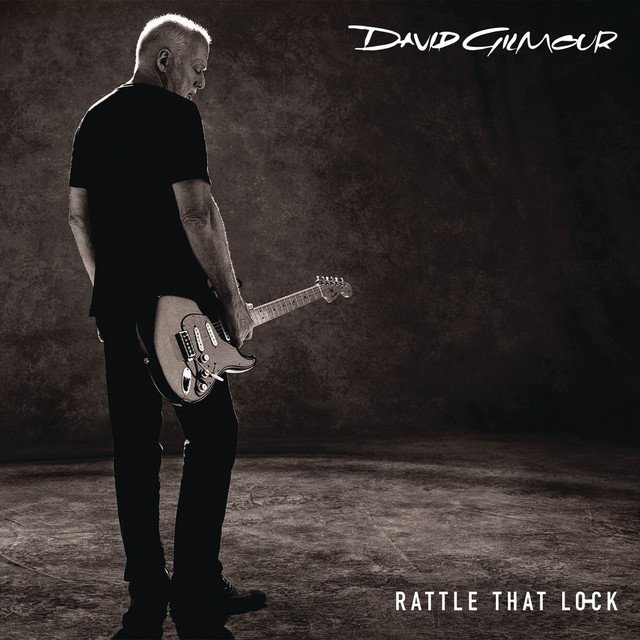
David Gilmour – Rattle That Lock
The music gear and equipment used by the artists, producers, engineers, and more involved in the making of the 2015 single Rattle That Lock.
Music from Rattle That Lock


Gear Used On Rattle That Lock
Explore the instruments, equipment, software, and production tools used in the making of David Gilmour – Rattle That Lock (2015). Click more on each item to see exactly how it was used.

Studio Equipment used by David Gilmour on Rattle That Lock

Avg price: $2,730.51
Used live from 1968 to 1977, as researched by Bjorn Riis of Gilmourish. One unit was sold on Reverb.com in 2017 via London Vintage Guitars, with the listing revealing that the unit was an OEM "Sound City Echomaster 2".
Gilmourish, "Binson Echorec"
David used the Binson 2 model from 1968 up to the Animals tour in 1977 after which he replaced it with MXR digital units. He later recalled, “I was tired of cleaning it and needed something more reliable”. Although he probably traveled with several backups, the constant touring and not least the outdoor gigs must have been hell for the delicate Binson.
After years of absence, David’s old Binson made a brief cameo on the 2003 BBC Dark Side of the Moon documentary and Richard Wright again used one with his Farfisa organ on David’s last tour in 2006.
A Binson 2 is also featured in David’s new recording studio, Medina, located in Hove outside Brighton. Both Pink Floyd’s Endless River and David Gilmour’s Rattle That Lock was recorded in the studio but it’s not documented if the Binson is featured on the albums.
(...) Between 1968-73 David had a very basic setup layed out on the floor that consisted of a Fuzz Face, a wah wah pedal, DeArmond volume pedal and an on/off foot-switch for the Binson. Later, the 1973-75 board and the 1976 Cornish board had built in on/off switches for the Binson that was connected through send/returns.
David would mainly use the repeat mode for a classic delay sound. The Binson 2 had a maximum time setting around 300-310ms, which was David’s main setting for most Floyd songs (he used the Echo/slap back setting on live versions of the intro on Time). The level and swell were both adjusted for different songs.
One of David’s trademarks in the early days was the sustained violin effect on the intro of Echoes and many other songs. On the beginning of Echoes on Pompeii you can see David using the slide, rubbing it back and forth on the high E string to create this sustained violin effect. This is achieved by drenching the tone with echo and adjusting the guitar volume for a mild ovedrive from the Fuzz Face. The effect is used on countless early Floyd songs from 1968-1971.
2017 Reverb.com listing
We are happy to offer the following original Binson Echorec which was used , owned by one of the worlds most respected of all artists , that is “Pink Floyd” , please see full details , specifications as follows
- Binson / Sound City Echomaster 2
- 1969 ( Circa)
- Green Hammerite Casing
- Pink Floyd Stock Plaque to side
- Service Signature by Pete Cornish to side dated 1979
- Remnants of original Input / Output Labels - Notes
Verification
The above unit comes with the following verification
Original Pink Floyd Stock Number Plaque to side
Email Verification from Pete Cornish that verifies his Signature / Label and confirms that he serviced , checked the unit for Pink Floyd in 1979
Various Photographic Verification - The unit comes complete with various published photographic verification of David Gilmour using a Sound City Echomaster II that has the Pink Floyd Original Stock Serial Number Plate that is affixed in exact same location / position ( The Picture is taken from 1975 Wish You Were here tour)
Please See Picture 6 + 7 for Verification of Stock Label Position
Note - The above unit is a Key Factor in the sound and tone of Pink Floyd


Avg price: $401.25
David Gilmour used the TC Electronic D-Two Delay during the 2015 recording sessions for his album "Rattle That Lock," as confirmed by Bjorn on Gilmourish.

Guitars used by David Gilmour on Rattle That Lock

Avg price: $3,324.50
David Gilmour is using a Gibson Country Western guitar on stage, notably during his "On an Island" and "Rattle That Lock" tours. This video showcases him playing the guitar, which dates back to 1959.

Taylor NS72ce Grand Concert Cutaway Nylon-String Acoustic-Electric Guitar
Avg price: $2,609.37
David Gilmour used the Taylor NS74ce Grand Concert Cutaway Nylon-String Acoustic-Electric Guitar while recording "Rattle That Lock," as confirmed by Bjorn on Gilmourish.
-m.webp?v=1785020404)
Avg price: $2,631.28
David Gilmour used a Martin D-18 from 1945 during the 2015 "Rattle That Lock" sessions, as confirmed by Bjorn on Gilmourish.

Microphones used by David Gilmour on Rattle That Lock

Avg price: $228.08
Used for vocals on the Rattle That Lock Tour, as featured in this article by Sound Technology Ltd.
After five decades as a leading live sound engineer Colin Norfield’s roster of acts reads like a who’s who of touring giants.
In 1994 he piloted the sound mix for Pink Floyd’s landmark Divisional Bell tour, and his relationship with band front-man, David Gilmour has endured right up to the five recent performances at the Royal Albert Hall to promote his new album, Rattle That Lock.
Over the years, Colin has become increasingly discerning with his equipment selection, and for the first time on these shows, he introduced the artist to AKG’s D7 dynamic mic. This had originally been brought to his attention by the Austrian company’s Artist & Key Customer Relations Manager, Walter Rührig, with whom he has enjoyed a long relationship.
“Colin and I spoke again before this tour, and I suggested he give the D7 another try,” says the AKG man. The mic was submitted for initial tests several months before full production rehearsals started, and Colin Norfield promptly adopted it, at the same time ensuring that the six backing vocalists were also equipped with the D7.
Explaining his reasons behind the decision, Colin Norfield explains, “It’s a problem to get a big punchy sound in The Albert Hall due to its notoriously difficult acoustics. I needed something that would deliver a clean, robust all round sound.
“Having used the AKG D7 on other artists I have found it to be a good all round microphone, which doesn’t let much in from outside. I know of other artists who have literally screamed into the D7 — with no evidence of distortion.”
Amplifiers used by David Gilmour on Rattle That Lock

Fender Concert Rivera Era Combo (1981-1987)
Avg price: $854.00
A couple of Fender Concerts were sold at auction for $77,500 as part of Christie's The David Gilmour Guitar Collection auction. The listing has the following description:
FENDER MUSICAL INSTRUMENTS, FULLERTON, CIRCA 1982 AND 1983 A PAIR OF GUITAR AMPLIFIERS, CONCERT One bearing the serial number F332178, stamped on the chassis, the other stamped F210503 18 ½ in. (47 cm.) high, the cabinet; 23 ¾ in. (60 cm.) wide; 11 in. (28 cm.) deep
The Fender Concert amplifier was part of the II Series line produced by Fender under Paul Rivera from 1982 to 1986, among the last amplifiers to be made at Fullerton. The amps were designed with both a clean and mid-boost gain channel to compete with the Mesa Boogie Mark Series amps that were popular at the time. A stereo set up of the two Fender Concert amplifiers was first incorporated into David Gilmour’s session rig in mid-1984 and used during recording sessions at London’s AIR Studios for Paul McCartney’s 1984 soundtrack album Give My Regards to Broad Street. With his 1984 Candy Apple Red 57V Stratocaster (lot 56) fed into the two Fender Concert amps, Gilmour performed a memorable solo on the McCartney ballad No More Lonely Nights, requesting that his session fee be donated to a charity of McCartney’s choice. The Concert amps made a notable appearance at the legendary Live Aid concert in London’s Wembley Stadium on 13th July 1985 when David Gilmour performed a set as part of Bryan Ferry’s band, which included the songs Sensation, Boys and Girls, Slave to Love and a cover of John Lennon’s Jealous Guy. Numerous photographs and live film recordings exist of the performance, showing a total of four Fender Concert amplifiers stacked on top of four Fender speaker cabinets on the stage. The concert amplifiers remained in Gilmour’s session and stage rig through 1985, used during recording of Pete Townshend’s 1985 solo album White City: A Novel and for live performances with Townshend’s short-lived supergroup Deep End in October and November 1985, including a live performance on cult British television show The Tube on 11th October and two nights at London’s Brixton Academy on 1 and 2nd November in aid of Townshend’s Double O charity.
As documented on Gilmourish and on Spare Bricks, one of the Fender Concert amps was also used on A Momentary Lapse of Reason, particularly for the intro of "Sorrow".
intro; the guitar was recorded with a Big Muff into a Fender Concert combo and fed through Floyd’s Quad PA system at the LA Sports Arena.
Meanwhile, Kit Rae notes that Gilmour used four different Fender Concerts for Live Aid.
A modified version of the rig was used on July 13th, 1985 when Gilmour played a set of songs with Bryan Ferry's band for the Live Aid benefit concert in London's Wembley Stadium. Keyboardist/guitarist Jon Carin was a member of Bryan Ferry's backing band at this time, and he would later work extensively with Pink Floyd in that same period. David can be heard on Slave to Love and John Lennon's Jealous Guy. He used four Fender Concert combo amplifiers stacked on top of four Fender speaker cabinets. The lower cabs do not appear to be mic'd. As sated above, the clean channel of the Concerts sounded very much like a black face Twin Reverb.

Effects Pedals used by David Gilmour on Rattle That Lock
Univibe & Rotary Effects Pedals

Avg price: $376.55
David Gilmour used a Fulltone Deja Vibe during the 2015 recordings for "Rattle That Lock," as confirmed by Bjorn on Gilmourish.
-m.webp?v=1785020886)
Avg price: $91.12
David Gilmour replaced his Uni-Vibe in 1974 and used it up until 1976 when he later switched to the Yamaha rotary and electric mistress in 1977. He would use it later on in live shows whenever he played shine on you crazy diamond
From the source article: "A MXR Phase 90 was also connected with send/returns during summer 1974."
