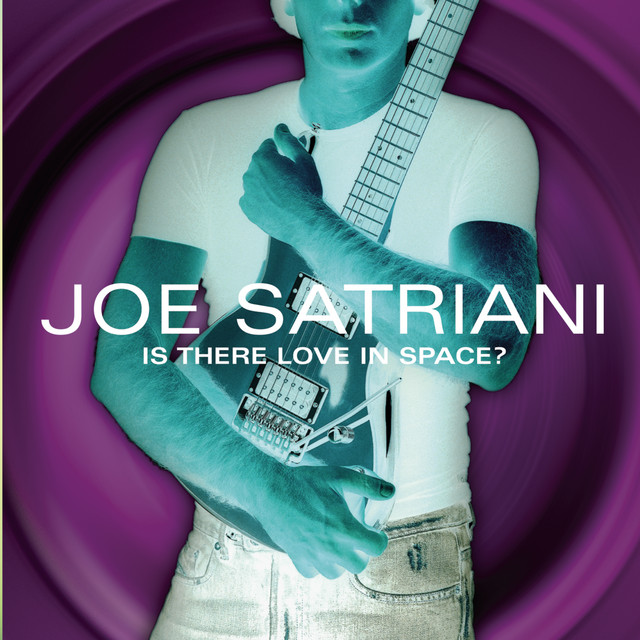
Joe Satriani – Is There Love In Space?
The music gear and equipment used by the artists, producers, engineers, and more involved in the making of the 2004 album Is There Love In Space?.
Music from Is There Love In Space?
Artists on Is There Love In Space?


Gear Used On Is There Love In Space?
Explore the instruments, equipment, software, and production tools used in the making of Joe Satriani – Is There Love In Space? (2004). Click more on each item to see exactly how it was used.

Effects Pedals used by Joe Satriani on Is There Love In Space?
-m.webp?v=1783349892)


Studio Equipment used by Joe Satriani on Is There Love In Space?
-m.webp?v=1783403145)
Avg price: $2,466.75
Used for rhythm guitar and bass on Not of This Earth, as stated by producer John Cuniberti in Strange Beautiful Music: A Musical Memoir. Satriani later writes that a unit was acquired for Studio 21 and first used for Is There Love in Space?.
Not of This Earth
John Cuniberti: As far as effects pedals, Joe was primarily playing through his orange Boss DS-1 Distortion pedal and CE-2 Chorus and that was pretty much it. All the echo-delay types of effects—reverbs, chorusing—we did with outboard gear. Typically, I would use a Universal Audio 1176 limiter for rhythm guitars and bass, and a Universal Audio LA-2A limiter for melodies and occasionally solos. Because again, those were limiters you would use for a singer, and since Joe’s phrasing and playing and arranging were that way, I tended to use the same processors as I would if there were people singing. An LA-2A’s not unusual for lead vocals, so of course that’s what I’d use on Joe’s melodies.
Is There Love in Space?
Before reuniting with John Cuniberti, Matt Bissonette, and Jeff Campitelli to record Is There Love in Space?, I started recording the new songs at Studio 21, my home studio, trying once again to break my own style down and rebuild it into something new. I was deeper into Pro Tools now and having much more success and fun with it. The new record would feature quite a bit of compositional variety, with lyrical-sounding melodies and more angular-sounding solos—and two vocal tracks!
At Studio 21, I was using a Korg Triton DAW keyboard, Universal Audio 1176 and LA-2A compressor/limiters, an Empirical Labs EL8S, old API EQs, the Millennia Media STT-1 mic pre, and Palmer speaker simulators. For guitar amps I had an interesting collection: Soldano, Mesa Boogie, Cornford, Vox, Wells, and several vintage Marshalls. Added to that group was my new Peavey JSX prototype head. Everything just started to sound better!


Universal Audio Teletronix LA-2A Classic Leveling Amplifier
Avg price: $4,246.03
Used for lead guitar on Not of This Earth, as stated by producer John Cuniberti in Strange Beautiful Music: A Musical Memoir. Satriani later writes that a unit was acquired for Studio 21 and first used for Is There Love in Space?.
Not of This Earth
John Cuniberti: As far as effects pedals, Joe was primarily playing through his orange Boss DS-1 Distortion pedal and CE-2 Chorus and that was pretty much it. All the echo-delay types of effects—reverbs, chorusing—we did with outboard gear. Typically, I would use a Universal Audio 1176 limiter for rhythm guitars and bass, and a Universal Audio LA-2A limiter for melodies and occasionally solos. Because again, those were limiters you would use for a singer, and since Joe’s phrasing and playing and arranging were that way, I tended to use the same processors as I would if there were people singing. An LA-2A’s not unusual for lead vocals, so of course that’s what I’d use on Joe’s melodies.
Is There Love in Space?
Before reuniting with John Cuniberti, Matt Bissonette, and Jeff Campitelli to record Is There Love in Space?, I started recording the new songs at Studio 21, my home studio, trying once again to break my own style down and rebuild it into something new. I was deeper into Pro Tools now and having much more success and fun with it. The new record would feature quite a bit of compositional variety, with lyrical-sounding melodies and more angular-sounding solos—and two vocal tracks!
At Studio 21, I was using a Korg Triton DAW keyboard, Universal Audio 1176 and LA-2A compressor/limiters, an Empirical Labs EL8S, old API EQs, the Millennia Media STT-1 mic pre, and Palmer speaker simulators. For guitar amps I had an interesting collection: Soldano, Mesa Boogie, Cornford, Vox, Wells, and several vintage Marshalls. Added to that group was my new Peavey JSX prototype head. Everything just started to sound better!

Avg price: $3,650.37
Used in Studio 21 for Is There Love in Space?, Professor Satchifunkilus and the Musterion of Rock and Black Swans and Wormhole Wizards (particularly for the intro of "Littleworth Lane"), as stated in Strange Beautiful Music: A Musical Memoir.
Is There Love in Space?
Before reuniting with John Cuniberti, Matt Bissonette, and Jeff Campitelli to record Is There Love in Space?, I started recording the new songs at Studio 21, my home studio, trying once again to break my own style down and rebuild it into something new. I was deeper into Pro Tools now and having much more success and fun with it. The new record would feature quite a bit of compositional variety, with lyrical-sounding melodies and more angular-sounding solos—and two vocal tracks!
At Studio 21, I was using a Korg Triton DAW keyboard, Universal Audio 1176 and LA-2A compressor/limiters, an Empirical Labs EL8S, old API EQs, the Millennia Media STT-1 mic pre, and Palmer speaker simulators. For guitar amps I had an interesting collection: Soldano, Mesa Boogie, Cornford, Vox, Wells, and several vintage Marshalls. Added to that group was my new Peavey JSX prototype head. Everything just started to sound better!
Professor Satchifunkilus and the Musterion of Rock
I was using an old Marshall SE100 as my main speaker simulator, which meant I was going guitar into amplifier into Marshall SE100 into Pro Tools directly, or through the STT-1 if I wanted to shape it with some EQ or optical compressor. Additionally, the SE100 has some really clever ways of simulating a microphone being right at the cone, at a slight angle, or at a big angle. I like using the 30- and 60-degree angles—off axis, they call it—and it worked pretty well. It really does sound like an amp being miked up by a 57, so that setup worked in my room. As far as guitars, I was using the Ibanez JS1200 and the JS1000 most of the time. What mattered more than the equipment by that point was that another two years had gone by where I continued getting more proficient at recording with Pro Tools in general.
Black Swans and Wormhole Wizards
With “Solitude,” I was thinking about how I often require time to be alone, much as my parents did, and I coupled that with my mother’s absence from her house once she passed. It was so profound, I couldn’t put it into words. I was working on a song called “Heartbeats” at my home studio one afternoon when the inspiration came. I was thinking “Heartbeats” needed some kind of introduction, but instead I started writing a piece that was much bigger. It was a song about my moments of solitude, and the lonely feeling in my mother’s house now that her spirit had moved on. It eventually found a home on the record right before “Littleworth Lane.” I played my JS1000 direct into my STT-1 for that recording.