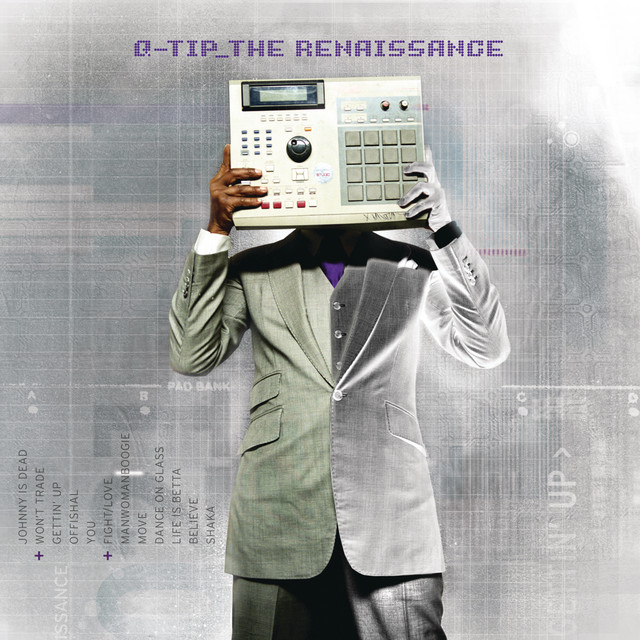
Q-Tip – The Renaissance
The music gear and equipment used by the artists, producers, engineers, and more involved in the making of the 2008 album The Renaissance.
Music from The Renaissance
Artists on The Renaissance


Gear Used On The Renaissance
Explore the instruments, equipment, software, and production tools used in the making of Q-Tip – The Renaissance (2008). Click more on each item to see exactly how it was used.

Studio Equipment used by Q-Tip on The Renaissance
-m.webp?v=1785164391)
Avg price: $490.00
Featured on the album art for The Renaissance, two of its promotional photos (here and here), and the single art for "Get Up".


Avg price: $1,187.69
Used on People's Instinctive Travels and the Paths of Rhythm and The Renaissance, as respectively stated by recording engineer Bob Power in this November 8, 2016 Wax Poetics interview, recording engineer Blair Wells in Q-Tip's January 2008 Remix interview, and Q-Tip himself in this April 19, 2009 Moovmnt interview. Transcripts of the Remix interview can be found at the Future Producers forums and this Prince.org forum.
Wax Poetics
Also, back then, MIDI was in a very primitive state. MIDI is the language that computers, synthesizers, and samplers use to speak to each other. It was extremely primitive at that point. Q-Tip was sequencing on an SP-1200, and Ali had an Alesis eight-track MIDI sequencer and an Akai S950. Sampling technology was very primitive. The S950 had maybe a second and a half worth of memory. Putting together those complex, elaborate constructions was so difficult. It took a lot of time. We had to do things bit by bit because of the undeveloped memory for samplers at that point. We had to be creative in the way we approached things. People say we used twenty-four tracks, but we really had twenty-two tracks to deal with because you needed to print a synchronization code on one track and use another track as your guard band. Because samplers would only hold less than a second worth of sound at one time, we ended up putting little bits of things across different tracks and combining them later.
Remix
Q-Tip goes even further with aural textures than he did on Open, trying numerous methods to get to the sound he hears in his head. “The MPC3000 has been his main workhorse,” Wells says, “but there was a period where he went back to the [E-mu] SP-1200 for obvious tonal reasons. He's tried the MPC4000 and the 1000, and some of the Roland boxes like the Fantom [X-series workstation] with the drum pads, to rework his samples.”
Moovmnt
The one thing that always told me something was a Q-Tip production were the drums. What kind of equipment did you use?
The SP(1200) for drums and for the loops the (AKAI S)950. That’s something that Large Professor put me onto (the AKAI S950). I just liked the snap of it. For me… I was always into the big drums with the tin like smack of it

Akai S950 MIDI Digital Sampler
Avg price: $1,098.62
Used on The Renaissance, as stated in this April 19, 2009 Moovmnt interview.
The one thing that always told me something was a Q-Tip production were the drums. What kind of equipment did you use?
The SP(1200) for drums and for the loops the (AKAI S)950. That’s something that Large Professor put me onto (the AKAI S950). I just liked the snap of it. For me… I was always into the big drums with the tin like smack of it

Avg price: $320.00
Used for The Renaissance, as stated in his January 2008 Remix interview. Transcripts can be found at the Future Producers forums (linked) and this Prince.org forum.
With recording engineer Blair Wells waiting in the wings on a Digidesign Pro Tools|HD3 system, Tip would often take whole sections of live jams and either layer them with sampled elements — kicks, snares and claps in particular — or reprocess them entirely.
“Really the one consistent piece has always been Pro Tools,” Wells notes. “We have it set up so the [Chandler LTD-1] mic pres run direct into the Pro Tools rig, through the patch bay. We've got everything patchable so we can sample back out of Pro Tools or sample back in. We try to route everything in a flexible way so that we can really experiment with the tonality and the overall structure of the songs.”
(...) Digidesign Pro Tools|HD3 Accel, 192 I/Os

Avg price: $2,800.00
Used for The Renaissance, as stated in his January 2008 Remix interview. Transcripts can be found at the Future Producers forums (linked) and this Prince.org forum.
With recording engineer Blair Wells waiting in the wings on a Digidesign Pro Tools|HD3 system, Tip would often take whole sections of live jams and either layer them with sampled elements — kicks, snares and claps in particular — or reprocess them entirely.
“Really the one consistent piece has always been Pro Tools,” Wells notes. “We have it set up so the [Chandler LTD-1] mic pres run direct into the Pro Tools rig, through the patch bay. We've got everything patchable so we can sample back out of Pro Tools or sample back in. We try to route everything in a flexible way so that we can really experiment with the tonality and the overall structure of the songs.”

Little Labs PCP Instrument Distro Rev 3.1
Avg price: $1,200.00
Used for The Renaissance, as stated in by recording engineer Blair Wells in Q-Tip's January 2008 Remix interview. Transcripts can be found at the Future Producers forums (linked) and this Prince.org forum.
For guitars, bass and keyboards (the latter usually played either by Q-Tip himself or prog-jazz upstart James Hurt), which were split between an amped-and-miked signal and direct to Pro Tools, most of the processing happened in Pro Tools with the aid of various effects plug-ins. “In general, we use our outboard gear to get the best quality signal into the machine,” Wells continues, “and then a lot of the manipulation is happening in the digital realm. But we also did a good amount of re-amping. We use the Little Labs PCP Distro, which is basically a glorified re-amp box, but it also has routing capabilities where you can have a signal going through multiple amplifiers and independently adjust the levels.”
The specific revision is not specified, but given that The Renaissance was recorded in 2007, the year that Rev 3.1 and Rev 3.1B were made available, this is likely the one.


Used for The Renaissance, as stated in his January 2008 Remix interview. Transcripts can be found at the Future Producers forums (linked) and this Prince.org forum.
Just as Open benefited enormously from the signature thwack-driven power of drummer Mark Colenburg, so too did the beats on The Renaissance — many of which were either reprocessed from the original sessions or based on recuts that Colenburg tracked using a Clavia ddrum SE-4 electronic drum kit. The kit has long been a favorite of Q-Tip's for its signature ability to compress drum sounds into a tube-warmed veil that maintains the snap of the original sample while creating a gritty, tape-baked sheen.
“I got hip to that just through searching,” Tip explains. “I have the Roland V-Drums, but with the ddrum, the way the brain processes the sound is just dope. I sampled and chopped up a lot of the drums on the album and then routed them through that. There's compression when you load sounds into the brain, so it really keeps the integrity of the drum sounds nice and even. Then we triggered everything up — I use a Ludwig Vistalite acoustic kit with a Black Beauty snare — and we'd run it through the ddrum and put that back in the room, as well. We'd have a monitor in the room and then mic that, too.”
Once Colenburg's original drum tracks — which were usually recorded with a pair of Coles 4038 ribbon mics and various combinations for the kick, snare and hi-hat — had been processed and loaded into the electronic kit, a live pass of ddrums would often be blended in or used to entirely replace the original. “It was a headache to get the sounds into it,” Wells recalls. “You had to use an old-style MIDI sample dump. But once they were in there, Mark would replay his original drum sounds to give us a take with no dynamics and just a solid groove all the way through. That allowed us to really integrate the drum kit itself between being a real kit and an electronic one. It was all Tip's idea originally, and Mark obviously had a lot of fun with it.”
Keyboards and Synthesizers used by Q-Tip on The Renaissance

Fender Rhodes Mark II Stage Piano 73
Avg price: $1,699.99
Featured in two promotional photos for The Renaissance (the second can be found here).


Avg price: $534.46
Used for The Renaissance, as stated in his January 2008 Remix interview. Transcripts can be found at the Future Producers forums (linked) and this Prince.org forum.
Q-Tip goes even further with aural textures than he did on Open, trying numerous methods to get to the sound he hears in his head. “The MPC3000 has been his main workhorse,” [recording engineer Blair] Wells says, “but there was a period where he went back to the [E-mu] SP-1200 for obvious tonal reasons. He's tried the MPC4000 and the 1000, and some of the Roland boxes like the Fantom [X-series workstation] with the drum pads, to rework his samples.”

Avg price: $470.00
Used for The Renaissance, as stated in his January 2008 Remix interview. Transcripts can be found at the Future Producers forums (linked) and this Prince.org forum.
Q-Tip goes even further with aural textures than he did on Open, trying numerous methods to get to the sound he hears in his head. “The MPC3000 has been his main workhorse,” [recording engineer Blair] Wells says, “but there was a period where he went back to the [E-mu] SP-1200 for obvious tonal reasons. He's tried the MPC4000 and the 1000, and some of the Roland boxes like the Fantom [X-series workstation] with the drum pads, to rework his samples.”

Avg price: $3,600.00
The "main workhorse" for The Renaissance, as stated in his January 2008 Remix interview. Transcripts can be found at the Future Producers forums (linked) and this Prince.org forum.
“I'd usually come up with a sketch on the [Akai] MPC3000,” he explains. “Then I'd shoot that to the guys, and they'd take it and play with it, and I'd take what they'd do sometimes and chop it up, so it was always going through processing. It would morph and change to become whatever it was meant to become. In that way, jazz was a little bit of an inspiration, especially with the way Miles [Davis] was so organic in what he did with his band. He'd go for certain colors and certain vibes, like a painting. Making music is like that, with the palettes, the colors, the tones and the hues.”
(...) Q-Tip goes even further with aural textures than he did on Open, trying numerous methods to get to the sound he hears in his head. “The MPC3000 has been his main workhorse,” [recording engineer Blair] Wells says, “but there was a period where he went back to the [E-mu] SP-1200 for obvious tonal reasons. He's tried the MPC4000 and the 1000, and some of the Roland boxes like the Fantom [X-series workstation] with the drum pads, to rework his samples.”
Microphones used by Q-Tip on The Renaissance

Avg price: $1,295.81
Used to record Mark Colenburg's drumming for The Renaissance, as stated in Q-Tip's January 2008 Remix interview. Transcripts can be found at the Future Producers forums (linked) and this Prince.org forum.
Just as Open benefited enormously from the signature thwack-driven power of drummer Mark Colenburg, so too did the beats on The Renaissance — many of which were either reprocessed from the original sessions or based on recuts that Colenburg tracked using a Clavia ddrum SE-4 electronic drum kit. The kit has long been a favorite of Q-Tip's for its signature ability to compress drum sounds into a tube-warmed veil that maintains the snap of the original sample while creating a gritty, tape-baked sheen.
“I got hip to that just through searching,” Tip explains. “I have the Roland V-Drums, but with the ddrum, the way the brain processes the sound is just dope. I sampled and chopped up a lot of the drums on the album and then routed them through that. There's compression when you load sounds into the brain, so it really keeps the integrity of the drum sounds nice and even. Then we triggered everything up — I use a Ludwig Vistalite acoustic kit with a Black Beauty snare — and we'd run it through the ddrum and put that back in the room, as well. We'd have a monitor in the room and then mic that, too.”
Once Colenburg's original drum tracks — which were usually recorded with a pair of Coles 4038 ribbon mics and various combinations for the kick, snare and hi-hat — had been processed and loaded into the electronic kit, a live pass of ddrums would often be blended in or used to entirely replace the original. “It was a headache to get the sounds into it,” Wells recalls. “You had to use an old-style MIDI sample dump. But once they were in there, Mark would replay his original drum sounds to give us a take with no dynamics and just a solid groove all the way through. That allowed us to really integrate the drum kit itself between being a real kit and an electronic one. It was all Tip's idea originally, and Mark obviously had a lot of fun with it.”


Drum Sets used by Q-Tip on The Renaissance

Avg price: $2,632.50
Used for The Renaissance, as stated in his January 2008 Remix interview. Transcripts can be found at the Future Producers forums (linked) and this Prince.org forum.
Just as Open benefited enormously from the signature thwack-driven power of drummer Mark Colenburg, so too did the beats on The Renaissance — many of which were either reprocessed from the original sessions or based on recuts that Colenburg tracked using a Clavia ddrum SE-4 electronic drum kit. The kit has long been a favorite of Q-Tip's for its signature ability to compress drum sounds into a tube-warmed veil that maintains the snap of the original sample while creating a gritty, tape-baked sheen.
“I got hip to that just through searching,” Tip explains. “I have the Roland V-Drums, but with the ddrum, the way the brain processes the sound is just dope. I sampled and chopped up a lot of the drums on the album and then routed them through that. There's compression when you load sounds into the brain, so it really keeps the integrity of the drum sounds nice and even. Then we triggered everything up — I use a Ludwig Vistalite acoustic kit with a Black Beauty snare — and we'd run it through the ddrum and put that back in the room, as well. We'd have a monitor in the room and then mic that, too.”
Once Colenburg's original drum tracks — which were usually recorded with a pair of Coles 4038 ribbon mics and various combinations for the kick, snare and hi-hat — had been processed and loaded into the electronic kit, a live pass of ddrums would often be blended in or used to entirely replace the original. “It was a headache to get the sounds into it,” Wells recalls. “You had to use an old-style MIDI sample dump. But once they were in there, Mark would replay his original drum sounds to give us a take with no dynamics and just a solid groove all the way through. That allowed us to really integrate the drum kit itself between being a real kit and an electronic one. It was all Tip's idea originally, and Mark obviously had a lot of fun with it.”