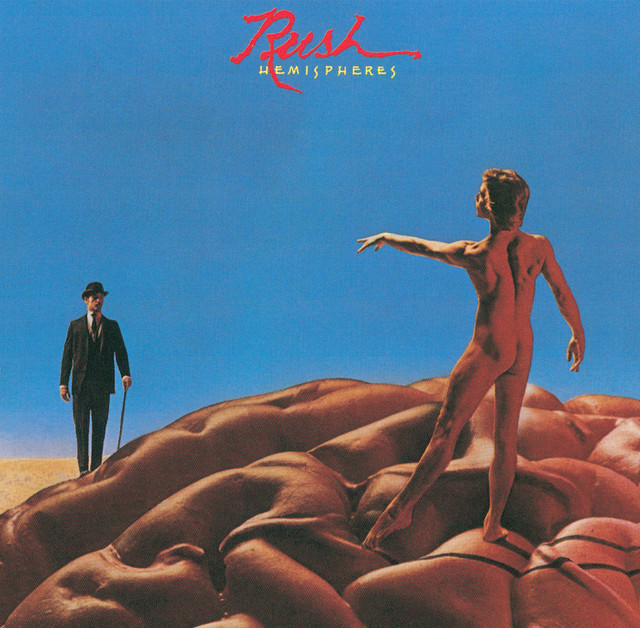
Rush – Hemispheres
The music gear and equipment used by the artists, producers, engineers, and more involved in the making of the 1978 album Hemispheres.
Music from Hemispheres
Artists on Hemispheres


Gear Used On Hemispheres
Explore the instruments, equipment, software, and production tools used in the making of Rush – Hemispheres (1978). Click more on each item to see exactly how it was used.

Alex Lifeson
Roles:
Amplifiers used by Alex Lifeson on Hemispheres

Hiwatt Custom 100 Amplifier Head
Avg price: $3,100.00
used on Hemispheres album, and live slightly before, afterwards. Two heads power 2 bottom cabinets, a 3rd head for the Leslie rotating speaker cabinet (under the Tapco Reverb and EQ to the left of the Hiwatt stacks) and a 4th head is the spare.
From the 1979 Hemispheres tour book:
Alex Lifeson
My amplifiers are three Hiwatt 100's spread over four 4x12 Hiwatt cabinets and one Leslie cabinet, with one spare amplifier and two spare cabinets. A Fender J.B.L. Twin Reverb is used for primary p.a. miking.
My guitars are one each Gibson ES335, Gibson ES355, Gibson Les Paul Standard, Gibson Custom Double-Neck, custom built Pyramid, Fender Stratocaster, Roland Guitar Synthesizer, Gibson Dove, Gibson J-55, Gibson B45-12, Gibson C-60 classical, and a Ramirez classical. I also play a set of Moog Taurus pedals.
The effects I use are three Rolands 301 Space Echo's, one Roland chorus, an Electric Mistress, a Morley volume pedal, a Cry Baby Wah Wah, a Maestro parametric filter, Ashley pre-amps for the acoustic guitars, and a custom build effects board designed by L.B., and built by Steele-Power Supply.
Here's the link to the original article
http://www.2112.net/powerwindows/main/HEMtourbook.htm
There's a ton of info in his 1980 Guitar Player cover interview...
http://www.2112.net/powerwindows/transcripts/19800600guitarplayer.htm


Avg price: $900.00
For Hemisphere's Lifeson says "The Boss Chorus unit had just come out at that time, but I think I used a Roland JC-120 for the chorus sound here. Hemispheres was the first of many ‘chorus’ albums.”
Effects Pedals used by Alex Lifeson on Hemispheres

Avg price: $190.00
Which guitars did you use on Rush's first LP, Rush?
I used the 335 and a rented Rickenbacker 12-string. That's it for guitars. I played them through my Marshall 50 with a 4-12 cabinet, and I used a Maestro phase shifter, a Cry Baby wah-wah, and an Echoplex.
Many of your songs have either a phased or a chorus effect.
I like both sounds. Ever since A Farewell To Kings I've used a Roland Boss Chorus. I liked the Maestro phaser as opposed to, say, MXR Phase 90s or 100s; it was a little more subtle than the MXR phase lines. But after I heard the Chorus, I loved it and decided to incorporate it into my music. Hemispheres and Permanent Waves have a lot of Chorus -almost every song has Chorus, since with a three-piece band it tends to widen the guitar sound.

Avg price: $565.11
Which guitars did you use on Rush's first LP, Rush?
AL: I used the 335 and a rented Rickenbacker 12-string. That's it for guitars. I played them through my Marshall 50 with a 4-12 cabinet, and I used a Maestro phase shifter, a Cry Baby wah-wah, and an Echoplex.
Many of your songs have either a phased or a chorus effect.
AL:I like both sounds. Ever since A Farewell To Kings I've used a Roland Boss Chorus. I liked the Maestro phaser as opposed to, say, MXR Phase 90s or 100s; it was a little more subtle than the MXR phase lines. But after I heard the Chorus, I loved it and decided to incorporate it into my music. Hemispheres and Permanent Waves have a lot of Chorus -almost every song has Chorus, since with a three-piece band it tends to widen the guitar sound.
Source: Guitar Player Magazine, June 1980.

Maestro MPF-1 Parametric Filter
Avg price: $899.00
The Maestro Parametric Eq was added . Note that it isn't part of the pedalboard, (later, recording Moving Pictures, his pedalboard is shown larger)
Here's the reference in June 1980's Guitar Player cover story.
What is your current onstage amplifier setup?
I'm using two Hiwatts; I have one 100-watt head driving two cabinets on my side of the stage, and another 100-watt head driving one cabinet on stage left-Geddy's side. He uses that as a monitor, and you can't even hear it out in the house. I also have a Fender Twin Reverb I use to get a clean, almost direct sound, and then I'm driving my Leslie with another Hiwatt head. In addition I have two Maestro parametric filters-one on my Hiwatt, and the other on the Leslie-and I use an Electro-Harmonix Electric Mistress flanger, a Roland Boss Chorus, an Advanced Audio Designs [3890 Stewart Rd., Eugene, OR 97402] digital delay, a Morley volume pedal, and a Cry Baby wah-wah.
You are credited on all your LPs since A Farewell To Kings as using bass synthesizer pedals. What are those?
They're Moog Taurus bass pedals, and they have an effective range of two octaves. I use them a lot on "Xanadu" [A Farewell To Kings] where I play harmony to Geddy's bass pedal line, and on "La Villa Strangiato" [Hemispheres]. Most of the time I'll play the lower end while Geddy takes the high, melodic parts.
Which guitars do you take on the road with you?
The electrics I have are the 355, the 345, the Stratocaster, and my white Gibson double-neck. My acoustics are the Epiphone C-60 classical and the Gibson Dove. I also have a Roland GR-500, but I don't use it much. I'm not really keen on it.
Keyboards and Synthesizers used by Alex Lifeson on Hemispheres

Used on the song "Hemispheres" ...I remember seeing them on the Permanent Waves tour, and he used this guitar when they played the title track.
id you use basically the same setup on Hemispheres?
All the same guitars, with the addition of a new Gibson ES-345 and a Roland GR-500 guitar synthesizer. I eventually gave the 345 to one of our road crew as a birthday gift and bought a black 78345 to replace it. For amps I used Hiwatt [21750 Main St., Matteson, IL 60443] tops and bottoms exclusively.
Guitars used by Alex Lifeson on Hemispheres
Semi-Hollowbody Electric Guitars

Gibson Howard Roberts Fusion I
Avg price: $2,624.16
"I always stuck with my 335, but at the beginning of this tour I got a Howard Roberts Fusion that I love, it's a great guitar. I use that for 'Hemispheres,' 'Tom Sawyer,' 'Camera Eye' and the medley at the end of the night. It's the dark guitar with the single cutaway - it looks like an oversized hollow-body Les Paul, which is basically what it is, it's a hybrid of the Howard Roberts and a Les Paul. It's a hollow-body guitar but it has a maple spur that runs down the center of the body so it's got the weight and density yet it has the acoustic qualities, like at a lower volume setting it's nice and clear, not fat and undefined like the Les Paul usually is. The back pickup is one of the hot Gibson pickups and the other one has a certain coiling to it that's a little more toppy, which you can use in that front, rhythm position."

Avg price: $3,574.50
In the article, Alex states (regarding Rush's Hemispheres):
“By that time I had my ES-355, and my acoustics were a Gibson Dove, J-55 and a B-45 12-string. I had my Marshall in the studio. I had the Twin and two Hiwatts, which I was also using live, but the Marshall was my real workhorse."


Avg price: $1,910.75
In this article, Alex states (regarding Rush's Hemispheres):
“By that time I had my ES-355, and my acoustics were a Gibson Dove, J-55 and a B-45 12-string. I had my Marshall in the studio. I had the Twin and two Hiwatts, which I was also using live, but the Marshall was my real workhorse."

Semi-Hollowbody Electric Guitars

Epiphone Inspired by Gibson Custom Alex Lifeson 1976 ES-355 Reissue Electric Guitar
Avg price: $1,449.20
Alex Lifeson uses the Epiphone Inspired by Gibson Custom Alex Lifeson 1976 ES-355 Reissue Electric Guitar, as confirmed by its feature in a 2026 Gibson/Epiphone magazine detailing his signature model. This information is supported by the Gibson Gazette's article, "Epiphone launches the Alex Lifeson 1976 ES-355 Reissue."


Neil Peart
Roles:
Drum Sets used by Neil Peart on Hemispheres

Latin Percussion M257B Matador Series 14" / 15" Brass Timbales w/ Stand
Avg price: $504.50
Neil Peart uses the Latin Percussion M257B Matador Series 14" / 13" Brass Timbales with Stand, as evidenced by Andrewolson's breakdown of Neil Peart's R40 Retro drum kit.