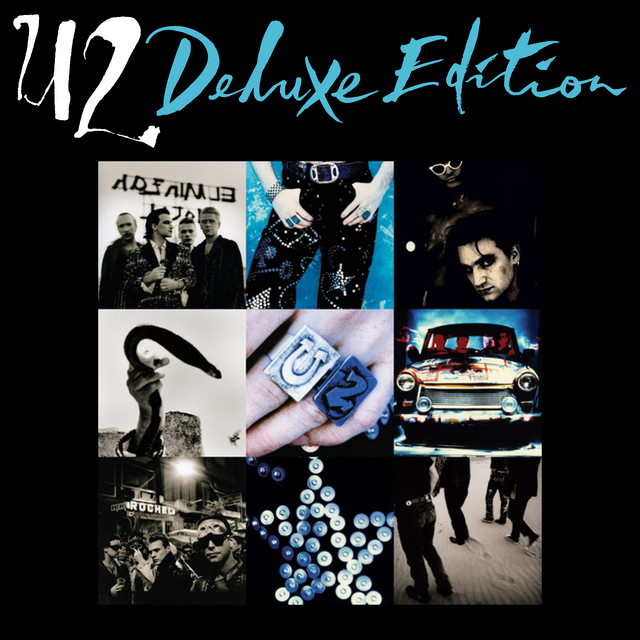
U2 – Achtung Baby (Deluxe Edition)
The music gear and equipment used by the artists, producers, engineers, and more involved in the making of the 1991 album Achtung Baby (Deluxe Edition).
Music from Achtung Baby (Deluxe Edition)

Gear Used On Achtung Baby (Deluxe Edition)
Explore the instruments, equipment, software, and production tools used in the making of U2 – Achtung Baby (Deluxe Edition) (1991). Click more on each item to see exactly how it was used.

Larry Mullen, Jr.
Roles:
Microphones used by Larry Mullen, Jr. on Achtung Baby (Deluxe Edition)

Avg price: $614.38
Used for the bass drum on Achtung Baby and Pop, as explained by engineer Robbie Adams in this July 1997 Sound on Sound interview.
DECONSTRUCTING DRUMS
Three years ago, U2 engineer Robbie Adams explained in SOS how he recorded Larry Mullen's drums with just three mics, an approach he had picked up from Flood, who, said Adams, "is bored with all this traditional, big stereo nonsense." Flood explained that his way of recording drums was partly born from necessity, and partly from reading Mark Lewisohn's classic book on The Beatles' recording sessions: "When we were working on Achtung Baby, we had two drum kits set up, and I had very few channels on the desk, so that was a bit of a problem. I noticed from the photographs in the Beatles book how there was always one mic parked just above the drum kit. I thought it was maybe just for the photo or something, but then I saw it in other studio shots as well, and so, because of the problem I had with too few channels, I decided to try it out on one of the two kits. I put one mic on the bass drum -- an AKG D12 or Neumann U47 -- a Shure SM57 on the snare, and an SM58 as the overhead just above the kit.
"What started to happen was that people would prefer that drum sound, even though it's virtually mono. I also noticed that with Larry, who is a powerful drummer, when you put the drums in stereo you have to have the levels up higher on playback, whereas the mono drums were more powerful, even at lower levels. When I thought about it, I realised that if you're standing in front of a drum kit, you hear it in mono -- you don't hear the toms panning neatly from left to right in your ears. Also, a mic just above the kit compresses the sound. And that's the same effect that happens in the ears of a drummer or when you stand close to the kit; the sound is compressing in your ears because of the level of air pressure. So when you have a cheap, lo-fi overhead mic in that position, and add compression on a mic that's already compressing, it brings out the excitement, the same feel and natural balance that the drummer is getting."
"I've used the three-mic approach as a starting point ever since. You can do all sorts of things with it. For example, if the room you're recording in is rather dead, you can add a bit of room reverb just on the mad-sounding compressed mic. That will give the illusion of the drums having space, and yet the physical punch still comes from the middle. I will sometimes add two more overheads, like a 414 or 87, placed a bit higher up, or at the same height as the drummer's ears. A lot of the times we end up monitoring kick, snare and these higher overheads, and then if the track sounds a bit lame, we'll feed that extra low overhead mic in, which can bring out all the reflections that the drummer gets and that you may not hear normally. It's always good to experiment and listen to the sound the drummer gets in the room. When we were working on Pop in Miami, we were in a room that had very little character, so we put the two ambient mics right in the corner, pointing towards the ceiling, away from the drum kit, thus deliberately creating a woolly, booming drum sound that went well with the brightness of the drum kit. We were always pushing for character, and trying to stay as far away as possible from a generic rock drum sound."


Avg price: $16,111.00
Used for the bass drum on Achtung Baby and Pop, as explained by engineer Robbie Adams in this July 1997 Sound on Sound interview.
DECONSTRUCTING DRUMS
Three years ago, U2 engineer Robbie Adams explained in SOS how he recorded Larry Mullen's drums with just three mics, an approach he had picked up from Flood, who, said Adams, "is bored with all this traditional, big stereo nonsense." Flood explained that his way of recording drums was partly born from necessity, and partly from reading Mark Lewisohn's classic book on The Beatles' recording sessions: "When we were working on Achtung Baby, we had two drum kits set up, and I had very few channels on the desk, so that was a bit of a problem. I noticed from the photographs in the Beatles book how there was always one mic parked just above the drum kit. I thought it was maybe just for the photo or something, but then I saw it in other studio shots as well, and so, because of the problem I had with too few channels, I decided to try it out on one of the two kits. I put one mic on the bass drum -- an AKG D12 or Neumann U47 -- a Shure SM57 on the snare, and an SM58 as the overhead just above the kit.
"What started to happen was that people would prefer that drum sound, even though it's virtually mono. I also noticed that with Larry, who is a powerful drummer, when you put the drums in stereo you have to have the levels up higher on playback, whereas the mono drums were more powerful, even at lower levels. When I thought about it, I realised that if you're standing in front of a drum kit, you hear it in mono -- you don't hear the toms panning neatly from left to right in your ears. Also, a mic just above the kit compresses the sound. And that's the same effect that happens in the ears of a drummer or when you stand close to the kit; the sound is compressing in your ears because of the level of air pressure. So when you have a cheap, lo-fi overhead mic in that position, and add compression on a mic that's already compressing, it brings out the excitement, the same feel and natural balance that the drummer is getting."
"I've used the three-mic approach as a starting point ever since. You can do all sorts of things with it. For example, if the room you're recording in is rather dead, you can add a bit of room reverb just on the mad-sounding compressed mic. That will give the illusion of the drums having space, and yet the physical punch still comes from the middle. I will sometimes add two more overheads, like a 414 or 87, placed a bit higher up, or at the same height as the drummer's ears. A lot of the times we end up monitoring kick, snare and these higher overheads, and then if the track sounds a bit lame, we'll feed that extra low overhead mic in, which can bring out all the reflections that the drummer gets and that you may not hear normally. It's always good to experiment and listen to the sound the drummer gets in the room. When we were working on Pop in Miami, we were in a room that had very little character, so we put the two ambient mics right in the corner, pointing towards the ceiling, away from the drum kit, thus deliberately creating a woolly, booming drum sound that went well with the brightness of the drum kit. We were always pushing for character, and trying to stay as far away as possible from a generic rock drum sound."

Microphones used by Bono on Achtung Baby (Deluxe Edition)
-m.webp?v=1783436198)
Avg price: $102.08
From the Sound On Sound March 1994 article "Robbie Adams: Recording U2's Achtung Baby & Zooropa":
Bono's vocals were largely recorded with an SM58 and compressed with a Summit compressor. Adams: "Instead of using the Summit, what we did on several of the tracks on Achtung Baby was to record his vocals on tape with Dolby SR and play it back without Dolby SR. It tightens up the vocal sound and gives it more brightness and presence. It makes his voice sit really nicely in the mix and easier to balance."


Adam Clayton
Roles:
Bass Guitars used by Adam Clayton on Achtung Baby (Deluxe Edition)

Avg price: $1,999.99
The link has more notes but he used this bass on the Achtung Baby sessions and live on One on the U2 360 tour.